
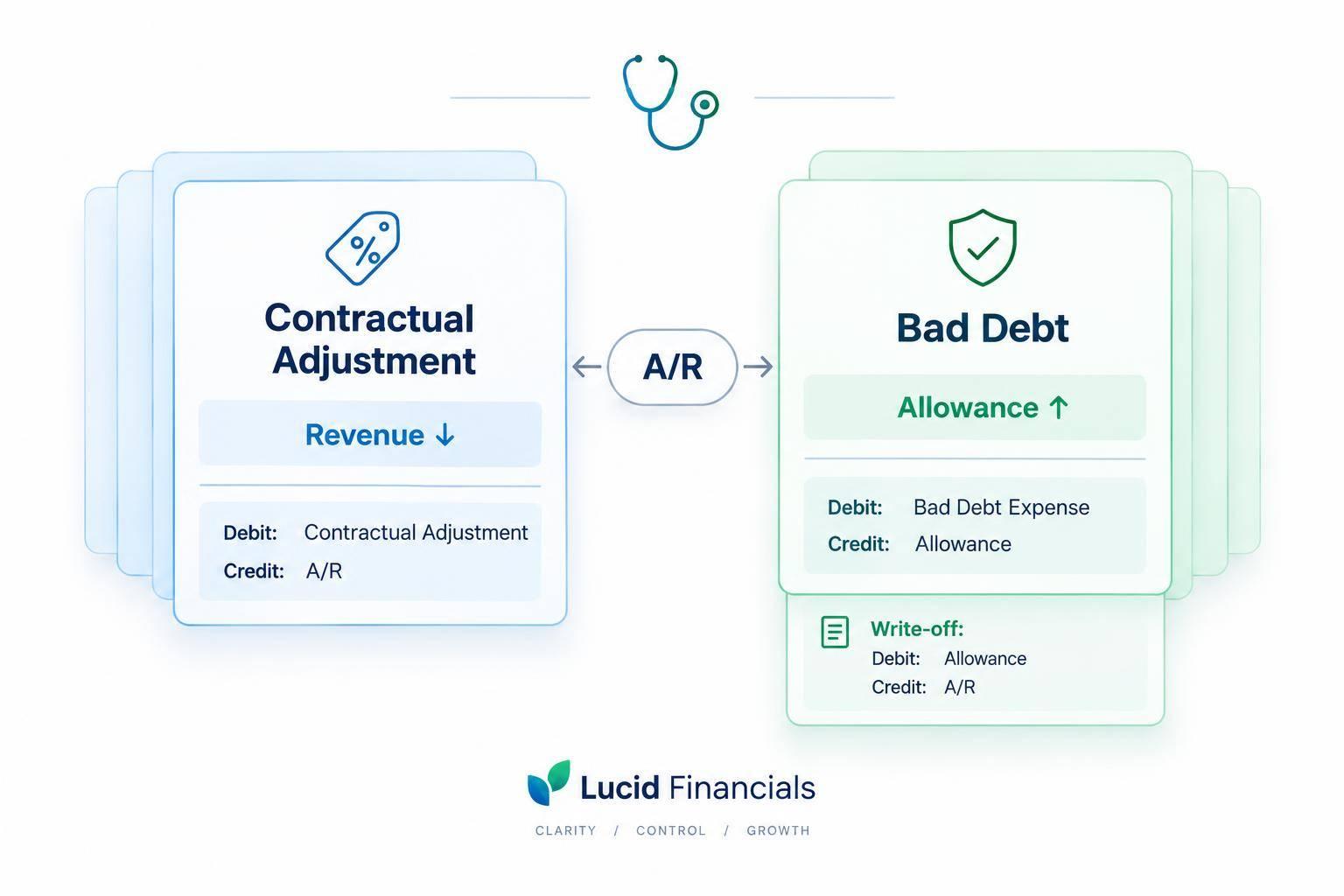
Contractual adjustments reduce revenue. Bad debt records a credit loss - not another revenue reduction. I start by asking why the balance changed before choosing the entry.
For a $1,000 charge with a $600 contracted allowable, the $400 difference reduces revenue. If the remaining $120 patient balance later becomes uncollectible, a credit-loss allowance reduces net accounts receivable (A/R).
Quick Comparison
| Posting point | Contractual adjustment | Bad debt or credit loss |
|---|---|---|
| Cause | Charge exceeds the contracted amount | Expected nonpayment of a recognized receivable |
| Timing | Estimated when revenue is recorded | Estimated before a specific write-off |
| Entry | Debit contractual adjustments; credit A/R | Debit bad-debt expense; credit credit-loss allowance |
| Effect | Reduces revenue and A/R | Increases expense and reduces net A/R |
| Support | Contract and remittance records | Aging, payment history, and collection records |
I also separate price concessions and financial assistance from credit losses, check Medicare reimbursement rules separately, and reconcile monthly postings to avoid counting a loss twice. This process is easier with AI-assisted accounts receivable reviews that identify aging inconsistencies. <u>These entries apply to accrual accounting</u>; I confirm the accounting method and approval requirements with the practice’s CPA before posting.
Contractual Adjustments vs. Bad Debt: Key Differences
| Comparison point | Contractual adjustment | Bad debt or credit loss |
|---|---|---|
| Cause | Gross charge exceeds the contracted allowable amount. | Expected nonpayment of a recognized receivable. |
| Contractual entitlement | The practice is not entitled to the full gross charge. | The practice is entitled to the amount owed, but collection is uncertain. |
| Timing | Estimated when revenue is recognized; updated as information changes. | Allowance estimated before a specific write-off. |
| Accounts used | Contra-revenue or a contractual allowance, plus A/R. | Bad-debt expense and allowance for doubtful accounts; write-offs reduce the allowance and A/R. |
| A/R effect | Contractual allowance may reduce gross A/R or sit as a contra-account. | A credit-loss allowance leaves gross A/R unchanged until write-off. |
| Revenue or expense effect | Contra-revenue under ASC 606. | Bad-debt expense under applicable ASC 326 guidance. |
| Supporting records | Payer contract, fee schedule, remittance advice, and explanation of benefits. | Aging, collection history, payment records, account notes, patient category, and allowance methodology. |
The difference between contractual adjustments and bad debt determines whether an entry reduces revenue or records bad-debt expense. Before posting, identify whether the balance reflects a contractual reduction or a credit loss.
Contractual Adjustments Reduce the Collectible Price
Gross charge − contracted allowable amount = contractual adjustment. The allowable amount includes patient deductibles and coinsurance. Moving those amounts from payer A/R to patient A/R does not create another contractual adjustment.
Under ASC 606, estimate contractual reductions when you recognize service revenue. Use current payer fee schedules and historical remittance data, then check those estimates against remittance advice. If the confirmed allowable differs, update revenue or contractual contra-revenue - don't automatically charge the difference to bad debt.
Bad Debt Is a Loss on an Amount Owed
Bad debt is a loss on a recognized receivable that the practice expected to collect. Under applicable ASC 326 credit-loss guidance, a practice may need an allowance before writing off a specific account. Assess balances using aging, recovery history by payer or patient category, payment plans, and current and forward-looking information.
The right to bill doesn't settle the classification. Historical collection practices may point to an implicit price concession under ASC 606 rather than a credit loss. Document that distinction before recording patient nonpayments as an expense.
Before a write-off, review denials, coding errors, missing authorizations, noncovered services, and unposted payments. Correct billing errors and separate valid patient responsibility from those errors, denials, and unposted payments. Age alone doesn't make a balance bad debt; the cause determines its classification and how the patient balance appears in A/R and revenue.
sbb-itb-17e8ec9
Journal Entries for a $1,000 Claim
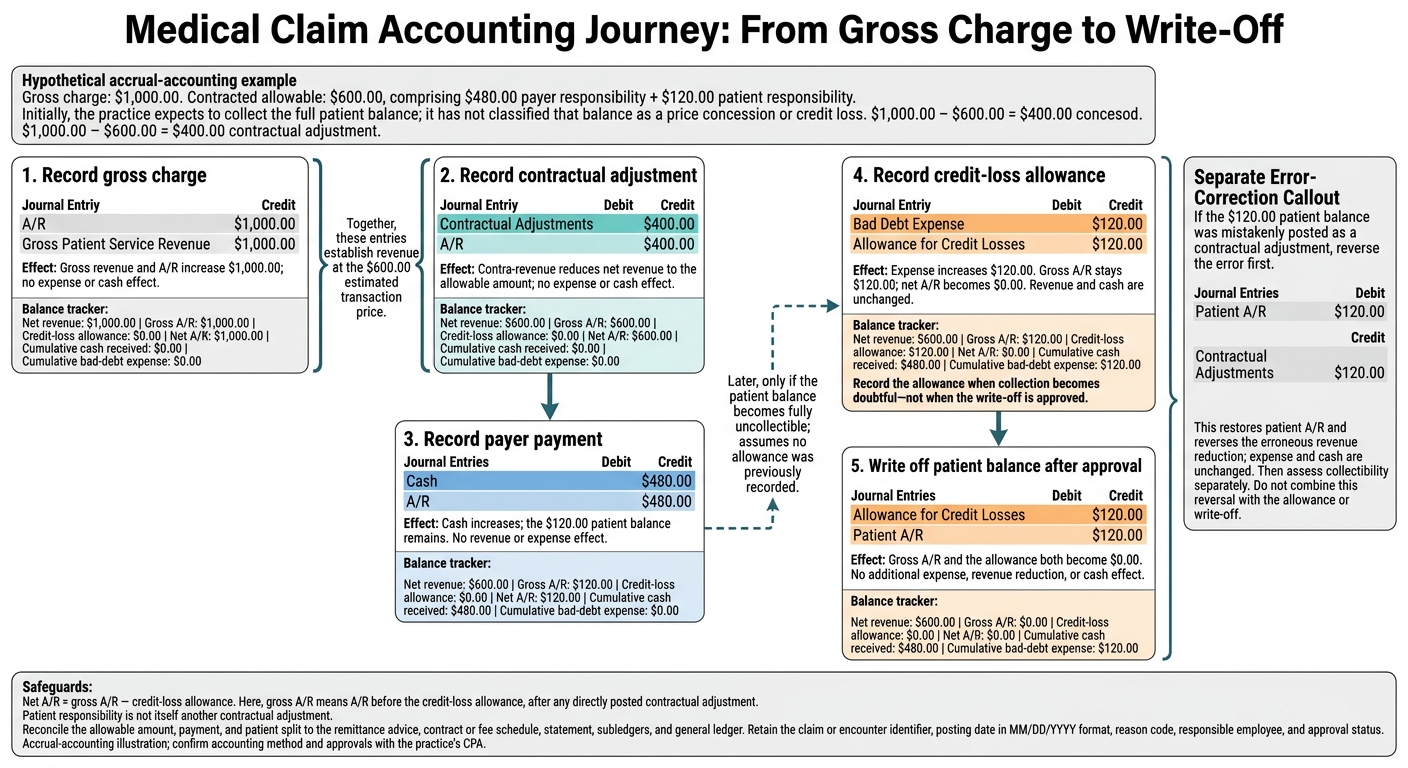
Contractual Adjustments vs. Bad Debt: $1,000 Claim Entries
Hypothetical claim: The gross charge is $1,000.00, and the contracted allowable amount is $600.00: $480.00 owed by the payer and $120.00 by the patient. The practice initially expects to collect the full patient balance and has not yet treated it as a price concession or credit loss.
Post the claim in three stages: charge, contractual adjustment, and payment. If collection later fails, record any separate credit loss.
Record the Charge, Contractual Adjustment, and Payment
First, confirm the allowable amount and the patient’s actual responsibility. The table below shows how the entries work; final revenue equals the estimated transaction price.
Scenario Debit Credit Purpose Effects on revenue, expense, cash, and A/R 1. Record gross charge A/R $1,000.00 Gross Patient Service Revenue $1,000.00 Record the billed charge Gross revenue and A/R increase $1,000.00; no expense or cash effect. 2. Record contractual adjustment Contractual Adjustments $400.00 A/R $400.00 Reduce the claim to the allowable amount Reduces net revenue through the contra-revenue adjustment; no expense or cash effect; A/R decreases to $600.00. 3. Record payer payment Cash $480.00 A/R $480.00 Record the payer’s payment Cash increases $480.00; patient A/R remains $120.00; no revenue or expense effect. 4. Later: record credit-loss allowance Bad Debt Expense $120.00 Allowance for Credit Losses $120.00 Recognize expected patient nonpayment Expense increases $120.00; gross A/R remains $120.00, but net A/R becomes $0.00; revenue and cash unchanged. 5. Write off patient balance after approval Allowance for Credit Losses $120.00 Patient A/R $120.00 Remove the uncollectible balance Gross A/R and allowance both become $0.00.
Record the Credit-Loss Allowance and Write-Off
Rows 4–5 assume the patient balance later becomes fully uncollectible and no allowance has been recorded. Record the allowance when collection becomes doubtful - not when the write-off is approved. The allowance reduces net A/R, while the gross balance stays on the books until write-off.
If the contractual adjustment was posted by mistake, reverse it before assessing collectibility.
Alternative correction: If staff incorrectly debited Contractual Adjustments and credited Patient A/R for $120.00, reverse that entry: debit Patient A/R $120.00; credit Contractual Adjustments $120.00. This restores patient A/R and reverses the erroneous reduction; expense and cash are unchanged. Then assess the restored balance separately. Do not combine the reversal with the allowance or write-off; doing so double-counts the reduction.
Reconcile the allowable amount, payment, and patient split against the remittance advice, contract or fee schedule, statement, subledgers, and general ledger. Attach the claim or encounter identifier, posting date in U.S. format (MM/DD/YYYY), reason code, responsible employee, and approval status. Have the CPA review material prior-period errors before posting them as current-period adjustments.
Classifying Patient Balances and Reporting Revenue
After posting the initial entry, classify the remaining balance based on why it changed. Patient responsibility identifies who owes the balance - not how to classify it. Deductibles, copays, and coinsurance can remain collectible A/R.
The $120.00 patient balance in the example requires different entries depending on whether the reduction is a contractual adjustment, price concession, financial assistance, or later credit loss.
Distinguish Price Concessions, Financial Assistance, and Credit Losses
The classification depends on what the practice expected when it recognized revenue and what changed afterward. Collection history and routine waivers support price-concession estimates. Failed payment plans, collection efforts, and changed circumstances support credit-loss estimates. AI-assisted dispute workflows can help reconcile these balances with billing evidence. Nonpayment alone does not establish eligibility for financial assistance.
| Classification | Classification evidence | Revenue effect | Receivables treatment | Documentation |
|---|---|---|---|---|
| Contractual adjustment | Payer agreement, fee schedule, remittance advice, or adjudication showing the practice cannot collect the gross charge | Reduces the transaction price and patient-service revenue | Removes the noncollectible contractual portion; valid patient responsibility stays open | Payer agreement, claim, remittance advice, adjustment code, and approval record |
| Implicit price concession | Historical collection rates, routinely waived patient balances, expected payment behavior, or other evidence that the practice did not expect to collect the stated charge at recognition | Reduces the transaction price and revenue because expected consideration is lower than the gross charge | Records A/R at the amount expected to be collected, or records an allowance/concession against the gross balance | Collection-history analysis, aging reports, policy documentation, payment-plan results, and periodic estimate updates |
| Financial assistance | Eligibility under a written charity-care, sliding-scale, hardship, or other assistance policy, supported by patient circumstances and application records | Qualifying charity care usually is not revenue; other assistance follows the written policy and applicable guidance | May prevent recognition of A/R or reduce an existing balance, depending on when assistance is approved | Approved application, income or hardship evidence, policy criteria, authorization, patient notice, and audit trail |
| Subsequent credit loss | A valid receivable was initially recognized, but later events - such as failed collection efforts, bankruptcy, or worsening circumstances - show collection is unlikely | Does not change the original transaction price; record separately as credit-loss or bad-debt expense | Reduces net A/R through an allowance or write-off after the loss estimate or uncollectibility is established | Aging, collection attempts, returned statements, agency reports, bankruptcy records, payment history, and write-off approval |
Keep Revenue and A/R Reporting Consistent
Keep gross charges in the ledger for day-to-day tracking, but report revenue at the ASC 606 transaction price. Use separate accounts for contractual adjustments, implicit concessions, assistance, and credit losses. Recording routine contractual adjustments as bad-debt expense overstates both revenue and bad-debt expense and distorts collection rates.
Use the same adjustment definitions across locations and the same labels during each monthly close. Monthly reports should separate reductions that determine revenue from allowances that reduce net A/R, keeping revenue, A/R, and write-offs aligned. Review concession estimates by payer category and self-pay collection history instead of applying one blanket percentage.
Apply Medicare Bad-Debt Rules Separately
Medicare reimbursement is a separate test, not a journal-entry classification. Under 42 CFR § 413.89, eligible bad debts must relate to covered services and deductible or coinsurance amounts. They must also meet reasonable-collection requirements, be uncollectible when claimed, and have no likely future recovery based on sound business judgment. Collection efforts generally should resemble those used for comparable non-Medicare balances. Do not treat 120 days as a universal write-off rule.
Medicare bad debts must not be written off to contractual-allowance accounts. For reimbursement purposes, the regulation treats bad debts, implicit price concessions, charity, and courtesy allowances as reductions in revenue. That treatment does not change the underlying financial-statement classification. Retain the collection policy, account history, notices, write-off date, and cost-report support. Have the CPA reconcile the reimbursement schedule to the ledger without merging the two classification systems.
Conclusion: Classify Balances and Reconcile Monthly
After posting the initial entry, review each remaining balance by its cause - not just its age.
Classify each balance before posting the entry. Contractual adjustments reduce revenue, while credit losses reduce net A/R through allowance accounting. Keep price concessions and financial assistance separate.
Then check the monthly close.
Check Adjustments, Allowances, and Write-Offs
At month-end, compare payer contracts with remittance advice and identify patient responsibility.
- Review aging by payer, location, provider, and patient category.
- Investigate unusual adjustment rates.
- Reconcile allowance estimates to collections, write-offs, and recoveries.
Reconcile the patient-account subledger to the general ledger before closing. Check that no loss was booked twice: as both a contractual adjustment and bad debt, or through both an allowance and a write-off. Keep account-linked support for contractual reductions, credit-loss estimates, and write-off approvals.
Use clear approval limits to control the process.
Set Staff Approval Limits and Require CPA Review
Document account mappings and approval limits by dollar amount and adjustment type. Keep posting and approval duties separate.
Require CPA review for manual allowance changes, material write-offs, prior-period corrections, and cross-entity entries. Keep multi-dimensional reporting by location and entity rather than relying only on combined totals.
FAQs
How do I record payments recovered after a write-off?
Record the payment as a new cash receipt instead of directly reversing the original write-off. Reversing the write-off can make the account’s financial history harder to follow. Reconcile the receipt against your receivables to account for the unexpected payment.
Check with your CPA to confirm that the recovery follows your practice’s accounting policies and that the journal entry doesn’t improperly inflate revenue for the current service period.
How should I classify an unresolved insurance denial?
Track an unresolved insurance denial separately from contractual adjustments and expected or pending collection shortfalls. Keep the balance marked as unresolved - don’t automatically reduce contractual “allowed” amounts.
In the accounting/AR roll-forward, place the balance in an unresolved denial/adjustment category, with billing evidence and the next action documented. The CPA should decide whether a valuation allowance or separate accounting treatment is appropriate based on collectibility and the evidence.
How do I adjust an overstated credit-loss allowance?
Ask your CPA to review the collectibility evidence and reporting basis to determine the right valuation entry. Don’t make an arbitrary correction or force the general ledger to match an aging report.
Once management approves the adjustment, record it in the appropriate system to reflect the revised allowance. Document how you arrived at the estimate and why it changed so reporting stays transparent and ready for an audit.