
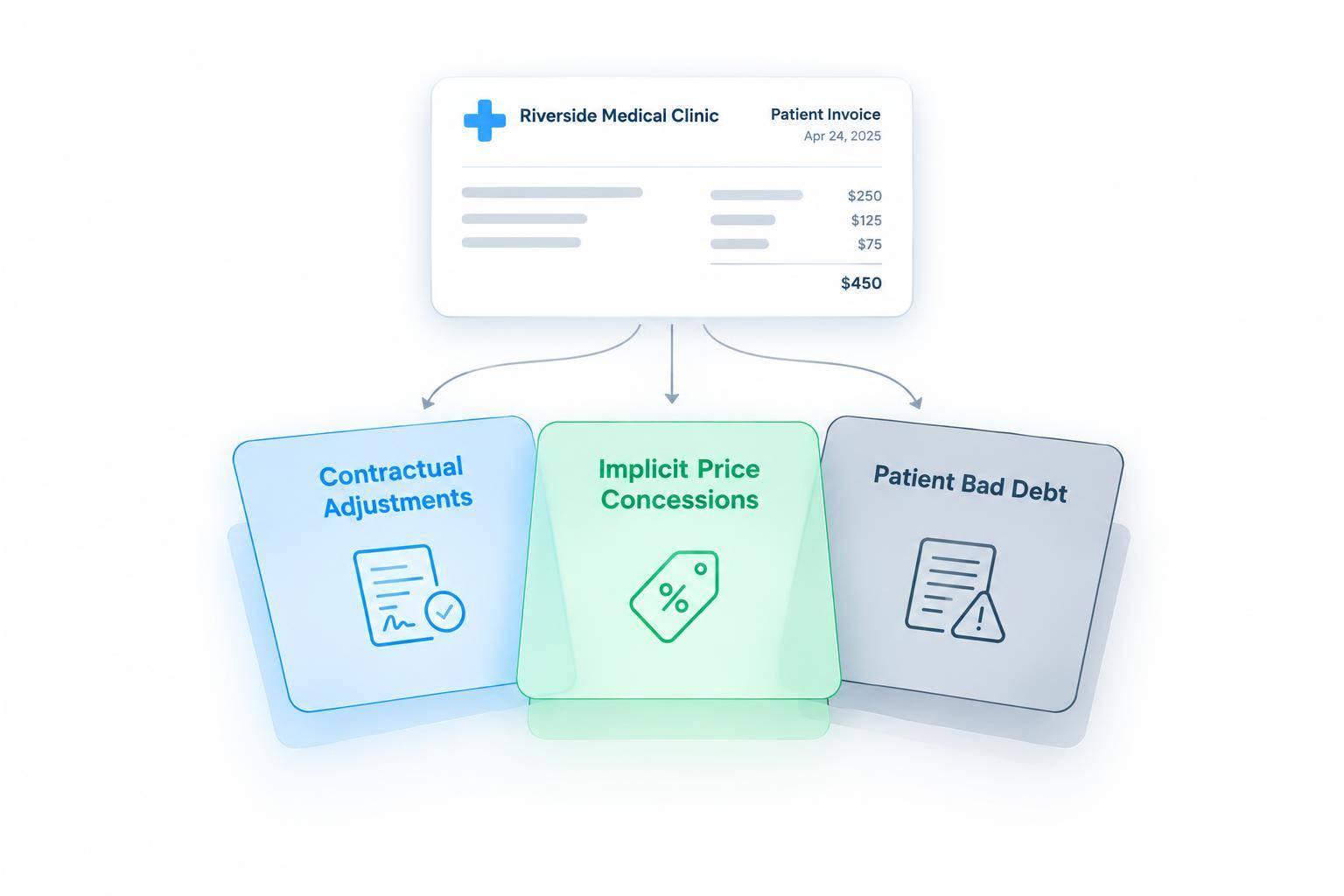
I classify unpaid patient balances by why they won’t be collected - not simply because they’re unpaid. Under accrual accounting, payer-required reductions and expected price concessions reduce revenue. Credit losses on recorded receivables create an expense.
A $30 shortfall can mean $30 less revenue or $30 in credit-loss expense. The difference is whether it reflects the price the practice expects to accept or a loss on an amount owed.
Quick Comparison
| Category | What causes it? | Accounting treatment |
|---|---|---|
| Contractual adjustment | Payer terms limit the allowed amount | Reduce patient service revenue |
| Implicit price concession | The practice expects to accept less than the remaining bill | Reduce patient service revenue |
| Patient bad debt | A recorded receivable has a credit loss | Record expense through a credit-loss allowance |
At month-end, I check payer terms, collection expectations, and credit-loss records, then reconcile each category by payer, location, and entity. <u>A write-off already covered by an allowance adds no expense.</u> That check helps me avoid counting the same loss twice.
Contractual allowances in healthcare
sbb-itb-17e8ec9
Contractual Adjustments, Price Concessions, and Bad Debt
Classify each shortfall by its cause: payer terms, expected collections, or credit loss. The reason a balance remains unpaid determines the category - not the unpaid status alone.
| Category | Cause | Entitlement to payment | Recognition timing | Supporting records |
|---|---|---|---|---|
| Contractual adjustment | Payer terms, including Medicare, Medicaid, and commercial contracts | No claim to the reduction amount | At service or billing | Patient management data, payer contracts, invoices |
| Implicit price concession | Business practices and historical collection patterns | Revenue reflects what the practice expects to accept | When revenue is first recognized | Historical collection data, patient management records, invoices |
| Patient bad debt | Credit losses from a patient’s inability or unwillingness to pay | Practice is legally entitled to the recorded receivable | When collection risk becomes apparent | Collection records, credit evaluations, invoices |
The table outlines the differences. The notes below explain how to apply each category.
Contractual Adjustments: Reductions Required by Payer Terms
Base the reduction on the payer’s allowed amount, not the cash received. Medicare and Medicaid payment rules, commercial payer contracts, and negotiated fee schedules set that amount. Because the practice has no claim to the reduction amount, match each contractual adjustment to the applicable payer terms.
Implicit Price Concessions: Amounts the Practice Expects to Accept
Estimate expected collections by payer or patient class using historical collections, patient circumstances, and collection policies. After contractual reductions, record the gap between that estimate and the remaining billed amount as an implicit price concession. Update the estimate as the supporting evidence changes.
Patient Bad Debt: Credit Losses on Recorded Receivables
Patient bad debt occurs when a recorded receivable later becomes uncollectible. Don’t use bad debt to account for a shortfall already reflected in revenue. Bad debt reduces net receivables and creates an expense; it does not reduce patient service revenue.
An unpaid balance isn’t automatically bad debt. A denial for missing information or prior authorization may call for billing follow-up rather than a credit-loss entry. Before writing off the balance, confirm the denial reason and payment obligation, then link the entry to the invoice or payer record.
How Each Category Affects Financial Reports
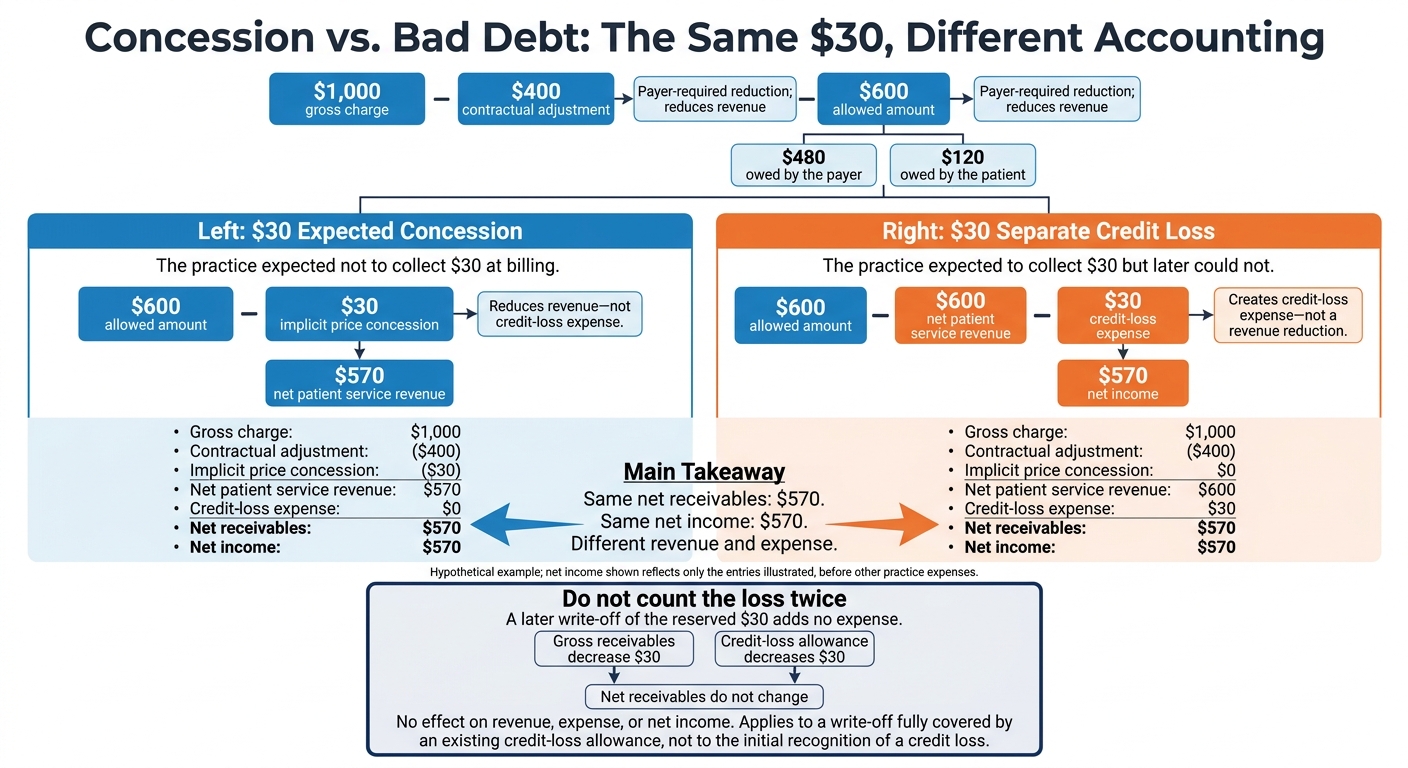
Concession vs. Bad Debt: The Same $30, Different Accounting
From Gross Charges to Net Patient Service Revenue
How you classify a balance determines where it appears in the reports. Net patient service revenue equals gross charges minus contractual adjustments and implicit price concessions. Credit-loss expense appears below revenue; it doesn’t reduce revenue.
Here’s how each entry affects revenue, expense, receivables, and net income.
| Entry or event | Patient service revenue | Expense | Net receivables | Net income |
|---|---|---|---|---|
| Contractual adjustment | Decreases | No effect | Decreases | Decreases |
| Implicit price concession | Decreases | No effect | Decreases | Decreases |
| Estimate increase | Decreases | No effect | Decreases | Decreases |
| Credit-loss provision | No effect | Increases | Decreases | Decreases |
| Write-off against an existing credit-loss allowance | No effect | No effect | No change | No effect |
Classification changes the story, even when net receivables match. Recording a concession as bad debt overstates both revenue and credit-loss expense. It can also distort revenue-based margins.
Recording Adjustments, Allowances, and Write-Offs
Under gross-charge accounting, contractual adjustments and concessions debit contra-revenue and credit receivables or an allowance account. Credit-loss provisions debit expense and credit an allowance.
A write-off covered by an existing allowance debits that allowance and credits receivables. Gross receivables and the allowance both decrease, so net receivables stay the same.
Review estimates at each reporting date using current evidence. Changes in the expected price affect revenue; changes in credit-loss estimates affect expense. Before recording a write-off, check the existing allowance so you don’t count the expense twice.
Hypothetical Example: A $1,000 Patient Charge
The same charge can produce different financial-statement results depending on whether the shortfall is a concession or a credit loss.
A $1,000 charge has a $400 contractual adjustment, leaving a $600 allowed amount: $480 owed by the payer and $120 by the patient. The same $30 shortfall is a concession if the practice expected not to collect it at billing, or a credit loss if it expected to collect it and later could not.
Measure $30 expected concession $30 separate credit loss Gross charge $1,000 $1,000 Contractual adjustment ($400) ($400) Implicit price concession ($30) $0 Net patient service revenue $570 $600 Credit-loss expense $0 $30 Net receivables $570 $570 Net income $570 $570 The final dollar result matches, but the revenue and expense measures do not. A later write-off of that reserved $30 adds no expense.
Classifying Adjustments During the Monthly Close
Check the Cause Before Posting a Write-Off
At month-end, classify each adjustment by checking payer terms first, expected collection second, and credit loss last. Base the decision on source documents - not billing codes. The classification determines whether the adjustment reduces revenue or creates credit-loss expense.
| Supporting records | Likely classification | Posting treatment |
|---|---|---|
| Payer contracts and remittance advice (EOB/ERA) | Contractual adjustment | Reduce gross patient service revenue |
| Patient quotes, billing estimates, and collection history | Implicit price concession | Adjust the transaction price and net revenue |
| Collection notes and aging reports | Credit loss | Record credit-loss expense and an allowance |
Keep the supporting records and approvals with the close package.
Reconcile Adjustments by Payer, Location, and Entity
Once adjustments are classified, reconcile totals by payer, location, and entity. Use separate ledger accounts or mappings for each category. Each month, reconcile payer adjudications, patient balances, collections, write-offs, allowances, and aging to the general ledger.
Keep location and entity detail intact before consolidation, and reconcile inter-entity balances separately. This keeps revenue reductions separate from credit losses at both the location and entity levels.
Review unusual adjustments and estimate changes by payer and patient class. Include the applicable contracts, collection analyses, reasons for changes, and approvals in the close package. Use the same classification rules across locations, but document any differences in payer terms or collection expectations.
Review Accounting Policies With a CPA
Have a CPA review disputed classifications, estimate changes, and automated code mappings before close. Lucid Financials provides CPA-led bookkeeping and CFO support for medical practices with single- or multi-location reporting.
Conclusion: Keep Price Reductions Separate From Credit Losses
The close process follows one rule: payer terms determine contractual adjustments, and collection expectations determine implicit price concessions. Both reduce patient service revenue. Credit losses on recorded receivables, however, create a separate expense.
Writing off a receivable fully covered by an allowance changes only the balance sheet. It does not affect revenue or expense again.
Before month-end close, check code mappings and collection assumptions. Keep pricing reductions separate from credit losses so net patient service revenue, receivables, and bad-debt expense are reported accurately.
FAQs
How do I distinguish a revised price concession from a credit loss?
A revised price concession lowers the payment you expect to receive. It reduces recognized patient service revenue and adjusts receivables to the allowed amount.
A credit loss (bad debt) is an amount you reasonably expect not to collect, typically after reviewing denials, aging balances, and collection efforts. You record it as a loss through an allowance or charge-off. This reduces receivables without retroactively changing the allowed rate.
Keep charges, revenue, and cash separate.
How should I record payments on previously written-off balances?
Treat the payment as a cash collection, not new patient service revenue. Use the transaction and approval records to match the deposit to the original patient or claim balance.
Reverse or adjust the write-off classification. Record the recovery in the receivable recovery or bad debt recovery/contra-expense account, and reduce the previously written-off balance. Reconcile the deposit to the ledger, supported by source records and reviewed journal documentation.
How much collection history do I need to estimate price concessions?
Reliable estimates use both collection history and current data. There’s no fixed data requirement: some predictive models may need at least 12 weeks of history or 50 invoices. Still, 12 to 24 months is recommended to account for seasonal changes.
Lucid Financials pairs this history with current accounting, payroll, and bank activity to create real-time projections. These help you anticipate when payments will arrive and what concessions may be needed.