Performance-based equity programs reward employees based on achieving specific goals rather than simply staying with a company. These programs are increasingly popular because they align employee contributions with business success, improve retention, and reduce costs. Companies like Google, Starbucks, Microsoft, Tesla, and Unilever have implemented unique equity strategies tied to performance metrics such as revenue, market capitalization, or sustainability targets. Here's a quick breakdown of their approaches:
- Google: Early stock options linked to milestones, including transferable options and accelerated vesting schedules.
- Starbucks: RSUs for all employees, with added performance-based rewards for senior leaders.
- Microsoft: Equity awards tied to individual and company performance, with staggered vesting schedules.
- Tesla: Milestone-based equity for employees and leadership, including Elon Musk’s 2018 CEO Performance Award.
- Unilever: Long-term incentive plans combining financial and sustainability metrics for senior executives.
These strategies illustrate how companies motivate employees, align incentives with business goals, and create long-term value. Below is a quick comparison.
Quick Comparison
| Company | Key Features | Metrics Used | Target Audience |
|---|---|---|---|
| Stock options, milestone-based awards | Revenue, team goals | Broad employee base | |
| Starbucks | RSUs for all employees, tenure-based vesting | Tenure, operational improvements | Baristas to senior leaders |
| Microsoft | Performance-driven RSUs, ESPP | Individual impact, company growth | All employees |
| Tesla | Milestone-based equity for innovation | Market cap, revenue, EBITDA | Engineers, executives |
| Unilever | Sustainability and financial goals combined | ROIC, cash flow, ESG metrics | Senior executives |
These examples demonstrate how performance-based equity programs can drive engagement and align employee rewards with organizational objectives.
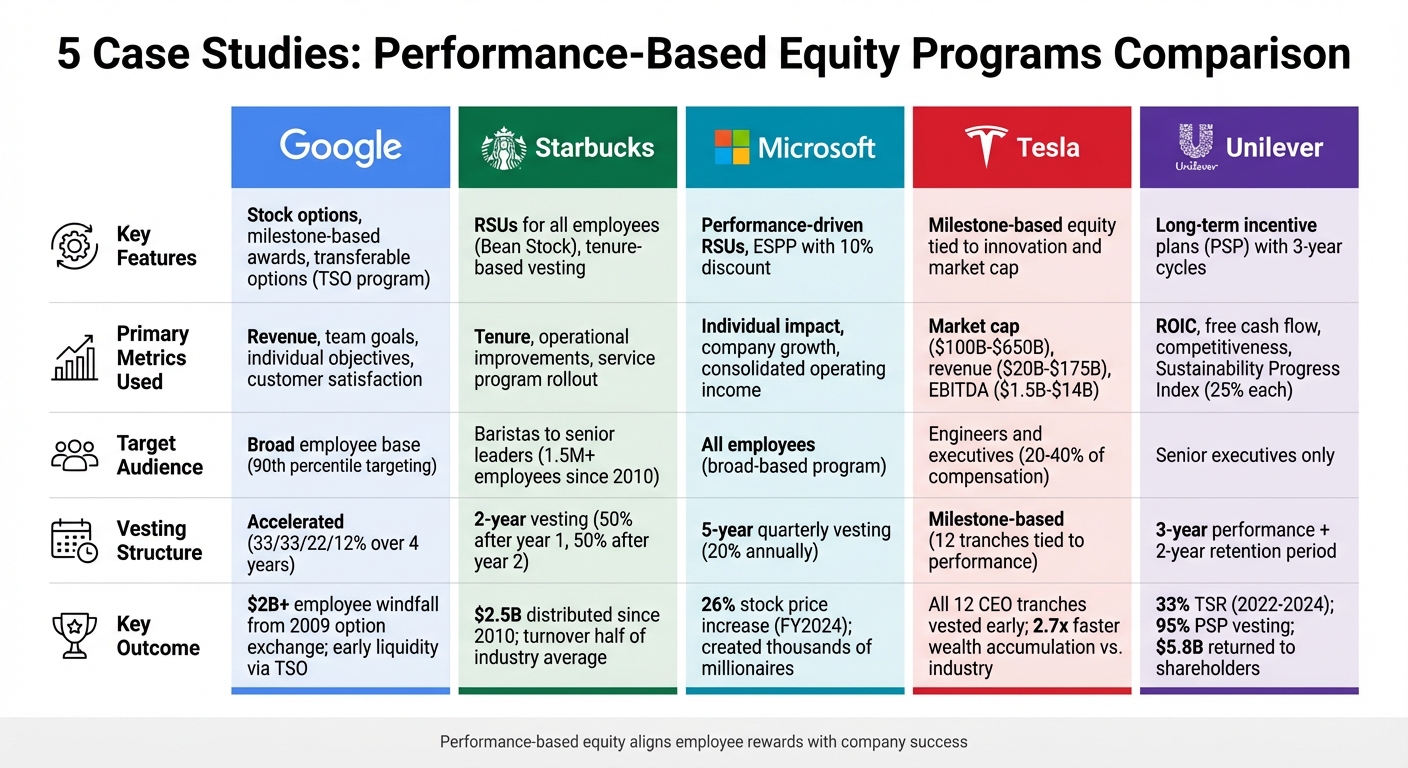
Comparison of 5 Performance-Based Equity Programs: Google, Starbucks, Microsoft, Tesla, and Unilever
Case Study 1: Google's Early Employee Stock Options
Program Structure and Performance Milestones
In 2004, Google introduced a stock plan that directly linked equity rewards to the company’s performance. The plan allowed for up to 28,931,660 shares and included a flexible set of "Performance Goals" tailored to either individual employees or entire teams. These goals ranged from financial metrics like Annual Revenue, Net Income, Operating Cash Flow, and Return on Assets to more personalized objectives, such as Customer Satisfaction MBOs (Management by Objectives) and Individual Objectives.
What set Google apart from many companies was its approach to equity grants. While most companies aimed for the 75th percentile in their equity programs, Google targeted the 90th percentile. Their plan offered three types of equity awards:
- New Hire grants: Designed to attract top-tier talent.
- Refresher grants: Rewarded ongoing high performers.
- Special grants: Included initiatives like Founder's Awards, given for extraordinary accomplishments.
In 2007, Google took another bold step with its Transferable Stock Option (TSO) program. This initiative allowed employees to sell their vested stock options through private auctions managed by Morgan Stanley. This was especially beneficial for employees whose options were "underwater" (when the strike price exceeded the market price). The program created an additional $42.7 million in value between 2006 and 2008.
"The goal is quite simple. It is to increase the perceived value of the option to the employee. You don't have to wait for an option to be $100 in the money to see its value." - David Rolefson, Google's Manager of Equity and Compensation
Another innovation was Google’s front-loaded vesting schedule. Instead of the typical equal 25% annual distribution, they used an accelerated schedule (33/33/22/12% over four years), enabling high performers to gain equity ownership faster.
Results and Employee Impact
Google’s equity program delivered both financial and cultural benefits. During the 2009 market downturn, about 85% of Google employees held "underwater" options. To address this, Google initiated an option exchange program for 16,000 non-executive employees. They swapped options with an average exercise price of $521 for new options priced at $308.57. By December 2009, as Google’s stock price climbed to $590, these repriced options generated an average profit of $280 per share, creating a total employee windfall exceeding $2 billion.
Beyond financial rewards, the program fostered a sense of ownership and alignment with company goals. Google’s use of Objectives and Key Results (OKRs) tied individual performance to broader company strategies, making employees feel their equity awards were directly connected to their contributions. Research revealed that while daily performance incentives from options were modest compared to promotion opportunities, unvested equity was the key factor driving employee retention.
A standout example of this approach was "Project Chauffeur" (later known as Waymo). In 2011, Google co-founder Larry Page introduced a milestone-based compensation structure to retain a core team of 12 engineers who were critical to the project. Compensation was tied to the project’s valuation, which was reassessed every four years. By the end of 2015, the project’s valuation hit $4.5 billion, leading to substantial payouts, including $120 million for lead engineer Anthony Levandowski. This strategy succeeded in keeping the team intact during pivotal development stages.
"We were focused on getting a start-up-like compensation system. And start-ups pay people a lot of money if they do something significant." - Larry Page, Co-founder, Google
Through its combination of performance-driven equity, innovative liquidity options, and milestone-based bonuses, Google created a stock program that not only attracted top talent but also encouraged long-term loyalty and innovation. The program’s success highlights how carefully designed equity plans can align employee goals with company growth, driving both individual and organizational success.
sbb-itb-17e8ec9
Case Study 2: Starbucks' Bean Stock Program
How Bean Stock Ties Equity to Performance
In 1991, Starbucks founder Howard Schultz introduced the Bean Stock program with a groundbreaking idea: making every employee a company partner. Through this program, Starbucks grants Restricted Stock Units (RSUs) to both full-time and part-time employees.
Eligibility is simple - employees hired by May 1 receive an annual RSU grant in November. The number of RSUs depends on the employee's role and pay grade. For example, store managers receive more than shift supervisors, who in turn receive more than baristas. Unlike Google's model, which ties equity to specific performance milestones, Starbucks bases its program on tenure and continued service.
The vesting schedule is tailored to Starbucks' partner-focused philosophy. RSUs vest gradually over two years: 50% after one year and the remaining 50% after two years. Employees who leave before these dates lose any unvested shares. Since 2010, the program has reached over 1.5 million employees across 21 countries.
"No matter where you are in the company – the roasting plant, the stores, the office – every person will have a stake in the success of the company." - Howard Schultz, Founder, Starbucks
In 2025, Starbucks added a performance-based layer for senior leaders, introducing Performance-Based Restricted Stock Units (PRSUs). With a target value of $6 million, these awards are tied to the "Back to Starbucks" strategy. Metrics like operating expense reduction, the rollout of the Green Apron Service program, and coffeehouse improvements must be met by the end of fiscal year 2027. This addition combines tenure-based equity with performance incentives, creating a balanced system that drives both engagement and results.
Employee Engagement and Retention Results
The Bean Stock program has had a direct and measurable impact on employee engagement and retention. Since 2010, Starbucks has distributed $2.5 billion in pre-tax gains to employees, with 240,000 employees receiving grants in 2024 alone. Retail employee turnover has dropped to nearly half the industry average, thanks to the program's vesting structure, which encourages long-term commitment.
A recent U.S. survey revealed that 84% of baristas and coffeehouse leaders participated in the program, marking the highest response rate in Starbucks' history.
The program's success stories are equally compelling. Employees have used their Bean Stock grants to achieve major personal and professional milestones. For instance, Sam Murgatroyd, a part-time barista at the Milan Reserve Roastery, used his Bean Stock earnings to secure a mortgage for an apartment in Milan. Meanwhile, Jacopo Cavallo, a Senior Manufacturing Manager, funded his Executive MBA at Politecnico di Milano with his Bean Stock, graduating in 2024.
Emerald, a store manager in California, shared:
"The Bean Stock program has been more than just a financial benefit; it has empowered me to be financially successful and create a lasting legacy for my growing family".
The program also fosters career growth. Employees who participate in Bean Stock are promoted at twice the rate of their peers. Combined with other benefits, Starbucks' compensation package averages $30 per hour for U.S. hourly employees.
Case Study 3: Microsoft's Performance-Based Stock Programs
Performance Criteria and Distribution Methods
Microsoft's equity awards use a mix of individual and company-wide performance metrics to drive results and reward employees.
At the core of their program are Annual Stock Awards, which are tied to an employee's "impact" as assessed during annual performance reviews, typically conducted in August. These awards vest quarterly over a five-year period (20% per year), creating a strong incentive for employees to stay with the company. High achievers may also qualify for Special Stock Awards or Leadership Stock Awards (LSAs), which come with different vesting timelines.
For executives, Microsoft transitioned from SPSAs to LSAs, offering a 25% increase in awarded shares if business targets are met. Introduced in fiscal year 2013, the LSA program begins with a base share grant, with additional shares awarded upon meeting performance metrics. Executive awards are further tied to an incentive pool based on a percentage of Microsoft's consolidated operating income. For example, in fiscal year 2012, this pool was set at 0.3% of the operating income. Executive officers received awards split into 20% cash and 80% stock, with total values ranging from 0% to 150% of their target, depending on individual performance evaluations.
Microsoft also offers an Employee Stock Purchase Plan (ESPP), allowing employees to buy stock at a 10% discount at the close of each purchase period. Employees can contribute between 1% and 15% of their gross compensation, with purchases made at the end of three-month offering periods. In 2003, Microsoft moved from stock options to Restricted Stock Units (RSUs), reflecting a shift in their equity strategy.
"By granting employees equity in the company, Microsoft fosters a sense of ownership and accountability. Employees are not just workers - they are shareholders with a vested interest in the company's success."
Here’s a snapshot of the key award types, criteria, and vesting schedules:
| Award Type | Performance Criteria | Vesting Schedule |
|---|---|---|
| Annual Stock Awards | Individual "impact" & performance reviews | 5 years (20% annually; vests quarterly) |
| On-Hire RSUs | Continued employment | 4 years (25% annually) |
| Leadership Stock Awards | Company business metrics (25% share increase if targets met) | 25% after Year 1; semi-annually for 3 years |
| Executive Incentive Plan | Consolidated operating income & individual assessment | 4 years (ratably) |
| ESPP | Voluntary participation (10% discount on stock purchases) | Immediate (after 3-month purchase period) |
These well-structured equity programs serve as a powerful tool for retaining top talent while aligning employee incentives with Microsoft's business goals.
Talent Acquisition and Financial Outcomes
Microsoft's equity programs have proven effective in retaining talent and delivering measurable financial results. The staggered vesting schedules - spanning four to five years - encourage employees to stay long-term, as leaving early means forfeiting unvested shares.
The financial benefits have been equally impressive. In fiscal year 2024, Microsoft's revenue grew by 16%, a significant jump from the 7% growth seen in fiscal 2023. Microsoft’s stock price also climbed by 26%, outperforming the Nasdaq's 20% increase. This rise has directly benefited employees, as the value of vested RSUs has grown substantially.
To further attract top talent, Microsoft introduced one-time cash awards in July 2024. Chief People Officer Kathleen Hogan announced that junior-level employees could earn up to 25% of their annual bonus, while senior directors were eligible for up to 10%.
"Microsoft's leaders want to show recognition to workers for a good fiscal year." - Kathleen Hogan, Chief People Officer, Microsoft
Microsoft’s equity programs have not only boosted financial performance but also shaped its workplace culture. By granting employees a stake in the company, Microsoft has cultivated a sense of shared ownership. This commitment is reflected in their fiscal year 2013 report, which showed $2.4 billion in stock-based compensation expenses. It’s a clear demonstration of how the company aligns individual success with its broader goals.
Case Study 4: Tesla's Milestone-Based Equity Awards
Equity Structure for Engineers and Executives
Tesla has taken a bold approach to equity compensation, especially for its CEO and employees, by tying rewards directly to performance milestones rather than offering guaranteed payouts.
One of the most striking examples is the 2018 CEO Performance Award, a 10-year plan that granted Elon Musk approximately 20.3 million stock options, representing about 12% of Tesla's total outstanding shares at the time. These options were divided into 12 distinct tranches, each contingent on Tesla achieving both market capitalization and operational milestones. The market cap targets began at $100 billion and increased in $50 billion increments, topping out at $650 billion. Operational milestones included eight revenue goals, ranging from $20 billion to $175 billion, and eight Adjusted EBITDA targets, starting at $1.5 billion and reaching $14 billion.
"Elon will receive no guaranteed compensation of any kind – no salary, no cash bonuses, and no equity that vests simply by the passage of time." - Tesla, Inc.
To meet these milestones, Tesla required sustained performance. Market capitalization was evaluated using six-month and 30-day trailing averages, while operational goals had to be met over four consecutive quarters. Additionally, a five-year holding period for shares after exercising options was built into the program to discourage short-term thinking.
Tesla's equity program isn't just for executives. For engineers and general employees, the company offers broad equity ownership through Restricted Stock Units (RSUs) and an Employee Stock Purchase Plan (ESPP) with a 15% discount on stock purchases. Equity accounts for 20–40% of employee compensation - significantly higher than traditional automakers. Tesla also recognizes groundbreaking contributions, such as advancements in Full Self-Driving or battery technology, with special one-time equity awards ranging from $25,000 to $100,000.
| Category | 2018 Plan Targets | Vesting Conditions |
|---|---|---|
| Market Capitalization | $100B to $650B (in $50B increments) | Sustained over 6-month and 30-day averages |
| Revenue | $20B to $175B (8 increments) | Achieved over four consecutive quarters |
| Adjusted EBITDA | $1.5B to $14B (8 increments) | Excludes stock-based compensation |
| Leadership | CEO or Exec Chair & CPO | Must remain in role for tranches to vest |
This carefully structured plan not only set clear expectations but also laid the groundwork for Tesla's impressive financial performance, as detailed below.
Innovation and Talent Retention Outcomes
Tesla's milestone-driven equity plans have delivered extraordinary results, both operationally and financially, while fostering a sense of ownership among employees.
From 2017 to 2022, Tesla's annual revenue skyrocketed from $11.8 billion to over $81 billion. Adjusted EBITDA surged from near break-even to over $14 billion, and the company’s market capitalization grew from $59 billion to over $650 billion by late 2020. Remarkably, all 12 tranches of the 2018 CEO Performance Award vested well ahead of schedule, by early 2024.
Tesla's earlier 2012 equity plan also played a pivotal role in the company’s growth, contributing to a 17-fold increase in market capitalization within five years. This plan emphasized developmental milestones, such as completing Model X and Model 3 prototypes and achieving production goals of 100,000 to 300,000 vehicles.
"Tesla views compensation as means to achieve its strategic objectives. The company believes that nothing will drive innovation and assure long-term profits more than employees that take full responsibility for its future." - GGSITC
Tesla’s equity-heavy compensation strategy has been a magnet for top engineering talent. Studies show that Tesla employees accumulate wealth 2.7 times faster than the industry average during growth periods. By offering 3–5 times more equity than traditional automakers like Ford, Tesla has cultivated an ownership-driven culture where employees at all levels are financially invested in the company’s success.
Case Study 5: Unilever's Long-Term Incentive Plan
Combining Financial and Sustainability Metrics
Unilever has taken a bold step by integrating both environmental and social goals into its executive compensation framework. Through its Performance Share Plan (PSP), the company operates on a three-year performance cycle, followed by a two-year retention period, to ensure long-term value creation.
The PSP evaluates performance using four equally weighted measures: Competitiveness (percentage of business winning), Cumulative Free Cash Flow, Underlying Return on Invested Capital (ROIC), and the Sustainability Progress Index (SPI). This balanced approach reflects Unilever's commitment to aligning financial performance with sustainability priorities.
The Sustainability Progress Index is a standout feature of the plan. It incorporates environmental targets and is assessed by both the Compensation Committee and the Corporate Responsibility Committee. For the 2025–2027 cycle, Unilever updated its Climate Scope 1 and 2 emissions targets within the SPI, ensuring alignment with the Science Based Targets initiative (SBTi) and refining greenhouse gas measurement methods. The company has pledged to achieve zero emissions in its operations by 2030 and net zero emissions across its full value chain by 2039.
In May 2021, Unilever presented its Climate Transition Action Plan (CTAP) to shareholders, receiving over 99% approval. This plan includes 34 specific commitments tied to executive pay and the company’s 1.5°C emissions reduction targets. To further support these goals, Unilever established a $1 billion climate and nature fund aimed at driving sustainability initiatives at the brand level.
"Unilever believes that the economy-wide shift to net zero will require greater and deeper thinking, and also strong engagement between companies and investors about the climate transition plan." - Unilever
Here’s a summary of the PSP performance measures for the 2022–2024 cycle:
| PSP Performance Measure (2022–2024) | Weighting | Performance Outcome (% of Target) |
|---|---|---|
| Competitiveness | 25% | 0% |
| Cumulative Free Cash Flow | 25% | 108% |
| Underlying ROIC | 25% | 155% |
| Sustainability Progress Index | 25% | 118% |
| Overall Formulaic Outcome | 100% | 95% |
These metrics showcase how Unilever balances financial performance with sustainability progress.
Business Performance and Leadership Alignment
Unilever’s integrated strategy has delivered tangible results in both financial and sustainability areas. During the 2022–2024 PSP cycle, the company achieved a total shareholder return of 33%, placing third among its 18 peers. In 2024, Unilever returned $5.8 billion to shareholders through dividends and share buybacks.
While the Competitiveness metric fell short at 0%, the Underlying ROIC exceeded expectations with a 155% performance, driven by an 18.1% exit year result. The Sustainability Progress Index also surpassed its target at 118%. These outcomes contributed to an overall vesting result of 95% of the target award for executives.
"The Committee remains committed to ensuring that remuneration for the Executive Directors aligns with the interests and experience of shareholders." - Andrea Jung, Chair of the Compensation Committee, Unilever
For 2025, Unilever’s CEO has a maximum PSP opportunity of 400% of fixed pay, while the CFO’s maximum opportunity is 320%, both tied to delivering the company’s "GAP 2030" strategy objectives. A significant equity stake ensures that executives remain closely aligned with these strategic goals.
Unilever’s approach highlights how integrating sustainability metrics at both corporate and brand levels can drive meaningful operational changes. The finance team plays a critical role in tracking sustainability goals with the same level of scrutiny applied to financial performance, ensuring accountability for all 34 CTAP commitments.
This model underscores how blending sustainability with financial objectives can align leadership incentives with long-term shareholder value.
Common Strategies and Lessons from These Programs
Side-by-Side Comparison of the 5 Programs
The five companies highlighted here showcase diverse approaches to performance-based equity, but some shared strategies stand out. Google, in its early days, used transferable stock options to provide liquidity before going public. This helped attract top engineering talent when cash compensation alone couldn't compete with established tech giants. Starbucks made equity available even to part-time baristas, fostering a culture of "partnership" that boosted engagement among frontline workers. Microsoft combined stock options with employee stock purchase plans, creating thousands of "employee millionaires." Tesla tied equity awards to ambitious operational and market capitalization milestones, aligning compensation with its bold innovation goals. Unilever went a step further by integrating sustainability metrics alongside financial targets, aligning leadership incentives with long-term environmental and social priorities.
| Program | Primary Performance Metrics | Eligibility | Key Outcome |
|---|---|---|---|
| Google (Early) | Service-based (Early), Milestone (Execs) | Broad employee base | Transferable stock options provided early liquidity |
| Starbucks | Service & Company Performance | Baristas to Managers | High employee engagement; "Partnership" culture |
| Microsoft | Financial & Growth Targets | Broad employee base | Created thousands of "employee millionaires" |
| Tesla | Operational & Market Cap Milestones | Engineers & Executives | 100% performance-contingent grants for leadership |
| Unilever | Financial & Sustainability (ESG) | Senior Executives | Alignment with long-term responsible business goals |
These examples highlight key takeaways for startups. Across these programs, Total Shareholder Return (TSR) was the most common metric, used by 64% of companies offering performance awards. Revenue came in second at 31%, while metrics like Return on Invested Capital (ROIC) were more frequent in non-tech sectors. Notably, 76% of companies now use multi-metric approaches, combining market-based metrics like TSR with internal financial goals such as revenue growth.
The standard performance measurement period is three years, used by 83% of companies. This strikes a balance between meaningful progress and typical career timelines. Vesting structures vary: Alphabet uses front-weighted vesting (33% in years 1 and 2) to attract talent with immediate value, while Amazon relies on back-weighted vesting (40% in years 3 and 4) to encourage long-term retention.
Practical Guidance for Startups
Startups can draw inspiration from these strategies to design performance-based equity plans that drive results. First, link equity to impact, not tenure. Using tools like a "9-box framework" to size awards shifts equity from being a reward for time served to a forward-looking investment in high-potential employees. For example, Semrush revamped its equity program in 2021 by introducing performance-based RSUs, shortening vesting periods to three years, and expanding employee coverage. This approach drove high retention and boosted return on investment.
Clear communication is critical. Employees need to understand how their equity works and its value. As the Semrush Total Rewards team put it:
"Equity only works when people believe it is theirs. That belief is what turns shares into ownership, and ownership into true impact".
Break down complex terms with interactive guides that explain vesting schedules, strike prices, and dilution in simple terms. Modern equity administration platforms can provide real-time visibility into vesting progress, replacing outdated spreadsheet trackers.
For early-stage startups, it's common to allocate 10% to 20% of total equity to an employee option pool. Equity grants usually range from 6.5% to 13% of an employee's base salary, depending on their role and seniority. As the company grows, refresh grants - typically 30% of the initial grant - can be introduced during performance reviews or promotions to maintain retention when the original grants vest. Equity vesting can also be tied to specific business milestones like ARR growth or product launches.
Finally, consider sliding scales for performance metrics. Use multipliers ranging from 0% to 200% of target awards. This ensures exceptional performance is rewarded generously, while missing minimum thresholds results in no vesting. Apple, for instance, determines RSU payouts for executives based on the company's TSR compared to the S&P 500. Executives receive 200% of target shares if Apple ranks in the 85th percentile, but nothing if it falls below the 25th percentile. This approach keeps equity rewards closely tied to performance and shareholder returns.
Conclusion
Performance-based equity programs go beyond the traditional approach of simply handing out shares - they reshape how employees view their roles. By linking equity to measurable business outcomes instead of just tenure, companies create a direct connection between individual contributions and overall success. For example, Semrush saw a 96% one-year retention rate after revamping its equity plan, while Indigo Paints boosted its annual revenue growth from 15–18% to over 40% with a self-directed ESOP program.
This shift fosters a sense of ownership, which drives deeper engagement and accountability. Hemant Jalan, founder of Indigo Paints, encapsulated this idea perfectly:
"The best way to create wealth is to share it with your employees. One entrepreneur can create 100 more inside their organization – each as driven and passionate as any founder".
An ownership mindset doesn’t just improve performance and retention - it delivers measurable results. Semrush, for instance, reported a 31% net ROI based on the opportunity cost of retention.
For startups, the roadmap is clear:
- Use RSUs instead of complicated stock options to ensure employees clearly understand equity value.
- Link equity grants to impact using models like the 9-box framework, which rewards performance and potential over tenure.
- Clearly communicate the value of equity to instill a sense of ownership.
- Shorten vesting cycles to three years to align with modern career trajectories and make rewards feel more immediate.
FAQs
What’s the difference between stock options, RSUs, and performance RSUs?
Stock options, RSUs, and performance RSUs are different forms of equity compensation, each serving a unique role:
- Stock options give employees the opportunity to purchase company shares at a fixed price in the future. If the stock price rises, employees can profit from the difference.
- RSUs (Restricted Stock Units) represent company shares that are awarded but only become accessible after certain conditions or time periods are met. They are taxed as regular income once they vest.
- Performance RSUs are similar to RSUs but come with an added layer of requirements. These shares vest only if specific business targets or performance milestones are achieved, aligning employee rewards with company performance goals.
Which performance metrics work best for startups using equity?
Startups looking to implement equity-based incentives often focus on performance metrics that directly tie employee efforts to the company’s success. Key metrics include:
- Revenue growth: A clear indicator of how well the business is scaling and generating income.
- Profitability: Ensures the focus remains on sustainable operations and long-term financial health.
- Market share: Reflects the company’s competitive position within its industry.
- Strategic milestones: These can range from product launches to entering new markets, aligning team efforts with broader company objectives.
By linking equity programs to these measurable goals, startups can motivate employees while fostering a shared commitment to achieving critical business outcomes.
How do companies avoid demotivating employees when equity is tied to big goals?
Companies can avoid employee demotivation in performance-based equity programs by focusing on three key strategies:
- Setting clear and achievable goals: When employees understand what’s expected of them and see that the goals are realistic, they are more likely to stay engaged and committed.
- Maintaining open communication: Regular updates and transparent conversations ensure employees feel informed and valued throughout the process.
- Recognizing progress: Acknowledging milestones, even small ones, helps reinforce trust and keeps employees motivated to pursue long-term objectives.
These approaches create a supportive environment where employees feel encouraged to perform their best.