Running out of cash is why 29% of startups fail. Mismanaging your burn rate - how fast you’re spending cash - can quickly put your business at risk. Even with a great product, if the money dries up, nothing else matters.
Here’s what you need to know to avoid common mistakes:
- Track accurately: Don’t rely on profit and loss statements alone; focus on real cash flow.
- Avoid scaling too fast: Premature growth locks you into high costs before proving revenue.
- Be realistic about revenue projections: Overestimating income leads to overspending.
- Control expenses: Regularly audit and cut unnecessary costs like unused subscriptions.
- Forecast cash flow: Use dynamic forecasting to plan for unexpected changes.
Example: A startup with $500,000 in cash and a $100,000 monthly burn rate has just 5 months of runway. Without proper planning, this short runway can lead to failure.
The solution? Use tools that provide real-time insights, monitor spending, and forecast potential cash flow issues. Staying on top of your burn rate ensures you can make smarter decisions, extend your runway, and keep your business moving forward.
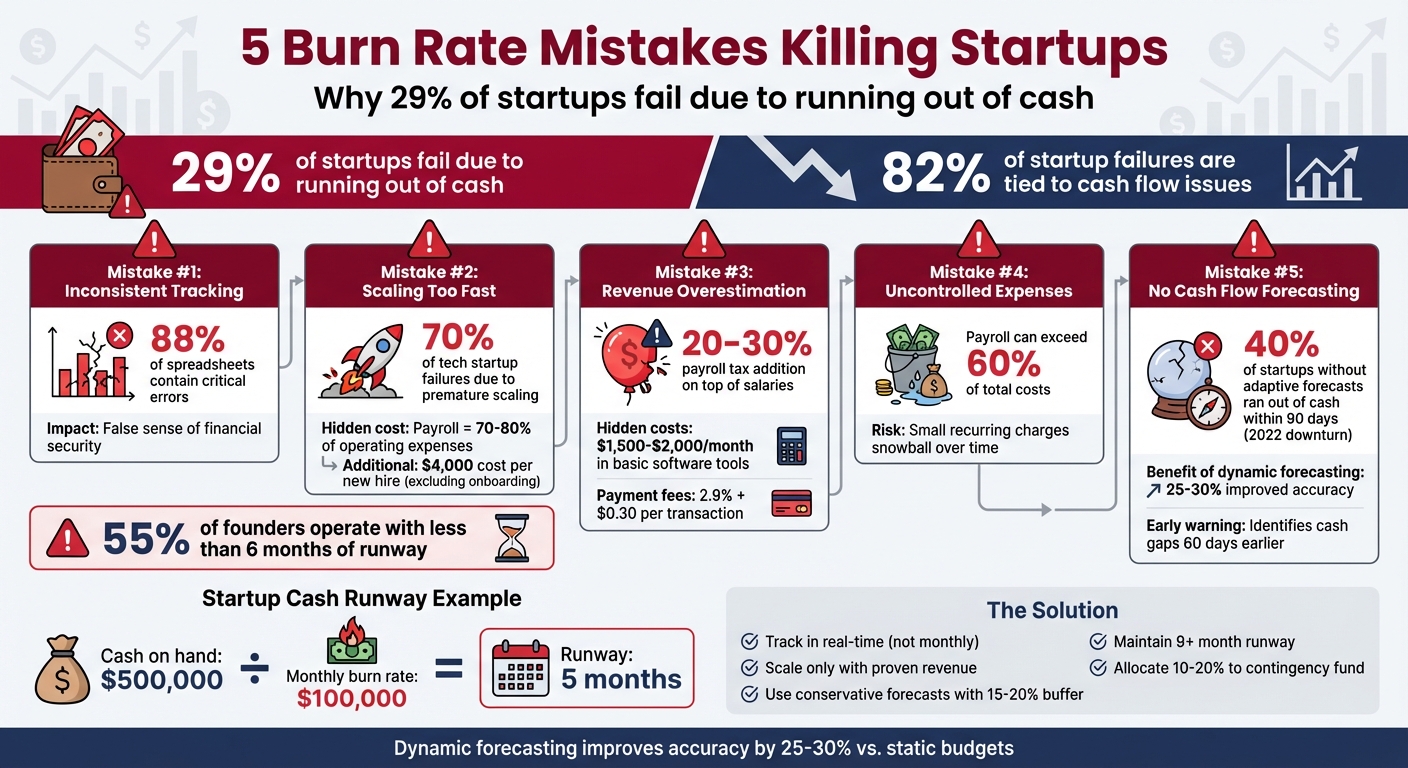
5 Critical Burn Rate Mistakes That Kill Startups: Key Statistics
You're Not Calculating Your Startup Burn Rate Correctly
sbb-itb-17e8ec9
Mistake 1: Tracking Burn Rate Inconsistently or Inaccurately
A lot of founders think they're keeping tabs on their burn rate, but in reality, they’re just glancing at their profit and loss statement once a month. This kind of casual tracking can leave you with blind spots, draining your cash runway faster than anticipated. You might assume you have a six-month cash buffer, only to discover later that your available cash is far less. The problem? A profit and loss statement doesn’t always reflect the actual cash flowing in and out of your business.
What Happens When You Don't Track Properly
One of the biggest pitfalls is confusing accounting losses with real cash burn. For instance, your profit and loss statement might show a loss that seems manageable. But hidden non-cash expenses - like prepaid annual software contracts, capital investments, or commissions paid out of sync with revenue - can make your actual cash burn much worse.
Another common issue is with revenue recognition. Many startups record revenue when they issue an invoice (billings), not when they actually collect the payment (collections). For example, if you sign a $120,000 annual SaaS contract but only collect $10,000 monthly, your accounting may show the full contract value upfront, while your cash flow reflects only the monthly payments. This mismatch can lead to a false sense of financial security.
On top of that, large one-time expenses - like annual software renewals, year-end bonuses, or quarterly tax payments - can skew your monthly averages. Don’t forget payroll taxes and benefits, which typically add 20% to 30% on top of base salaries. If you’re only looking at averages, you’re likely underestimating your actual cash burn.
Solution: Use Real-Time Monitoring Tools
The fix? Start using tools that give you real-time insights into your cash movements. These tools help bridge the gap between accounting records and actual cash flow, ensuring you have a clear picture of your burn rate.
Stop relying on month-end bank statements - they don’t tell the whole story. Instead, calculate your burn rate directly from your bank balance. Subtract your ending cash from your starting cash and exclude financing activities like loans or investments to get a clear view of your true cash burn. Additionally, track three revenue metrics - earned revenue, invoiced billings, and actual cash collections - but rely only on collections when calculating net burn.
Consider adopting Lucid Financials to automate this process. Lucid connects directly to your bank accounts, providing real-time updates on your burn rate through Slack. It alerts you to spending spikes, reconciles transactions automatically, and generates investor-ready reports on demand. With AI monitoring both gross burn (total expenses) and net burn (expenses minus cash collected), you’ll always know exactly where you stand. No more surprises or scrambling to cover unexpected cash shortages.
Mistake 2: Scaling Too Fast Without Proven Revenue
Securing funding can tempt founders to scale operations too quickly. But scaling prematurely is a major pitfall - it's responsible for 70% of tech startup failures. The issue often lies in converting flexible variable costs into hefty fixed costs before proving unit economics. This locks your business into expenses that are tough to undo.
Take SaaS founder Angelo Esposito, for example. In May 2025, after a funding round, his company onboarded six employees in just four weeks and launched three simultaneous marketing campaigns. Within seven months, their burn rate doubled, Customer Acquisition Cost (CAC) skyrocketed fivefold, and churn rates increased. Despite all this activity, revenue barely budged. To survive, they had to halt hiring, conduct a full cost audit, and consolidate roles. Reflecting on the experience, Angelo remarked:
"Raising money didn't make us smarter - it made our mistakes louder".
The Hidden Costs of Growing Too Quickly
Premature scaling doesn't just drain cash; it introduces operational headaches. While salaries might seem like the primary cost, there are hidden expenses to consider. Each new hire requires equipment, software licenses, benefits, and payroll taxes, which typically add 20% to 30% on top of base salaries. Payroll alone often makes up 70% to 80% of operating expenses. Plus, hiring a new employee costs around $4,000 - not including onboarding time or the extra management effort required.
Ramping up too quickly also slows down your ability to adapt. More people mean more meetings and coordination, which can bog down decision-making. And then there's the risk of cultural misalignment. When you hire at breakneck speed, new employees might not have the time to fully embrace your company values, leading to miscommunication and higher turnover.
Even established companies aren't immune. Snapchat learned this the hard way in 2022 when it launched its experimental "Pixy" drone. The product was shelved within months due to disappointing revenue and escalating risks.
Solution: Align Growth with Revenue Milestones
The key is to scale only when your revenue justifies it. Hold off on major hiring or marketing expenses until your unit economics are solid and profitable. A good rule of thumb: ensure your CAC payback period is under 12 months. If it takes longer than that to recoup your customer acquisition costs, increasing your marketing spend could drain your resources even faster.
Adopt a phased approach to hiring, linked directly to sales milestones. Bring on new team members only when your financials and roadmap clearly indicate the need. Instead of committing to full-time hires right away, consider using freelancers, part-time contractors, or virtual assistants for non-core tasks.
Tools like Lucid Financials can help you maintain control during this delicate phase. With rolling forecasts and AI-powered scenario planning, you can predict how each hire or marketing dollar will impact your runway. Lucid also integrates with Slack, providing real-time alerts when your spending veers off course. This way, you won’t have to wait months to realize your burn rate has spiraled - you’ll know immediately and have the insights to adjust your strategy accordingly.
Mistake 3: Overestimating Future Revenue
Overestimating revenue might seem harmless at first, but it can lead to excessive spending on marketing and hiring, draining your cash reserves faster than anticipated.
Why Top-Down Forecasting Falls Short
Top-down forecasting often inflates revenue expectations. A common example is claiming, "We'll capture 2% of a $5 billion market", which translates to $100 million in revenue. While it sounds promising, Kaylee Philbrick-Theuerkauf from Bizplanr.ai points out:
"Saying 'we'll capture 2% of a $5 billion market' is not a revenue projection. It's a placeholder for a number you haven't built yet".
This method skips over the practical work of acquiring, converting, and retaining customers. It also ignores critical metrics like Customer Acquisition Cost (CAC), conversion rates, and your team’s ability to handle growth. Curt Mastio, Managing Partner at Founder's CPA, highlights the risk:
"Excessive marketing spending and hiring can drive cash burn that you never recoup".
Even if your business looks profitable on paper, Philbrick-Theuerkauf reminds us, "Profit on paper doesn't pay back a loan. Cash does".
Hidden costs add to the problem. Payment processing fees (around 2.9% plus $0.30 per transaction) can chip away at your margins. On top of that, basic software tools for startups can easily cost $1,500 to $2,000 per month. These overlooked expenses make inflated revenue projections even riskier.
Solution: Build Conservative, Data-Driven Models
Instead of relying on broad assumptions, create bottom-up forecasts based on specific data points like reach, conversion rates, pricing, and purchase frequency. For example, if you reach 10,000 potential customers, convert 5% of them, and charge $80 per month, you’d have 500 customers and $40,000 in monthly revenue.
Take into account acquisition costs and churn rates. If acquiring a customer costs $200 and they pay $80 per month, it’ll take about three months to break even - before churn even comes into play. To prepare for uncertainties, use scenario analysis to create Conservative (slower growth), Base (realistic), and Optimistic (best case) forecasts. Adding a 15–20% buffer for variable costs can also help cover unexpected expenses.
Revisit your forecasts monthly during the first year to adjust based on actual performance. This way, you can address potential cash flow issues before they become critical.
Tools like Lucid Financials make this process easier. With AI-driven features like real-time forecasting, scenario modeling, and Slack-based support, founders can quickly see how changes in growth or costs impact their runway. Using tools like this ensures your financial strategy stays grounded in data and adaptable to changing realities.
Mistake 4: Letting Operating Expenses Get Out of Control
Uncontrolled operational spending can quietly undermine your cash runway, just like inconsistent burn rate tracking or premature scaling. Beyond revenue forecasting, unchecked expenses - like unused software subscriptions, outdated vendor contracts, and overlooked administrative costs - can drain your resources faster than you might expect. While payroll often garners the most attention (it can exceed 60% of total costs), it’s the smaller, recurring costs that often slip through unnoticed, steadily eating away at your reserves.
Even minor recurring charges - like a $50/month tool or a $200/month service - can snowball into a significant burden over time. These seemingly insignificant expenses, when combined, can become a serious threat to your financial stability and runway.
How to Find and Cut Unnecessary Costs
Conduct regular expense audits to uncover waste. Review every line item on a quarterly basis to identify unused software, overlapping subscriptions, or vendor contracts that are no longer competitively priced. Many startups unknowingly pay for multiple SaaS tools with overlapping features. Consolidating these tools can save money without sacrificing productivity.
As your company grows, renegotiate vendor agreements. Contracts that made sense when you launched may no longer offer competitive terms. Challenge these agreements to ensure you’re getting the best possible rates. Also, evaluate your asset strategy. Renting office space and leasing equipment can help maintain flexibility and avoid tying up cash in non-essential assets. Opting for cloud-based infrastructure for HR, payroll, and IT ensures that costs scale with usage, rather than requiring large upfront investments.
To prevent budget overruns before they occur, implement spend controls. Modern tools can cap corporate card limits, block certain vendor categories, and require pre-approvals for significant charges. Tim Lipton from CFO Services explains:
"If you've got 12 months of runway, whether someone spent $5,000 more or less on travel isn't that important... but if there's no smoke, there's definitely no fire".
To effectively combat rising expenses, automation is key.
Solution: Use Automated Expense Tracking
Relying on manual spreadsheets can leave you vulnerable to mistakes. In fact, 88% of spreadsheets used for financial modeling contain critical errors, leading to misinformed spending decisions and missed opportunities to cut waste. Real-time visibility into operational spending is vital for catching budget discrepancies early.
Lucid Financials offers an AI-powered expense tracking solution that automates reconciliations and keeps your financial records clean. With real-time monitoring integrated into Slack, you can instantly check spending details, flag duplicate subscriptions, and catch unexpected charges. The platform automatically reconciles transactions and generates up-to-date financial reports, giving you the insights needed to make smarter decisions about cutting costs. Best of all, Lucid Financials ensures your books are accurate and actionable within just seven days.
Mistake 5: Skipping Cash Flow Forecasting and Backup Plans
Relying on a static, outdated budget puts your startup at serious risk. Startups operate in an unpredictable environment - unexpected customer churn, supply chain disruptions, or economic downturns can happen at any moment. And here's a sobering statistic: 82% of startup failures are tied to cash flow issues, with poor forecasting being a major culprit. Without financial projections that adapt to real-time changes, you're essentially navigating without a map.
The fallout from neglecting dynamic forecasting can be devastating. During the 2022 tech downturn, 40% of startups that lacked adaptive forecasts ran out of cash within just 90 days. Take WeWork's collapse in 2019 as an example. The company relied on static budgets that projected $4 billion in revenue but failed to account for massive tenant churn. Meanwhile, they were burning through $1.8 billion annually. Without a contingency plan, this misstep led to bankruptcy, erasing a $47 billion valuation. Startups that can't pivot quickly in the face of market changes often face layoffs - or worse, complete shutdowns.
Why You Need Dynamic Forecasting
Static budgeting just doesn’t cut it in the fast-paced world of startups. Instead, implement a 12-month rolling forecast that updates monthly using real-time data like actual expenses and revenue trends. This approach ensures you always have a clear 12-month runway view, which is critical in volatile conditions.
Key metrics to monitor include:
- Monthly burn rate changes (e.g., a jump from $150,000 to $200,000 due to new hires).
- Net cash position - especially if it dips below six months of runway.
- Aging accounts receivable that could signal cash flow delays.
Dynamic forecasting isn’t just about staying on top of numbers - it’s about staying ahead of problems. Compared to static models, it improves accuracy by 25-30%, allows for proactive adjustments like postponing hires to conserve cash, and helps identify cash gaps 60 days earlier.
Solution: Plan for Uncertainty with AI-Driven Scenarios
To truly prepare for the unexpected, you need to model multiple "what-if" scenarios. For example, what happens to your runway if revenue drops by 20% or if marketing expenses double? This kind of planning can make all the difference. In Q2 2023, Brex extended their runway from 4 to 14 months during a market downturn by using AI-driven cash flow scenarios. Under CFO Claire Koenigsberg's leadership, they modeled a 25% revenue cut and reduced non-essential spending by 18%, ultimately securing a $50 million Series D.
Tools like Lucid Financials make scenario planning easier. Using AI, Lucid generates forecasts automatically, showing how changes in spending or revenue impact your runway. It even sends Slack alerts when critical thresholds - like dropping below six months of runway - are reached. For example, it flags high-risk expenses such as unused software subscriptions, helping clients reduce burn by 15-20% through timely interventions.
To stay prepared:
- Allocate 10-20% of your monthly burn to a contingency fund.
- Stress-test for 30% revenue declines every quarter.
- Maintain at least a 9-month runway.
With tools like Lucid's AI-driven forecasting and proactive alerts, you'll have the insights you need to weather whatever challenges come your way.
Conclusion
Keeping a close eye on your burn rate is key to ensuring your startup's survival. No matter how great your product or team is, running out of cash can bring everything to a halt. The pitfalls we’ve discussed - like inconsistent tracking, scaling too soon, overly optimistic projections, unchecked expenses, and rigid budgeting - are all avoidable with the right mindset and tools.
The takeaway? Staying ahead with proactive financial management always beats scrambling to fix problems later. By leveraging real-time burn rate insights, adaptable forecasting, and automated expense tracking, you can stretch your runway and make smarter choices. The numbers are clear: 29% of startups fail because they run out of cash, and 55% of founders operate with less than six months of runway.
Platforms like Lucid Financials show how AI-driven tools can turn guesswork into strategy. Lucid simplifies bookkeeping, tracks your burn rate in real-time, and offers scenario planning - all in one place. You'll have clean books in just seven days, instant Slack support, and reports ready for investors at a moment’s notice. The AI even alerts you when critical thresholds - like dipping below six months of runway - are reached. This kind of forward-thinking planning ensures you stay flexible, even when markets shift.
As Aviv Farhi, Founder and CEO of Showcase, shares:
"Lucid has made it incredibly easy to track spending, plan ahead, and handle our growth. It's straightforward and effective".
Whether you’re gearing up for your next funding round or trying to extend your runway, having real-time insights and expert support can make all the difference. Don’t wait until it’s too late - equip yourself with the tools to stay financially strong and focus on growing your business.
FAQs
What’s the difference between gross burn and net burn?
Gross burn refers to the total amount of cash a company spends each month on operating expenses, without factoring in any income or revenue. On the other hand, net burn takes the income earned into account, showing how quickly a business is using up its cash reserves.
For instance, if a startup spends $50,000 in a month but generates $10,000 in income, the gross burn would still be $50,000. However, the net burn would be $40,000, reflecting the actual cash depletion. Knowing both figures is essential for managing cash flow and planning the company's financial runway effectively.
How do I calculate my runway from my bank balance?
To figure out your runway, use this formula:
Runway (months) = Cash Balance ÷ Monthly Burn Rate
When calculating, focus only on liquid assets, such as bank balances or Treasury bills. Avoid including non-liquid assets like inventory. For the burn rate, account for your monthly cash outflows after subtracting any revenue. This will give you a clear picture of how many months your business can sustain operations before requiring extra funding.
What should I include in a 12-month rolling cash forecast?
A 12-month rolling cash forecast includes several key components to help businesses stay on top of their financial health:
- Cash inflows: This includes revenue, collections from accounts receivable, and any other sources of income. Tracking these ensures you know exactly what's coming in and when.
- Cash outflows: Monitor all outgoing cash, such as operating expenses, payroll, and payments to vendors. This helps avoid surprises and ensures you can meet obligations.
- Timing of cash movements: It's crucial to align the timing of inflows and outflows to maintain liquidity. This means carefully managing payment schedules and collection timelines.
- Stress testing: Use conservative revenue estimates to prepare for potential shortfalls. This ensures you're ready to handle unexpected dips in cash flow.
- Cost breakdown: Separate fixed costs (like rent) from variable costs (like utilities or materials). This makes it easier to identify areas where you can control spending.
The goal is to create realistic projections that keep your operations stable and your finances predictable.