Managing risk is critical for growing businesses. Companies traditionally use manual methods like spreadsheets and static reports, but these are slow, error-prone, and reactive - addressing problems only after they occur. Enter AI: a solution that monitors risks in real time, flags anomalies, and updates compliance policies automatically.
Key Takeaways:
- Manual Risk Management: Relies on human effort, periodic reviews, and static tools. It's time-intensive and prone to errors.
- AI-Driven Risk Management: Uses automation and predictive analytics to detect risks faster, reduce errors, and save time.
The future of risk management lies in blending AI's efficiency with human judgment. While AI handles data-heavy tasks, humans focus on strategic decisions, creating a balanced and effective approach.
Manual Risk Management: How Traditional Methods Work
Standard Practices in Manual Risk Management
Manual risk management depends heavily on human intervention, spreadsheets, and occasional reviews. Teams typically rely on Excel files for tracking compliance data, Word documents for storing policies, and periodic reports to capture snapshots of risk. As KPMG puts it:
Risk management has long been an array of spreadsheets, static reports, and infrequent assessments.
This approach is largely reactive. Risk teams manually input data, maintain lists of processes and controls, and perform audits on a quarterly or annual basis. Instead of keeping a constant eye on potential risks, these methods focus on analyzing past failures - often after the damage is already done. Compounding the issue, data is scattered across various departments in disconnected systems, making it nearly impossible to grasp the full scope of compliance risks across the organization.
While these traditional methods are widely used, they expose critical weaknesses when examined closely.
Problems with Manual Methods
As businesses grow, the flaws of manual systems become more apparent. These methods often lead to high error rates due to human mistakes, repeated data entries, and inconsistencies across siloed tools.
One of the biggest challenges is slow detection. Risks are often identified only after they’ve caused problems, leading to delayed responses and costly consequences. Bruno J. Navarro from Workday highlights this issue, noting that traditional techniques are far too reactive to keep up with today’s rapidly evolving threats.
Another drawback is the time investment. Teams spend more hours compiling reports than actively managing risks. KPMG describes this as a "production-heavy" process that prioritizes assembling data over making informed decisions. Despite global organizations spending $4.4 trillion on contingent workforces, many still rely on outdated, manual risk management practices to oversee these workers. As companies expand, manual methods require a proportional increase in staff and resources, which can be particularly overwhelming for smaller organizations.
These challenges highlight the growing need for smarter, AI-driven solutions to handle modern risk management efficiently.
Managing AI Risk: AI Governance Strategies for Enterprise Leaders
AI-Driven Risk Management: Automation and Real-Time Analysis
Artificial Intelligence (AI) is reshaping risk management, turning it into a strategy that looks ahead rather than just analyzing past data. By continuously monitoring and addressing risks in real time, AI enables businesses to stay proactive. As KPMG puts it:
AI is not just a tool for risk management; it is a catalyst for transformation.
This evolution shifts risk management teams from focusing on oversight to developing foresight. Instead of relying on static, periodic assessments, AI enables constant monitoring and predictive analytics. With AI taking on the labor-intensive tasks of data processing and pattern recognition, teams can redirect their efforts toward strategic decision-making.
Core Features of AI-Driven Risk Management
AI-powered systems excel at monitoring both internal and external data. They flag risks instantly and adjust controls as regulations evolve. This proactive risk scanning approach replaces the older, interview-based assessments.
Another standout feature is automated compliance updating. AI keeps an eye on regulatory changes in real time, updating internal policies and controls as needed. Some companies are even developing virtual regulators - AI personas programmed with regulatory guidelines. These virtual regulators "stress test" business plans, helping organizations avoid compliance issues before they arise.
AI's predictive analytics and Natural Language Processing (NLP) capabilities uncover patterns and anomalies that human analysis might miss. For instance, NLP can sift through lengthy contracts or policies to identify critical changes and risks. Machine learning models can detect unusual activity in security logs or operational data. AI can also generate synthetic data to simulate scenarios like geopolitical shifts, enabling businesses to test their strategies under hypothetical conditions.
Control testing is another area where AI shines. It automates the process of verifying safeguards and identifying anomalies across massive datasets. For model validation, AI generates documentation and flags data drift, ensuring systems remain accurate and reliable. These tools free up risk management teams to focus on higher-level strategic tasks.
Benefits of AI in Workforce Risk Management
The advantages of AI-driven risk management are undeniable. According to research, 98% of executives report that digital tools like AI and advanced analytics have enhanced their ability to identify, monitor, and mitigate risks.
One key benefit is improved accuracy. AI handles high-volume tasks with consistency, minimizing errors that often occur with manual processes. Unlike human-driven methods, which are vulnerable to fatigue and inconsistencies, AI maintains precision across vast datasets.
Real-time data analysis is another game-changer. Businesses no longer have to wait weeks or months to identify threats. Continuous monitoring acts like a "flashlight", illuminating emerging issues as they arise. This approach replaces the outdated, static snapshots of traditional audits. Matt Stirrup, Executive Vice President of Global Business Finance at Oracle, highlights this shift:
Finance staff augmented by AI tools can focus their time on the most complex analysis and strategic decision-making.
AI also reduces administrative burdens, leading to significant cost savings. For instance, S&P 500 companies could collectively save around $65 billion over five years by adopting AI. Additionally, 70% of CFOs anticipate productivity gains of 1% to 10% from Generative AI, with 13% expecting even greater improvements.
As businesses grow, AI systems can handle increasing data volumes without requiring a proportional increase in staffing. This scalability allows smaller organizations to access advanced analytics tools once limited to large enterprises. PwC explains:
By scaling their capabilities with automation... these teams can evolve into highly strategic advisors to the business.
sbb-itb-17e8ec9
Manual vs. AI Risk Management: Side-by-Side Comparison
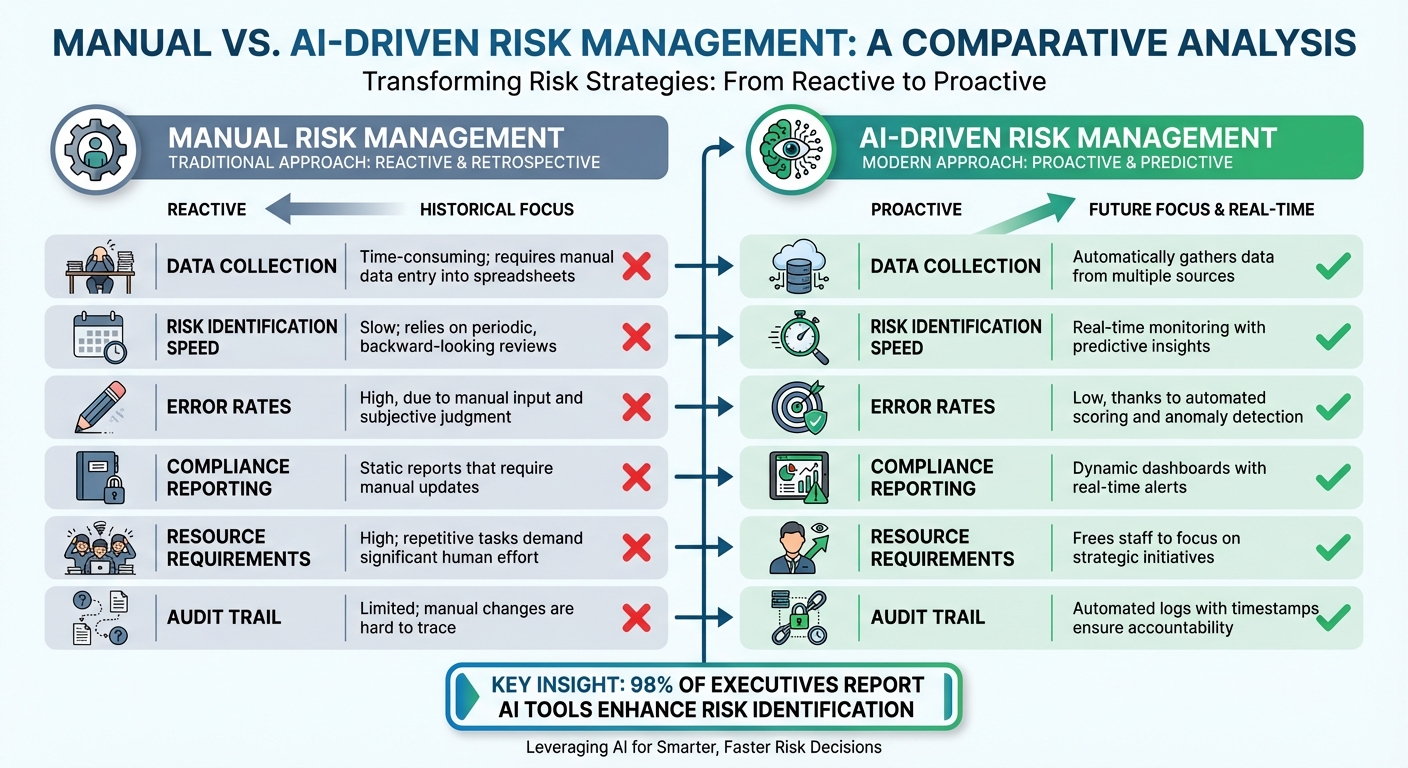
Manual vs AI-Driven Risk Management: Key Differences Comparison
When you put manual and AI-driven risk management side by side, the differences are striking. Manual methods depend heavily on human effort - teams gather data, input it into spreadsheets, and conduct periodic audits. This process is not only time-consuming but also pulls people away from focusing on strategic decisions. On the other hand, AI takes over tasks like data collection and analysis, allowing teams to focus on more impactful work.
The shift from manual to AI processes marks a move from merely reacting to risks to proactively identifying them. Traditional methods rely on static snapshots of data, often outdated by the time they’re reviewed. In contrast, AI systems provide continuous monitoring and predictive insights, spotting potential threats as they arise.
Comparison Table: Manual vs. AI Methods
| Feature | Manual Risk Management | AI-Driven Risk Management |
|---|---|---|
| Data Collection | Time-consuming; requires manual data entry into spreadsheets | Automatically gathers data from multiple sources |
| Risk Identification Speed | Slow; relies on periodic, backward-looking reviews | Real-time monitoring with predictive insights |
| Error Rates | High, due to manual input and subjective judgment | Low, thanks to automated scoring and anomaly detection |
| Compliance Reporting | Static reports that require manual updates | Dynamic dashboards with real-time alerts |
| Resource Requirements | High; repetitive tasks demand significant human effort | Frees staff to focus on strategic initiatives |
| Audit Trail | Limited; manual changes are hard to trace | Automated logs with timestamps ensure accountability |
How Each Approach Handles Regulatory Changes
Adapting to regulatory changes is another area where AI shines. With manual methods, teams must constantly monitor regulatory updates, interpret them, and adjust policies across departments. This process can take weeks - or even months. AI systems, however, track regulatory changes in real time and automatically align controls with established frameworks like NIST, ISO, or CIS. This means organizations can respond to compliance updates in hours or days, rather than waiting for the next audit cycle.
The financial risks of falling behind are massive. For example, GDPR fines can climb as high as €20 million or 4% of a company’s annual global revenue. Meanwhile, the average cost of a data breach has reached $4.35 million, and it typically takes an average of 287 days to detect and contain one. Ben O'Brien, Managing Director at Jaywing, highlights this urgency:
AI-driven risk management is becoming less of an option and more of a necessity.
For startups and fast-growing companies, this efficiency gap is especially critical. AI levels the playing field by providing access to advanced analytics that were once the domain of large enterprises. Smaller organizations can now compete in risk management without needing to build large compliance teams. Tools like Lucid Financials (https://lucid.now) showcase how automation in risk management can redirect human resources toward strategic growth, demonstrating how AI bridges the gap between efficiency and expertise in risk management.
Combining AI Automation with Human Judgment
AI is reshaping how organizations approach workforce risk, but the real magic happens when technology and human oversight work hand in hand. According to data, 98% of risk executives believe digital acceleration enhances risk identification. At the same time, 42% emphasize the necessity of human oversight to ensure effective outcomes. The key to success lies in blending these elements - leveraging AI's capabilities while relying on human judgment to guide critical decisions.
Why Human Expertise Still Matters
Regulators have made it clear: accountability cannot be delegated to machines. A Head of Compliance in professional services put it succinctly:
"Ultimately, it is the human beings who must be accountable. You can't outsource accountability. That's a principle in regulation that will always stay."
This point becomes even more crucial in high-stakes, complex situations where context and intuition are indispensable. A Chief Financial Officer in North America echoed this sentiment:
"There needs to be a human component because while AI is great, sometimes nothing can beat good old common sense and intuition."
In fact, only 5% of professionals feel comfortable entrusting risk and compliance entirely to autonomous AI systems without human involvement. It's clear that human expertise remains a cornerstone in managing nuanced challenges.
AI as a Support Tool, Not a Replacement
Rather than replacing human roles, AI thrives as a support tool. Think of it as a "flashlight" - it illuminates hidden risks buried in vast datasets, but it’s the human experts who interpret the findings and make informed decisions. This division of labor - AI handling data-heavy tasks and humans focusing on strategy - is becoming the norm.
That said, this collaboration requires careful planning. Half of the time saved by AI is often spent correcting its errors. To counteract this, organizations must establish structured oversight processes, including clear guidelines, evidence-based recommendations, and regular reviews to minimize automation bias.
While 91% of risk and compliance professionals acknowledge AI's potential and 53% are actively using or testing the technology, only 30% have reported tangible benefits. This gap between promise and performance often comes down to how well human judgment is integrated into AI-driven workflows. For startups and growing businesses, platforms like Lucid Financials (https://lucid.now) demonstrate this balance by automating routine financial tasks while ensuring experienced professionals remain available to handle complex decisions and long-term strategies.
Conclusion: Selecting the Right Approach for Your Business
Deciding between manual and AI-driven risk management comes down to your company's size and the pain points in your current processes. If you're relying heavily on spreadsheets and static reports, it might be a sign that your system needs an upgrade. Manual methods often lead to mistakes in control management and risk scoring, which could signal it's time to look into automated solutions.
For startups and fast-growing businesses, AI can be a game-changer. It provides access to advanced analytics and decision-making tools that were once reserved for larger companies. For example, AI-enabled accounting can handle 55% more clients while shaving 7.5 days off monthly close times. These efficiencies are especially critical when scaling quickly.
A phased approach works best for implementation. Start by auditing your current systems to identify where manual efforts are most time-consuming. Then, run pilot programs on low-risk, high-impact tasks like invoice processing or automated reporting. Once these pilots prove their value, integrate them into your existing systems to show a clear return on investment. This step-by-step process lays the groundwork for a smoother transition to automation.
Keep in mind that AI thrives on clean, well-organized data. Without high-quality inputs, its effectiveness diminishes. For startups navigating frequent regulatory changes - 64% anticipate auditors will assess AI controls - real-time monitoring becomes indispensable.
FAQs
How does AI make risk management faster and more accurate?
AI is reshaping risk management by offering real-time detection, analysis, and response to potential threats. Traditional manual methods often lag behind and tend to be reactive, but AI-powered systems work continuously, learning and adjusting to new information. This allows organizations to respond faster and with greater precision.
By automating tasks and processing massive data sets, AI delivers richer insights into risks, enabling teams to make informed, forward-thinking decisions. The result? Improved accuracy, fewer weak spots, and the ability to tackle challenges swiftly and effectively.
What are the challenges of using only AI for risk management?
AI has the potential to make risk management more efficient by automating tasks and offering real-time insights. However, it isn't without its limitations. AI often falls short when faced with complex or nuanced risks that demand human intuition or ethical reasoning. It can also be influenced by biased data, exposed to cybersecurity threats, or prone to unexpected errors - any of which might lead to flawed decisions.
To ensure a well-rounded approach to risk management, AI should work alongside human oversight. Humans bring ethical judgment, strategic thinking, and accountability to the table, filling in the gaps where AI struggles. This partnership creates a more dependable and balanced way to handle risks effectively.
What’s the best way for small businesses to use AI in risk management?
Small businesses can simplify risk management by leveraging AI-driven tools to automate tasks and analyze data in real time. These tools help pinpoint potential risks more quickly and precisely than traditional manual methods, offering constant monitoring and early alerts for financial, operational, or market-related challenges.
Integrating AI platforms allows businesses to handle routine risk assessments more efficiently, perform instant scenario analyses, and respond to changes swiftly - eliminating the delays that come with manual updates. For example, solutions like Lucid Financials combine automation with expert insights, enabling small businesses to stay compliant, enhance accuracy, and approach risk management in a more responsive and scalable way.