AI tools have transformed scenario modeling for startups, helping founders predict financial and operational outcomes faster and with greater accuracy. These tools allow startups to run "what-if" analyses, test assumptions, and make informed decisions about growth, hiring, and resource allocation. From financial forecasting to workflow automation, AI simplifies complex processes, saving time and improving decision-making.
Key Takeaways:
- AI-powered platforms like Lucid Financials streamline financial planning with features like cash flow forecasting, hiring plan modeling, and real-time dashboards. It’s priced at $150/month and integrates with tools like Slack and QuickBooks.
- Prefect automates workflows and supports dynamic scenario testing, ideal for startups managing data pipelines.
- Flyte specializes in scalable resource modeling for machine learning and data-heavy operations.
- SiliconFlow combines multiple data types for comprehensive simulations, suitable for startups needing diverse scenario analysis.
Choosing the right tool depends on your startup's needs - whether it's financial planning, resource scaling, or workflow automation.
How Startups Can Use AI for Pricing Strategy and Sales Forecasting
sbb-itb-17e8ec9
Lucid Financials: AI-Powered Scenario Modeling for Startups

Lucid Financials takes the complexity out of financial management for startups by leveraging AI to deliver fast, accurate scenario modeling and insights.
Lucid Financials stands out as the first AI-powered, all-in-one accounting platform designed specifically for startups and rapidly growing businesses. It combines bookkeeping, tax services, tax credits, and CFO-level support into a single intelligent system. What really makes it shine is its ability to handle scenario modeling - something that traditionally required either a full-fledged finance team or complicated software. Plus, it integrates seamlessly with Slack, so founders can get instant answers to pressing questions like, "What will happen to our runway if we hire three engineers next quarter?" or "How will a 20% drop in sales affect our cash flow?" The platform provides immediate, chart-supported responses.
Lucid’s edge lies in its speed and usability. It delivers precise financial reports in just seven days and offers reporting that’s 100 times faster than traditional methods. For startups navigating critical decisions like fundraising, hiring, or market shifts, Lucid enables you to explore multiple scenarios - whether best case, worst case, or somewhere in between - and delivers actionable insights in minutes instead of days.
Key Features of Lucid Financials
Lucid’s AI-driven tools are designed to make financial forecasting and planning quick and effective. Key features include:
- Cash flow forecasting and hiring plan modeling: Test different scenarios with ease, such as comparing a base case with a $500,000 monthly burn to a downside scenario at $650,000. This helps founders understand how changes, like increased headcount, impact their burn rate.
- Real-time dashboards: Continuously monitor burn rate, runway, and scenario variances. These visual tools ensure founders always have a clear picture of their financial health.
- Sensitivity analysis: Quickly see how tweaks to your plans affect your overall financial position, empowering you to make smarter, more agile decisions.
These features allow founders to stay ahead of challenges and make informed calls without delays.
Benefits for Startup Founders and Teams
Lucid Financials removes the heavy lifting from financial management by automating time-consuming tasks while keeping experienced professionals involved to maintain accuracy and compliance. Founders can generate investor-ready reports complete with scenario visualizations, making fundraising and board meetings smoother than ever. Aviv Farhi, CEO of Showcase, shares:
"Lucid has made it incredibly easy to track spending, plan ahead, and handle our growth. It's straightforward and effective".
The platform also excels at comparing different growth strategies. Whether you’re extending your runway, scaling your team, or preparing for your next funding round, Lucid provides the data you need - without the manual effort. Luka Mutinda, CEO of Dukapaq, highlights:
"As our company grows, budgeting and cash flow management have become crucial. The features provided are essential and have greatly streamlined these processes for us".
Starting at just $150 per month, Lucid Financials is priced to be accessible for startups at any stage. By simplifying financial management and delivering actionable insights, Lucid becomes a key partner in driving sustainable growth.
Other AI Tools for Scenario Modeling in Startups
AI tools designed for scenario modeling are becoming invaluable for startups, helping them simulate operations and make smarter decisions about resources. These tools target areas like workflow automation, resource modeling, and simulations involving multiple variables. Each one addresses specific challenges, making them great complements to broader financial platforms.
Prefect for Workflow Automation
Prefect is a powerful solution for automating workflows built on Python. It enables startups to simulate complex scenarios without needing to overhaul their existing systems. With features like dynamic control flow and runtime branching, Prefect makes it easier to test "what-if" scenarios across various business processes. Its Horizon feature connects AI agents directly to internal systems, while Prefect Cloud offers services like autoscaling, single sign-on, and SOC 2 Type II compliance for secure and scalable workflow orchestration. If your focus is on optimizing resource allocation, there are other tools worth exploring.
Flyte for Scalable Resource Modeling
Flyte is built for startups looking to model scalable resource usage effectively. It excels at testing how resources will scale as workloads grow, allowing businesses to experiment with different allocation strategies before making major investments. This approach minimizes the risk of over-provisioning or under-provisioning resources, which can be critical as your company expands.
SiliconFlow for Multimodal Simulations

SiliconFlow takes scenario modeling to the next level by integrating multiple data types and variables into unified simulations. This AI cloud platform allows startups to combine financial projections, operational data, and market trends into a single model. By viewing how these elements interact, founders gain insights into potential bottlenecks or opportunities that simpler models might miss. This comprehensive perspective makes it easier to spot hidden risks or advantages.
Together, these tools showcase how startups can leverage AI to refine their scenario modeling, offering greater precision and flexibility in decision-making.
Comparing AI Tools for Scenario Modeling
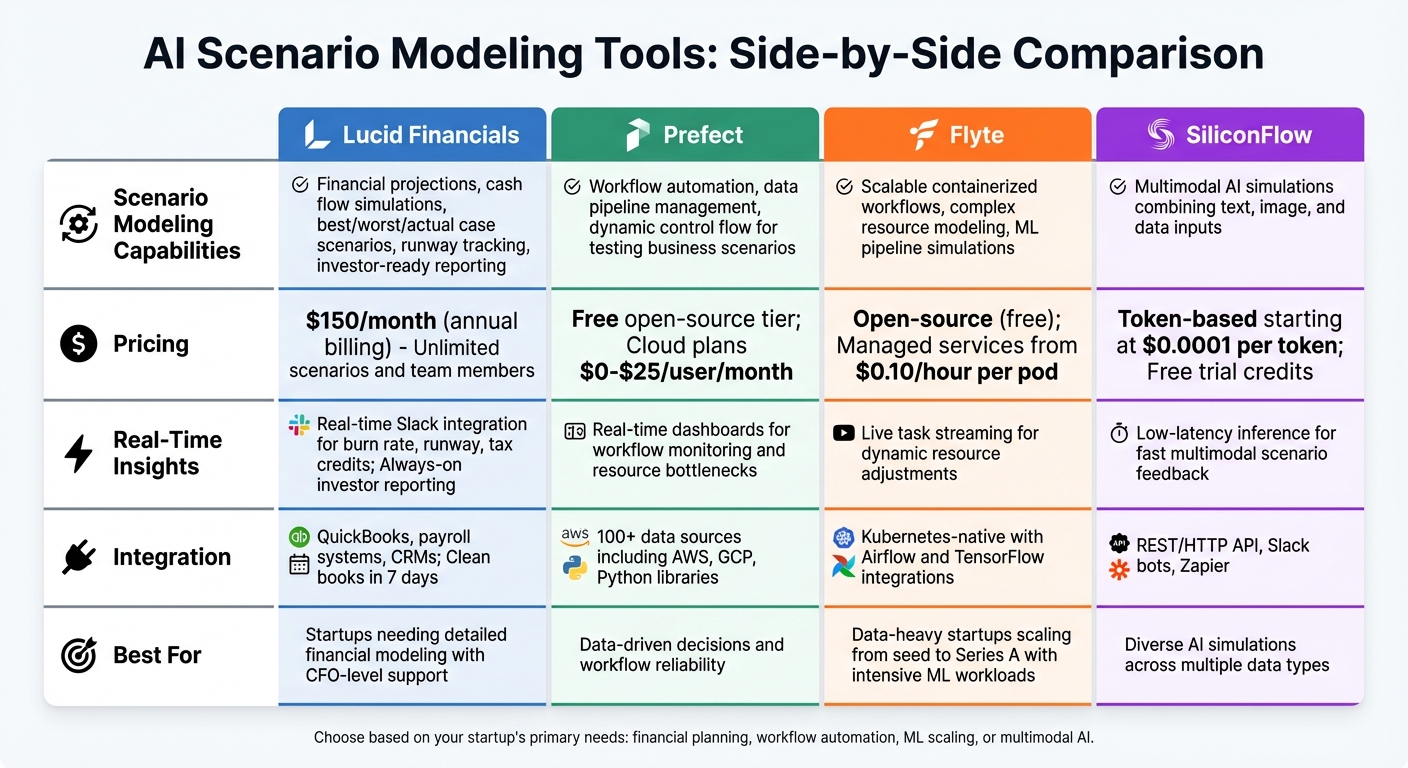
AI Scenario Modeling Tools Comparison for Startups: Features, Pricing and Best Use Cases
Comparison Table of AI Tools
Here's a breakdown of how various AI tools stack up across key features and metrics. The table below provides a snapshot of their capabilities, pricing, integration options, and ideal use cases.
| Tool | Scenario Modeling Capabilities | Startup-Friendly Pricing | Real-Time Insights | Ease of Integration | Best For |
|---|---|---|---|---|---|
| Lucid Financials | Financial projections, cash flow simulations, best/worst/actual case scenarios, runway tracking, and investor-ready reporting | $150/month (annual billing); unlimited scenarios and team members | Real-time Slack integration for burn rate, runway, and tax credit monitoring; always-on investor reporting | Native integrations with QuickBooks, payroll systems, and CRMs; clean books in 7 days | Startups needing detailed financial modeling with CFO-level support |
| Prefect | Workflow automation for managing data pipelines and dynamic control flow for testing business scenarios | Free open-source tier; cloud plans from $0 (hobbyists) to $25/user/month (teams) | Real-time dashboards for workflow monitoring and identifying resource bottlenecks | Supports over 100 data sources, including AWS, GCP, and Python libraries | Startups focused on data-driven decisions and workflow reliability |
| Flyte | Scalable, containerized workflows for complex resource modeling, including ML pipeline simulations | Open-source (free for self-hosting); managed services starting at $0.10/hour per pod | Live task streaming for dynamic resource adjustments | Kubernetes-native with integrations for Airflow and TensorFlow | Data-heavy startups scaling from seed to Series A with intensive ML workloads |
| SiliconFlow | Multimodal AI simulations combining text, image, and data inputs for versatile scenario testing | Token-based pricing starting at $0.0001 per token; free credits for early trials | Low-latency inference delivering fast multimodal scenario feedback | REST/HTTP API integrations compatible with Slack bots and no-code tools like Zapier | Startups conducting diverse AI simulations across multiple data types |
Each tool offers distinct advantages depending on your startup's needs. Lucid Financials provides predictable monthly pricing with unlimited scalability, making it a go-to for startups requiring in-depth financial analysis. Prefect and Flyte, on the other hand, lean into open-source flexibility, keeping costs low while demanding some technical know-how. SiliconFlow's token-based pricing is perfect for startups needing quick, versatile simulations without long-term commitments.
When it comes to real-time insights, Lucid Financials shines with instant Slack-based financial updates, such as burn rate or hiring feasibility. Prefect and Flyte concentrate on operational health, like pipeline performance and task execution. SiliconFlow delivers rapid feedback for AI model simulations but is less focused on financial decision-making.
For startups in growth stages - like scaling from seed to Series A - Lucid Financials offers professional support and continuously updated financial reports. Prefect automates workflows with agents capable of managing thousands of tasks, Flyte handles large-scale simulations on Kubernetes, and SiliconFlow scales elastically with GPU/TPU resources for high-computation scenarios. Use these metrics to match the right tool to your startup's strategic goals.
Choosing the Right AI Tool for Your Startup
Selecting the right AI tool for your startup isn’t just about picking the flashiest features - it’s about finding a solution that aligns with your current stage and priorities. Early-stage founders focused on bootstrapping and hitting product-market fit have very different needs compared to growth-stage teams gearing up for Series A. Making the wrong choice can drain your time and budget, two resources no startup can afford to waste.
When it comes to growth, maintaining financial health is non-negotiable. Managing runway, fundraising, and scaling headcount requires tools that can handle the pressure. That’s where Lucid Financials comes in. For $150 per month, you get a powerful combination of AI-driven forecasting and full-stack accounting services. Features include real-time Slack updates to track your burn rate, spotless books in just seven days, and always-ready investor reporting. Aviv Farhi, Founder and CEO at Showcase, sums it up perfectly:
"Lucid has made it incredibly easy to track spending, plan ahead, and handle our growth. It's straightforward and effective."
Of course, not every startup will prioritize financial tools. Some may focus on workflow automation or managing data pipelines. But for growth-stage companies, financial scenario modeling often takes center stage. Operational tools can complement your stack, but they can’t replace the need for strong financial planning.
Speed of implementation is another critical factor. Lucid Financials integrates quickly with platforms like QuickBooks and Slack, delivering results in just days. This kind of efficiency is a lifesaver when preparing for board meetings or due diligence. Luka Mutinda, Founder and CEO at Dukapaq, shares:
"As our company grows, budgeting and cash flow management have become crucial. The features provided are essential and have greatly streamlined these processes for us."
To find the best fit, start by identifying your riskiest assumptions and test how well the tool can handle them. For example, model scenarios like a 5% increase in churn or a 15% jump in headcount. Look for tools offering AI-powered what-if analysis and natural language queries. Always take advantage of free trials to ensure the tool meets your needs before fully committing. And don’t forget to track ROI with metrics like time saved on planning or improved forecast accuracy. The right tool should make your decisions easier - not add more complexity to your workflow.
FAQs
What scenarios should my startup model first?
To plan effectively, start by creating scenarios that tackle major uncertainties and core business factors. Focus on three key scenarios: the base case (your most probable outcome), the best case, and the worst case. These models help you prepare for fluctuations in revenue, costs, and market dynamics.
Additionally, include scenarios for fundraising and market expansion. These will provide a roadmap for managing capital requirements and exploring growth opportunities. By building these foundational models, you'll be better equipped to allocate resources wisely and adapt as your business grows.
How do I know if my scenario model assumptions are realistic?
To make sure your scenario model assumptions hold up in the real world, rely on measurable, data-driven metrics like customer acquisition costs, churn rates, and revenue growth. Tap into historical data and external market trends to shape these assumptions. Tools like Lucid Financials can help automate this process, ensuring your assumptions are tied to actual numbers. Keep your models accurate and relevant by regularly updating them with the latest data.
How can I measure ROI from using AI for scenario modeling?
Measuring ROI involves looking at how accurate, fast, and high-quality the insights from AI tools are compared to older methods like spreadsheets. Some key metrics to watch include better decision-making, noticeable cost savings - like saving over $80,000 annually with tools such as Lucid Financials - and quicker paths to growth or funding. Additionally, consider how features like real-time forecasts and resource recommendations improve financial planning and boost your business's overall performance.