AI tools are transforming financial audits by automating processes, analyzing 100% of transactions, and generating real-time, audit-ready documentation. For startups, this means faster compliance, reduced costs, and enhanced accuracy. Manual audits are no longer sufficient to handle growing transaction volumes and stricter regulations. AI-powered solutions like MindBridge, AuditBoard, and Lucid Financials address these challenges by streamlining anomaly detection, compliance management, and financial operations.
Key Highlights:
- Full Transaction Analysis: AI reviews all transactions, eliminating gaps left by sampling.
- Real-Time Monitoring: Continuous tracking ensures issues are flagged immediately.
- Transparency: Tools provide clear explanations for decisions, solving the "black box" problem.
- Cost and Time Savings: Companies report up to 70% lower compliance costs and 90% faster audit cycles.
For startups navigating compliance frameworks like SOX or SOC 2, these tools are indispensable. They integrate seamlessly with existing systems, maintain secure audit trails, and allow finance teams to focus on strategic priorities. Whether it's anomaly detection with MindBridge, control management with AuditBoard, or end-to-end financial oversight with Lucid Financials, AI tools are reshaping how audits are conducted.
All eyes on: AI in Audit
sbb-itb-17e8ec9
Why Startups Need Financial Data Access Audits
Startups scaling quickly need to keep a close eye on financial data access. Why? Because every transaction, access point, and control needs to be documented and defensible - not just for internal accountability, but also for external stakeholders. Investors want solid proof that your numbers add up. Enterprise clients often demand compliance certifications before they’ll sign on the dotted line. And regulators? They expect clear, transparent accountability for who has access to what.
The old-school way of doing audits - manual sampling - leaves dangerous gaps. It’s not comprehensive, and it lacks the traceability needed to catch every issue. AI-powered audits, on the other hand, analyze 100% of transactions and access points continuously. This approach eliminates seasonal lapses and ensures that anomalies are caught as they happen, not months down the line.
Compliance and Risk Management
If you’re a SaaS startup, compliance frameworks like SOC 2 and ISO 27001 aren’t just nice to have - they’re essential. Without them, your sales team might hit roadblocks during procurement reviews, leading to longer deal cycles. As one compliance platform puts it:
"With EasyAudit, you can go from 'blocked by procurement' to audit-ready in weeks - not months".
But compliance isn’t just about closing deals. Regulations across industries require startups to maintain transparent, continuous controls. AI audit tools make this manageable by providing real-time monitoring. They alert you immediately when access controls are breached or unusual activity occurs, ensuring you stay compliant year-round.
One major hurdle for automation in finance has been the "explainability problem." Modern AI tools address this by offering clear, per-run rationales and confidence indicators. This makes it easier to explain automated decisions to external auditors, turning a potential obstacle into an advantage. Beyond meeting regulatory requirements, this approach sets the stage for major efficiency improvements.
Efficiency and Cost Savings
For lean finance teams, manual audits can feel like a never-ending grind. Weeks are wasted chasing down evidence from multiple sources. AI tools eliminate this headache by automatically pulling data from platforms like AWS, GitHub, and Okta. They even escalate non-responses to management - no human intervention needed.
The financial benefits are hard to ignore. AI-powered compliance platforms can slash compliance costs by up to 70% compared to traditional methods or outsourced audits. Control testing hours drop by 30–60%, and audit timelines shrink by an impressive 90%. What used to take weeks of manual effort now takes just hours - or even minutes. This frees up your finance team to focus on high-impact tasks like financial planning and investor relations instead of chasing down audit details.
AI doesn’t just save time and money; it also catches what manual reviews often miss. For example, automated expense audits can scan 100% of reports in minutes, flagging duplicates or policy violations that might otherwise slip through the cracks. One platform claims it can analyze a 100-page policy document in just 90 seconds, achieving up to 98% accuracy for frameworks like SOC 2 or GDPR. That kind of speed and thoroughness simply isn’t achievable with manual processes.
Best AI Tools for Financial Data Access Audits
Choosing the right AI tool can completely change how your startup handles financial data access audits. Below, we dive into three platforms that tackle different aspects of audit automation - from spotting anomalies to managing compliance and streamlining financial operations.
MindBridge: AI-Powered Anomaly Detection
MindBridge focuses on pinpointing anomalies with precision. It evaluates 100% of your transactions - over 260 billion across 3,000+ ERP systems - using a combination of advanced techniques. These include 8,000+ GAAP rules, unsupervised models, statistical methods like Benford's Law, and business rules to assign risk scores and flag anomalies.
With more than 40 "control point" capabilities, the platform identifies red flags like unusual keywords, rare vendor-account interactions, or irregular transaction volumes. Jessica Helms, Partner at Cherry Bekaert, sums it up well:
"MindBridge automates and pinpoints what to look for, turning this random process into something targeted and efficient".
For startups with limited finance teams, this means your resources can focus on the riskiest areas instead of combing through every transaction manually. Chris Swanson, Manager of Internal Audit Data Solutions at Polaris, shares:
"Instead of doing a little bit of everything at one of our divisions or subdivisions, we can locate the areas of highest risk and focus our time on them".
MindBridge also ensures transparency with deterministic results and an auditable chain of evidence - key when explaining automated decisions to auditors or investors. It’s SOC 2® and SOC 3® compliant, adhering to AICPA security standards.
AuditBoard: Centralized Controls and Compliance Management
If your startup is aiming for seamless SOX compliance and control documentation, AuditBoard provides a centralized solution. It simplifies evidence collection and automates control testing, making SOX compliance easier to manage while documenting thorough audit trails.
AuditBoard is especially helpful for startups juggling multiple compliance frameworks like SOC 2, ISO 27001, and SOX. Its AI-assisted sampling prioritizes which controls to test based on risk, enabling small teams to cover all bases without being overwhelmed. For startups preparing for SOX compliance or investor scrutiny, this tool helps demonstrate control effectiveness to auditors and stakeholders efficiently.
Lucid Financials: Complete Financial Management with Built-In Audit Support

Lucid Financials offers an all-in-one platform tailored for startups, combining bookkeeping, tax services, and CFO support with built-in audit readiness. The system uses AI for tasks like transaction matching, reconciliation, and categorization, while experienced finance professionals oversee the results to ensure accuracy [lucid.now].
What sets Lucid apart is its investor-ready reporting baked into daily operations. Instead of scrambling to prepare for audits, it keeps your financials audit-ready at all times. The platform generates forecasts, financial reports, and alerts from live data, giving you up-to-date, defensible numbers. For startups preparing for investor due diligence or formal audits, Lucid’s real-time AI insights highlight potential issues early, saving time and effort.
Lucid also delivers board-ready reports and investor-grade forecasts with just one click, eliminating the need for weeks of manual prep before fundraising or compliance reviews. Unlike standalone audit tools, Lucid integrates audit readiness into your financial operations from the start, ensuring your books, tax filings, and reports are structured correctly. Pricing starts at $150/month, making it a budget-friendly option for early-stage startups [lucid.now/pricing].
Each of these platforms addresses unique needs, from anomaly detection to compliance management and full-scale financial operations, giving startups the tools to handle audits more efficiently and confidently.
What to Look for in AI Audit Tools
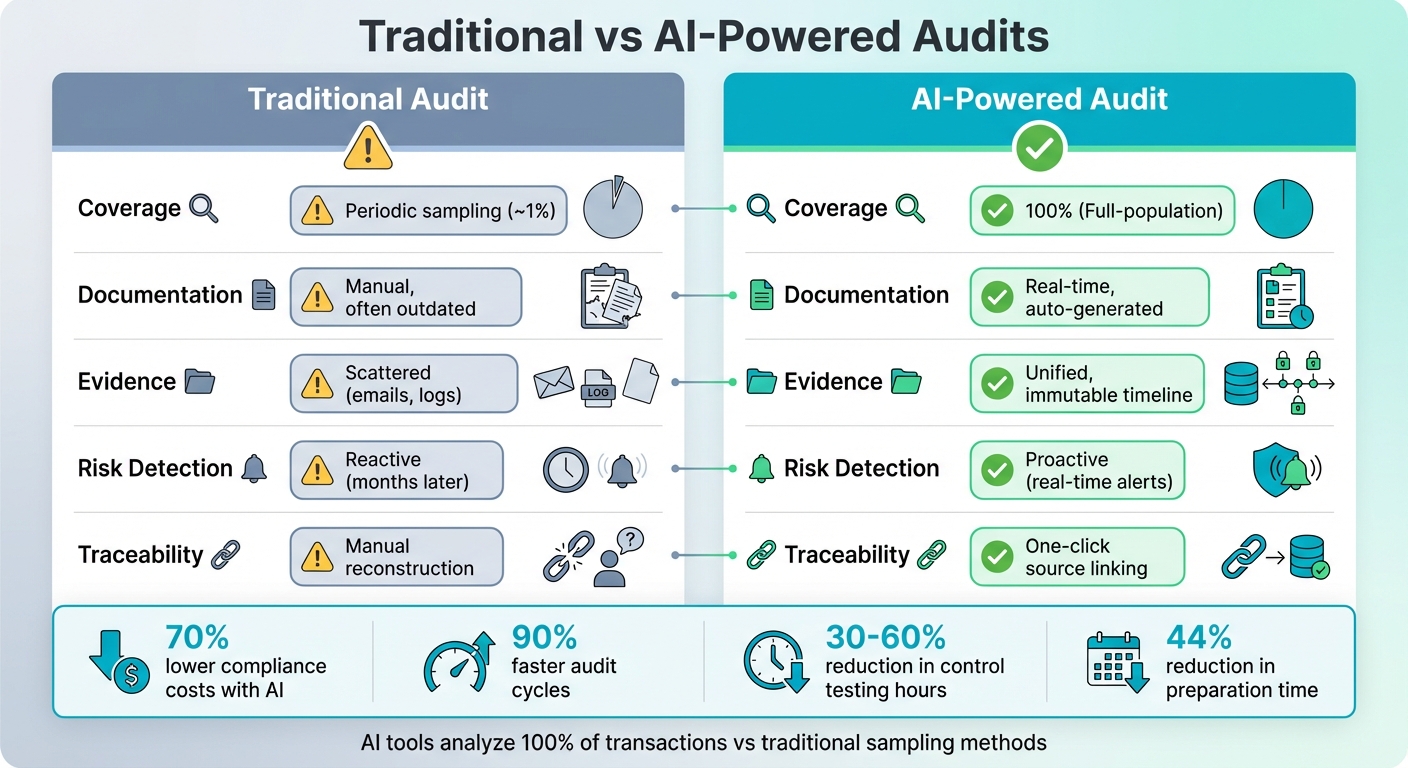
Traditional vs AI-Powered Financial Audits Comparison
AI audit tools vary widely in their capabilities, and the right features can mean the difference between saving hours of work or adding unnecessary complexity. Here’s what you should focus on when evaluating platforms for financial data access audits.
Full-Population Testing and Anomaly Detection
Traditional audits often rely on sampling, which leaves gaps in coverage. AI tools, on the other hand, should be able to analyze 100% of your transactions.
These tools use multiple control points - like statistical analysis, business rules, and behavioral patterns - to ensure comprehensive transaction coverage. By blending these methods, they can catch anomalies that single-rule checks might miss.
AI-driven audits can reduce preparation time by 44% and speed up root cause investigations by as much as five times. As Erik Yao, Co-Founder & CTO at Leapfin, aptly says:
"The most dangerous number in finance isn't the one that's red. It's the one that looks green, but isn't".
With full-population testing, nothing is overlooked. Look for tools that also include confidence scoring for flagged items, so your team can prioritize what needs immediate attention and what can wait.
Next, consider how automated audit trails can enhance these capabilities.
Automated Audit Trails and Documentation
When auditors arrive, the last thing you want is to scramble to piece together an audit trail. The right AI tool should automatically maintain an immutable, timestamped record of every transaction, decision, and approval.
The best platforms use append-only logs, ensuring records can’t be altered or deleted, creating a secure chain of evidence that auditors can trust. Advanced tools even track bi-temporal data, capturing both the event time and the discovery time.
Top-tier tools also auto-generate audit-ready narratives, process explanations, and data mappings in real time. As Erik Yao puts it:
"The AI system has to document itself... The black box becomes a glass box".
This level of transparency is essential for explaining automated decisions to auditors or stakeholders. Every figure in your final report should link back to its original source, extraction timestamp, and supporting rationale.
Integration with Existing Systems
An AI audit tool is only as good as its ability to integrate with your current systems. Whether it’s ERP platforms like NetSuite, SAP, or Oracle, payment processors like Stripe, banking APIs, or communication tools like Slack, seamless connectivity is critical.
The tool should standardize and correlate data from these sources. This eliminates ambiguity and ensures consistent reporting.
For example, effective platforms can merge ERP logs, email approvals, and Slack conversations into a unified timeline to spot patterns that might indicate fraud or unauthorized actions. Automated evidence collection can also cut manual controls testing by 30% to 60%.
To maximize efficiency, look for tools that integrate directly into your team’s workflows. For instance, platforms that embed document review functions within Excel eliminate the need to switch between multiple applications.
| Feature | Traditional Audit | AI-Powered Audit |
|---|---|---|
| Coverage | Periodic sampling (~1%) | 100% (Full-population) |
| Documentation | Manual, often outdated | Real-time, auto-generated |
| Evidence | Scattered (emails, logs) | Unified, immutable timeline |
| Risk Detection | Reactive (months later) | Proactive (real-time alerts) |
| Traceability | Manual reconstruction | One-click source linking |
Finally, ensure the tool can automatically route low-confidence items or high-risk anomalies to human review queues. While AI can handle much of the workload, critical decisions still require human judgment. As Ameya Deshmukh from EverWorker explains:
"AI compliance tools in finance move you from risk-averse paralysis to governed execution".
How to Implement AI Tools for Financial Data Access Audits
Introducing advanced AI tools into financial data audits requires a well-thought-out plan to ensure smooth deployment and effective results. A structured approach helps safeguard data, maintain compliance, and build trust with auditors. By turning the tools’ capabilities into secure, actionable practices, you can streamline processes while keeping everything audit-ready.
Define Audit Objectives and Key Metrics
Before diving into AI implementation, it’s crucial to define clear objectives. Instead of setting a vague goal like "automate audits", focus on specific applications such as invoice triage, purchase order matching, or variance analysis. These targeted use cases allow for testing high-control processes without risking the entire financial close cycle. Establish a standard operating procedure (SOP) that includes clear guidelines for escalating cases to human review, based on factors like confidence levels or transaction value thresholds.
For instance, in October 2025, Leapfin introduced "Luca", an AI agent designed for order-to-cash workflows. By using a JavaScript-based domain-specific language (DSL), Luca ensures AI actions remain structured and reliable. This tool processes billions of transactions and enables accounting teams to close their books in under 48 hours by automating complex revenue recognition tasks and creating journal entries with an immutable audit trail in Snowflake. Erik Yao, Co-Founder & CTO at Leapfin, emphasizes:
"AI doesn't need trust – it needs constraints. The right architecture doesn't hope for reliability; it forces it."
To ensure the AI tool performs as expected, conduct a trial run using prior-year data. This research and development audit will help you benchmark performance and identify areas where additional oversight might be necessary.
Once objectives are in place, the next step is securing your data environment.
Ensure Data Security and Access Governance
When dealing with sensitive financial data, prioritizing security is non-negotiable. Implement strong encryption standards, such as AES-256 for data at rest and TLS 1.2+ for data in transit. Use role-based access controls (RBAC), single sign-on (SSO), and multi-factor authentication (MFA) to manage access. Mask sensitive information, like account numbers or Social Security numbers, before processing, and avoid transmitting regulated data over public networks. Instead, rely on private networking solutions such as VPC/VNet peering or private endpoints. Additionally, ensure that your vendor agrees not to use your data for external model training.
Austin Braham from EverWorker underscores the importance of these measures:
"The deciding factor isn't the AI itself; it's your architecture, safeguards, and governance."
With security protocols in place, the focus shifts to integrating human oversight for critical decisions.
Include Human Oversight for Critical Decisions
AI excels at processing large volumes of transactions, but human judgment remains irreplaceable for critical decisions. To ensure accuracy and accountability, set up human checkpoints for tasks like journal entries, payments, vendor updates, and master data modifications. These checkpoints allow auditors to review and address any flagged issues effectively. Define clear escalation rules so that transactions flagged based on risk criteria are promptly reviewed by qualified professionals.
Additionally, choose AI tools that offer "show me why" features, which provide clear, traceable explanations for every anomaly flagged. This transparency builds confidence in the system's findings.
Alan Anderson, CPA, highlights the value of AI in audits:
"AI can give you 100% of the population, which makes anomaly detection extremely reliable when it's based on proper parameters set by the auditors."
Finally, assign responsibility for managing AI models and conduct periodic reviews to prevent model drift. This ensures the tool continues to align with your audit goals as your business evolves.
Conclusion
AI tools are reshaping how financial data access audits are conducted, offering full-population testing, continuous monitoring, and audit-ready documentation - capabilities that manual processes simply cannot match. According to Gartner, internal audit leaders are focusing on AI adoption by 2025 to improve coverage and effectiveness as regulatory scrutiny intensifies. The ability to analyze 100% of transactions, rather than relying on selective sampling, allows startups to detect anomalies earlier, close their books faster, and build stronger compliance systems without increasing staff. These advancements are crucial as startups navigate the complexities of growth.
Startups often operate with lean teams, face expanding systems, and must address growing regulatory requirements like SOX compliance and investor due diligence. AI-powered audit tools provide the speed, precision, and scalability needed to meet these challenges. Features such as rapid data extraction, immutable audit trails, and real-time risk alerts make these tools indispensable.
One platform that stands out in this space is Lucid Financials, which combines AI-driven audit readiness with comprehensive financial management. Offering AI-powered bookkeeping, tax services, and CFO support directly through Slack, it ensures clean books within seven days, delivers investor-ready reports on demand, and maintains continuous audit transparency. This scalable solution supports compliance and control, making it an essential tool for growing businesses.
Strong infrastructure is key to staying competitive. By incorporating AI into financial operations, startups can achieve faster closes, smoother fundraising, and reduced audit costs. Pairing AI's processing capabilities with human oversight for critical decisions creates a financial system that’s both efficient and reliable - exactly what investors and auditors look for as your business scales.
FAQs
What data sources should an AI audit tool connect to first?
An effective AI audit tool needs to link seamlessly with key financial systems - like bank accounts, payment platforms, ERPs, and accounting software. Why? These connections allow the tool to automatically gather, organize, and verify financial data without manual input.
By automating these steps, the audit process becomes faster and more efficient, while also reducing the chances of errors. Plus, with accurate and organized data at its core, the tool can deliver more reliable results.
How do AI audit tools explain why something was flagged?
AI audit tools provide detailed, easy-to-understand explanations for flagged issues. They create narratives that break down anomalies or concerns by examining the data and patterns involved. This approach helps users grasp the reasoning behind each flagged item, making the findings more accessible and actionable.
What human approvals should stay in place with AI audits?
Human involvement plays a key role in ensuring AI systems operate effectively and responsibly. Approvals from humans help validate these systems, keep an eye on model drift, enforce strict access controls, and carefully review audit trails. These measures are crucial for maintaining compliance, ensuring accuracy, and safeguarding security during financial data access audits.