AI tax compliance systems are transforming how startups handle taxes. These platforms automate bookkeeping, tax calculations, and compliance tasks, saving time and reducing errors. They track regulations across thousands of jurisdictions, alert users to deadlines, and ensure accurate filings. For startups expanding across states or countries, these tools simplify complex tax requirements and cut costs. With features like real-time validation, anomaly detection, and predictive planning, AI systems turn tax compliance into a year-round, stress-free process.
Key Takeaways:
- Automates tax tasks like bookkeeping, calculations, and filings.
- Tracks compliance across 12,000+ jurisdictions.
- Reduces manual effort by up to 40% and saves about 25% in costs.
- Alerts users to nexus thresholds and regulatory changes.
- Pricing starts at $150/month, offering a high return on investment.
Switching to an AI-driven system streamlines tax management and helps startups focus on growth while staying compliant.
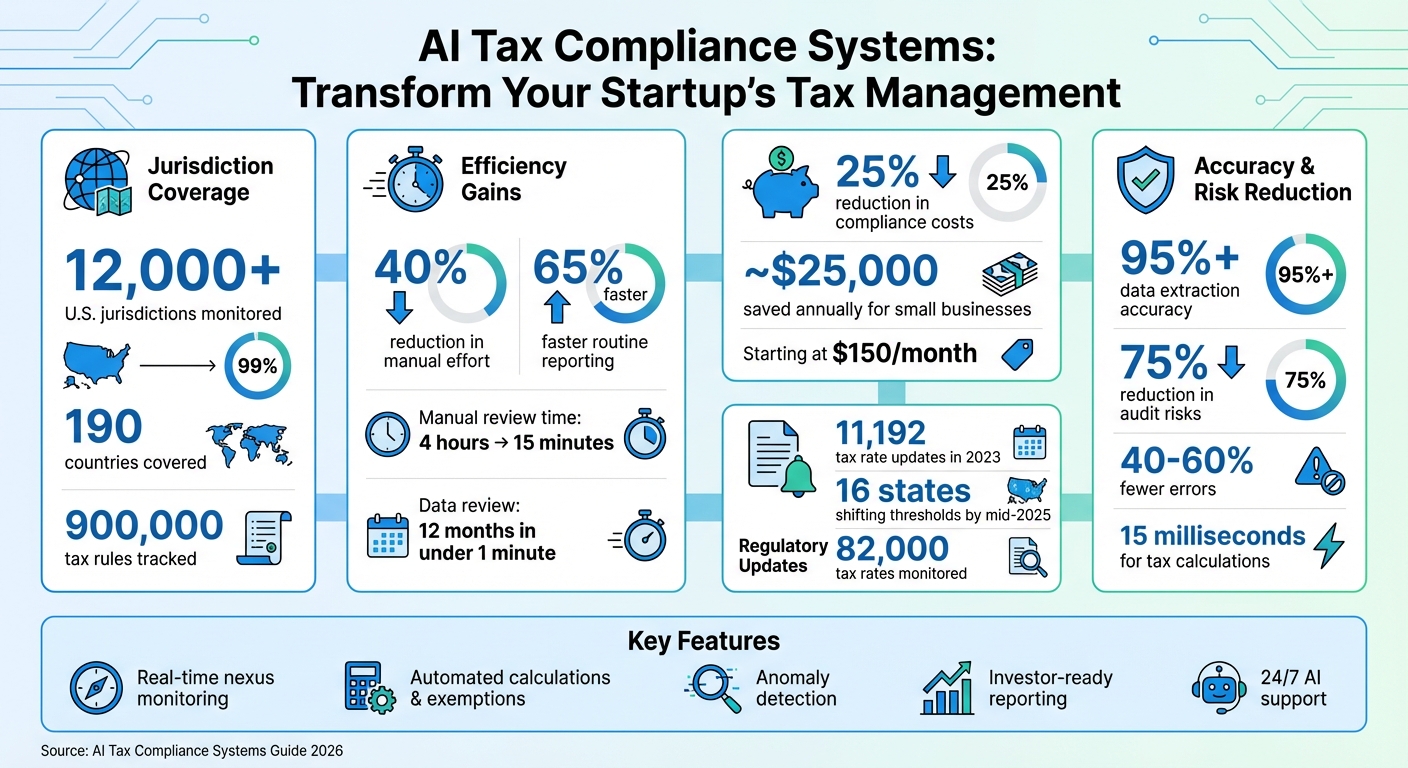
AI Tax Compliance Systems: Key Benefits and ROI Statistics for Startups
Webinar: Reinventing tax compliance: The AI boom and how to put it to work
sbb-itb-17e8ec9
Core Features of AI Tax Compliance Systems
Modern AI tax platforms keep tabs on compliance across more than 12,000 U.S. jurisdictions by seamlessly integrating with order management systems, payment processors, and shipping carriers. These systems track revenue and transaction counts in real time, sending alerts as you approach critical economic nexus thresholds. For instance, if you hit 75% of a state's limit, you'll be notified, giving you enough time to register before obligations take effect.
In addition to monitoring revenue, these platforms also track physical nexus triggers - like remote employee locations or inventory storage - ensuring nothing slips through the cracks. They adjust to constant changes, such as the 11,192 tax rate updates in 2023 and the shift in 16 states from transaction-based to revenue-based thresholds expected by mid-2025. A practical example? In early 2026, a mid-sized e-commerce retailer in the health and wellness space used an AI-powered nexus detection system to uncover four additional states where economic nexus had been triggered. This proactive approach not only allowed them to register on time but also cut manual review time by 60%.
These platforms don’t stop at monitoring - they also handle tax calculations and exemption validations with precision.
Automated Tax Calculations and Exemption Validation
AI tax systems go beyond just monitoring; they deliver highly accurate tax calculations. By analyzing product descriptions and pinpointing customer locations through zip codes, they assign the correct tax rates at checkout - all in as little as 15 milliseconds. On top of that, they streamline exemption certificate management by digitizing, validating, and securely storing certificates. This ensures every exempt sale is properly documented and ready for audits. Some platforms even extend their reach globally, covering 190 countries, 900,000 tax rules, and 82,000 tax rates.
Anomaly Detection and Risk Assessment
Another standout feature is anomaly detection, which protects compliance by identifying irregularities. AI learns normal transaction patterns and flags anything unusual, like miscoded subscriptions or unexpected expense spikes. This process slashes manual review time from four hours to just 15 minutes per client, and it can review 12 months of data in under a minute. It also validates documentation by identifying vendor payments that exceed 1099-NEC thresholds when no W-9 is on file. The system then creates a digital paper trail, linking flagged issues to source documents like receipts, invoices, and bank records, ensuring audit readiness.
"Compliance should be touchless by default, manual by exception. This isn't just automation; it's a fundamental reimagining of the tax function."
- Ray Grove, Head of Product, Corporate Tax and Trade, Thomson Reuters
With these capabilities, startups can stay compliant without breaking a sweat, freeing up time and resources to focus on growth while minimizing financial and operational risks.
How to Implement AI Tax Compliance for Startups
Switching to AI tax compliance can transform how startups handle taxes, moving from chaotic spreadsheets to a streamlined, automated process in just weeks. With the right steps, you can set up a system that saves time, reduces errors, and adapts as your business grows. Here's how to get started.
Preparing Your Data for AI Integration
AI systems thrive on clean, organized data. Start by gathering all your transaction records, payment data, and shipment logs from platforms like your accounting software, payment processors (e.g., Stripe), or order management tools. The goal is to consolidate everything into a single, standardized format to avoid manual data entry and sync discrepancies.
Once your data is collected, clean it up. Look for duplicates, missing vendor details, or incorrectly categorized transactions. While AI systems can extract data from tax forms with over 95% accuracy, they perform best when the input data is consistent and well-structured. During this phase, set up confidence scores to help the system process high-confidence matches automatically while flagging uncertain entries for review. This way, you reduce manual work without compromising accuracy.
Deploying and Customizing AI Systems
After organizing your data, it’s time to deploy and tailor your AI system to fit your startup's needs. Start by defining clear goals - maybe you want to cut data entry time by 30% or boost the number of returns processed by 25%. AI systems are highly adaptable, allowing you to simulate different business scenarios and predict tax outcomes.
Begin with high-priority document types, such as W-2s or 1099s, before expanding to more complex tasks like processing bank statements or running comprehensive compliance checks. For startups with multiple entities, ensure the system tracks each entity’s tax obligations separately. You can also automate workflows to assign tasks based on complexity, notify team members of their responsibilities, and send automated status updates.
Roles should be clearly defined: admins manage data uploads, preparers handle reviews, and managers oversee overall performance. Once deployed, continuous monitoring ensures the system evolves alongside your business and keeps up with changes in tax regulations.
Monitoring and Optimizing AI Performance
To keep your AI tax compliance system effective, regular monitoring is essential. Set it up to scan IRS and state agency databases in real time, so the system stays updated with the latest tax codes without manual updates. Track performance metrics to ensure you’re hitting your goals - AI can save 75% to 90% of the time spent on routine tasks and reduce errors by 40% to 60%. If results fall short, review flagged transactions to refine how the AI learns your business operations.
Even with AI handling much of the heavy lifting, human oversight remains critical. Regularly review flagged discrepancies and verify the system’s assessments to ensure compliance and accuracy. Over time, as the system learns your startup’s transaction patterns, its categorization and efficiency will improve. Periodic adjustments and reviews will keep the system running smoothly, allowing you to focus on growing your business without the stress of tax challenges.
Benefits and Use Cases of AI Tax Compliance
AI doesn't just make tax compliance easier - it transforms how businesses handle financial management by improving efficiency, reducing risks, and building investor confidence. Startups embracing AI-powered tools often see noticeable gains in accuracy, speed, and adherence to regulations.
Efficiency and Time Savings
AI takes over time-consuming bookkeeping tasks like categorizing transactions, reconciling accounts, and estimating taxes. This automation slashes manual effort and reduces errors, offering instant insights into key metrics like burn rate, runway, and cash flow - no more waiting for manual calculations to catch up.
Essentially, bookkeeping and tax preparation become tasks that run quietly in the background. Aviv Farhi, Founder and CEO of Showcase, shared:
"Managing my finances has become much easier with this platform. It's user-friendly and efficient, saving me a lot of time and effort."
By integrating with accounting and payment platforms, AI tools automatically gather and organize financial data. This seamless process allows founders to focus more on growing their business and less on administrative headaches. The automation also strengthens compliance and risk management practices.
Compliance and Risk Mitigation
AI systems use real-time analytics to stay ahead of compliance risks. They continuously update tax rules by scanning IRS and state agency databases, applying changes directly to filing templates without requiring manual updates. These systems monitor for new thresholds, deductions, or filing requirements, ensuring businesses are always prepared. Alerts about tax changes shift management from a last-minute scramble to a proactive, year-round approach.
Advanced anomaly detection tools analyze thousands of transactions to flag issues like duplicate invoices, mismatched figures, or unusual vendor activity before they escalate into audit concerns. Every number on a tax return is backed by a digital trail of receipts, invoices, and payment confirmations, making audits smoother and reducing the risk of penalties.
Investor-Ready Reporting
AI tax systems go beyond operational tasks by enhancing transparency - something investors highly value. Automated reports tailored for investors showcase financial discipline and readiness. Instead of manually compiling data, AI generates detailed, polished reports that meet investor expectations. Luka Mutinda, Founder and CEO of Dukapaq, noted:
"As our company grows, budgeting and cash flow management have become crucial. The features provided are essential and have greatly streamlined these processes for us."
Whether it’s U.S.-specific filings or cross-border requirements, AI-generated reports demonstrate the kind of operational precision that attracts investor confidence during funding rounds.
Why Choose Lucid Financials for AI Tax Compliance

Lucid Financials' All-in-One Financial Platform
Lucid Financials brings together bookkeeping, tax services, CFO support, and R&D credit optimization under one roof, designed specifically for startups. With everything in one place, you can manage accounting, tax filings, and financial planning seamlessly. The platform promises clean, organized books in just seven days, along with investor-ready financial reports.
This integrated system eliminates the messy, disconnected workflows that many startups struggle with. By running tax compliance on the same up-to-date financial data that powers your CFO dashboards, it reduces errors and ensures consistency across all filings. Giorgio Riccio, Founder of Lumino Technologies, shared his experience during a VC meeting:
"Just want to say props to the whole Lucid team. We pulled up the Lucid platform in a meeting with a VC and they were extremely impressed. His jaw just about dropped when he saw October was even up to date."
The platform's solid foundation is further strengthened by instant, AI-driven insights and support.
AI-Powered Insights and Real-Time Slack Support
Lucid takes accessibility to the next level by integrating with Slack, offering 24/7 AI support for tax questions, compliance concerns, and financial insights. Wondering if you've triggered nexus in a new state? Ask in Slack. Curious about how hiring a new employee impacts your burn rate? The AI provides instant answers, saving you the hassle of switching between tools.
The platform's AI is constantly monitoring compliance risks, proactively alerting you to nexus thresholds, filing deadlines, and potential issues before they escalate. These alerts are delivered directly via Slack, ensuring you stay informed in real time. Plus, Lucid's finance team is available to back up the AI, combining the speed of automation with the reassurance of human expertise.
Transparent Pricing for Startups
Lucid Financials keeps things simple with flat-rate pricing tailored to startup budgets. Here’s what’s included:
- Bookkeeping: $150/month
- Tax essentials: $150/month
- CFO services: $150/month
For R&D tax credits, there’s no upfront cost - you only pay if the credits are successfully obtained. Additional filings, like multi-state returns, are priced transparently at $25 per state, while forms like FBAR or foreign shareholder filings cost $42 each. No hidden fees, no surprises.
Best Practices for Adopting AI Tax Compliance Systems in 2026
To get the most out of AI-driven tax compliance, it's essential to stick to rigorous practices during deployment.
Data Governance and Security
Protecting your financial data should be a top priority. Use end-to-end encryption like AES-256 for data at rest and TLS 1.3 for data in transit. Isolate your data with tools such as AWS Virtual Private Cloud and adopt a zero-trust architecture to ensure strict access controls.
Make sure your AI vendor meets high security standards, such as SOC 2 Type II or ISO 27001 certifications, and complies with the FTC Safeguards Rule. Insist on clear policies regarding data residency, especially for compliance with GDPR and CCPA. To safeguard sensitive data, use "zero-retention" APIs or private AI models that avoid using your data for public training.
For transparency, maintain immutable audit trails using technologies like AWS QLDB or Azure Immutable Blob. These tools log every data access, API call, and compute task. Strengthen security by requiring multi-factor authentication (MFA) for all users accessing sensitive systems. Conduct annual penetration testing on your AI systems, especially before tax season, to identify vulnerabilities.
Human-in-the-Loop Reviews
While AI can handle a large portion of payroll and tax data, human oversight is critical for making final decisions on complex issues. Set a 90% confidence threshold for AI outputs - any transaction falling below this should be flagged for human review through platforms like Slack.
Reserve human input for intricate matters such as R&D credit eligibility, cross-border transfer pricing, or nuanced tax interpretations. As Dominic Vitucci, CEO of Onshore, wisely notes:
"If your system can't prove where a number came from, you'll be the one explaining it to auditors".
Before submission, always cross-check AI-generated tax returns against third-party data, such as 1099s and W-2s, to avoid triggering IRS audits. With audit rates for individuals earning over $10 million expected to hit 16.5% by 2026 - and large corporations facing rates as high as 22.6% - having defensible documentation supported by human oversight is essential.
Integration with Existing Tools
Once your AI tax compliance system is secure, ensure it integrates seamlessly with your current tools for real-time financial accuracy. Use API-first connectivity to link your AI system with platforms like Slack, ERP systems, and regulatory gateways such as EDGAR or HMRC MTD. Pull data from bank feeds using services like Plaid or Tink, and standardize it with ISO 20022 for consistency.
Translate General Ledger data into formats like XBRL, iXBRL, or SAF-T to meet jurisdiction-specific filing requirements. Automate workflows to assign tax returns based on complexity and route completed work to human review queues via Slack. Real-time syncing with accounting software and payment platforms ensures automatic reconciliation of financial data and accurate transaction classification.
Follow a structured 7-day sprint for implementation, covering steps like scoping, data mapping, sandbox testing, rule configuration, template creation, dry runs, and go-live. Continuously monitor vendor SOC 2 compliance using tools such as Drata or Vanta. Stay alert for model drift, which can occur if vendor naming conventions or your chart of accounts change, potentially affecting AI accuracy.
Conclusion
AI tax compliance systems have transitioned from being optional tools to becoming a core necessity for startups navigating the intricate regulatory environment of 2026. These systems can slash routine reporting time by as much as 65%, lower audit risks by up to 75%, and save small businesses approximately $25,000 annually. Such automation has become a cornerstone for efficiency and cost savings in 2026.
Beyond these operational benefits, advanced AI is now reshaping broader business strategies, influencing areas like pricing, cash flow management, and supply chain optimization. As Holger Mueller from Constellation Research points out, tax automation is a "sweet spot" for generative AI because of its practicality and the significant business value it delivers. These tools are no longer limited to back-office functions - they're now integral to strategic decision-making.
Lucid Financials brings together bookkeeping, tax compliance, R&D credits, and CFO support into a unified, intelligent platform. It offers real-time insights and investor-ready reports in just days. With Slack-integrated support and clean books delivered within seven days, Lucid Financials allows founders to concentrate on scaling their businesses. Starting at $150/month, it provides straightforward pricing designed for rapidly growing companies.
To thrive in 2026, startups need to strike the right balance between automation and human oversight while ensuring smooth integration with existing systems like ERPs and payment platforms. Those who embrace AI-first compliance strategies now will be better prepared to tackle the complexities of multi-jurisdiction tax requirements as they expand. This guide highlights how AI-driven tax compliance isn't just about operational efficiency - it's a strategic tool for fueling startup growth.
FAQs
Will AI tax compliance replace my CPA?
AI-powered tax compliance systems bring greater precision and speed to the process by automating tasks such as data extraction and generating reports. That said, these systems don't eliminate the need for CPAs. Professionals still play a crucial role by offering expert judgment, nuanced insights, and tailored advice for complex tax scenarios.
What AI does is work alongside CPAs, taking over repetitive tasks so accountants can dedicate their time to more strategic responsibilities, like advising clients and ensuring compliance with ever-changing regulations. The combination of AI and CPA expertise results in a more streamlined and effective way to manage taxes.
How do these systems detect nexus before I owe tax?
AI-driven tax compliance tools leverage machine learning to sift through data and keep tabs on critical factors such as physical presence, economic activity, transaction volumes, and sales. These systems pinpoint state-specific thresholds and flag possible nexus points early, enabling businesses to stay on top of their tax responsibilities.
What data do I need to set up AI tax compliance fast?
To get AI tax compliance up and running quickly, start by collecting all your financial data. This includes income statements, balance sheets, cash flow records, tax filings, payroll information, and sales tax details. Make sure everything is accurate and up-to-date.
Next, connect your banking information, payment systems, and accounting software. This integration enables real-time data access, which is critical for the AI to function smoothly. When your financial data is well-organized and current, AI systems can handle compliance tasks more effectively, ensuring your startup meets federal, state, and local tax obligations.