AI is transforming financial reporting by converting raw data into clear, actionable insights. Instead of spending hours analyzing spreadsheets, businesses can now use AI tools to generate automated narratives, detect anomalies, and provide real-time updates. These tools improve reporting speed, accuracy, and decision-making.
Key Takeaways:
- Time Savings: AI reduces report preparation time by up to 90%.
- Real-Time Insights: Platforms like Lucid Financials offer live updates via tools like Slack.
- Better Decision-Making: Predictive analytics and scenario modeling help explore "what-if" scenarios.
- Accuracy Matters: Clean, updated data is essential for reliable AI outputs.
- Human Oversight: AI-generated insights require validation to ensure compliance and transparency.
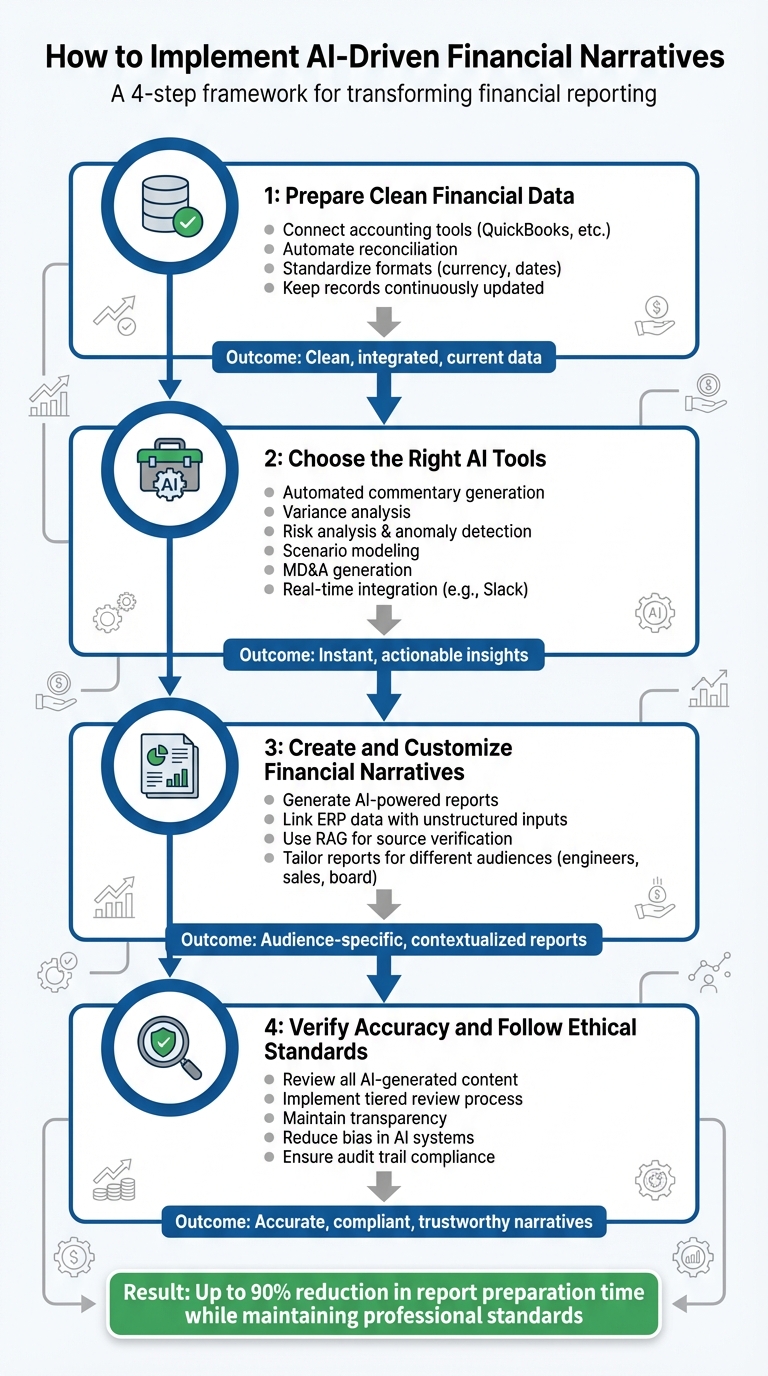
4-Step Process for Implementing AI-Driven Financial Narratives
Creating an AI Agent for Financial Report Analysis
Step 1: Prepare Clean Financial Data
If your financial data is messy, incomplete, or outdated, AI won’t be able to generate reliable narratives. As KPMG puts it, generative AI is "only as good as the underlying data and well-engineered prompts".
Clean and Integrate Your Data
Start by connecting your accounting tools - like QuickBooks - to an AI platform that automates reconciliation. These platforms can automatically pull in transactions, flag unusual figures, and normalize data from various sources to ensure consistency. AI plays a critical role here by spotting patterns, identifying outliers, and uncovering hidden relationships within your consolidated data.
For US-based startups, standardizing your data is key. Use formats like "$1,234,567.89" for currency and "03/05/2026" for dates, ensuring commas separate thousands and periods mark decimals. This level of standardization prevents errors during processing and ensures AI interprets your financial data correctly.
Tools like Lucid Financials can streamline this process. They integrate with platforms such as Slack for real-time reconciliation, combining AI with expert oversight to clean and standardize data from multiple sources. The result? Investor-ready, reconciled financials delivered in just seven days.
Once your data is clean and integrated, it’s important to keep it updated for continuous accuracy.
Keep Your Records Current
Cleaning your data once isn’t enough - your records need to stay current for effective real-time AI analysis. Up-to-date financials enable dynamic narratives, like live updates for investors or scenario modeling. On the other hand, stale data leads to outdated insights, which can derail decision-making.
The future of financial reporting is moving toward live investor dashboards that provide constantly evolving narratives. But this only works if your financial records are updated continuously, not just at the end of each month.
Step 2: Choose the Right AI Tools
Selecting the right platform can make a world of difference in simplifying financial reporting. The ideal tool should handle tasks like automating commentary, flagging discrepancies, and providing live insights, all tailored to your specific needs.
Key AI Features to Consider
When evaluating tools, prioritize those offering automated commentary generation. For instance, the AI should be able to explain why revenue dropped 12% in Q2 or why marketing expenses increased by $18,500 last month. Variance analysis is another must-have - it compares actual performance against budgets and provides instant explanations, saving hours of manual effort. Tools equipped with risk analysis can identify anomalies, such as unusual spending patterns, before they escalate into major issues. Features like scenario modeling allow you to explore "what-if" situations, such as the financial impact of hiring three engineers next quarter, by translating raw data into clear, actionable narratives.
For a comprehensive approach, consider platforms with MD&A (Management's Discussion and Analysis) generation. This feature creates structured narratives summarizing financial performance, which is invaluable for investor updates. Anomaly detection is equally critical, as it highlights outliers in your data, ensuring you're not caught off guard by unexpected variances. Finally, tools with explainability features help you understand how the AI arrived at its conclusions, adding transparency and trust to the process.
These capabilities ensure your financial insights are not only immediate but also practical, paving the way for real-time reporting and decision-making.
Get Instant Answers Through Slack
Beyond robust AI features, integrating real-time communication can elevate your financial management. For startups, instant answers can replace the need for lengthy monthly reports. Imagine asking, "What's our current runway?" and getting an immediate response. Lucid Financials integrates seamlessly with Slack, allowing you to access financial data through conversational AI. You can ask questions like, "What’s our Q3 revenue projection?" and receive instant updates such as, "Projected revenue is $2,500,000, up 20% year-over-year."
This Slack-based setup combines AI automation with expert oversight, ensuring both speed and accuracy. With Lucid Financials, you get real-time, investor-ready updates and CFO-level insights without needing to leave your Slack workspace. It turns financial data into a strategic advantage, keeping you informed and prepared.
While AI can significantly enhance efficiency, always double-check its outputs to ensure accuracy and maintain ethical reporting standards.
Step 3: Create and Customize Financial Narratives
After choosing the right AI tools, it’s time to turn your spreadsheets into clear, actionable stories. AI shines at bridging the gap between raw numbers and meaningful context, making it easier for stakeholders to grasp key insights and take action. Here's how AI can transform your data into tailored reports and adjust them to suit different audiences.
Generate AI-Powered Reports
AI doesn’t just crunch numbers - it connects the dots. By linking ERP data with unstructured inputs like emails, Slack messages, or CRM entries, it can explain financial trends in a way that makes sense. For instance, if your revenue jumped by $450,000 in Q4, AI can pinpoint the increase to a specific enterprise deal in Salesforce, complete with details like the date and customer name.
This automated context generation goes beyond surface-level insights. It identifies key metrics, uncovers trends, flags unusual patterns, and highlights risks - like rising customer churn - offering fresh perspectives on your financial data.
Using Retrieval-Augmented Generation (RAG) ensures that AI-generated insights are grounded in your uploaded financial documents. Each claim can be traced back to its source, such as a link to the relevant General Ledger lines, allowing you to instantly verify the accuracy of the information.
Tailor Reports for Your Audience
Once you have clean data and precise AI outputs, the next step is tailoring reports to suit different stakeholders. AI doesn’t just generate detailed reports - it helps you craft narratives that align with what each audience cares about most.
For example, an engineering manager might need a detailed breakdown of cloud spending by service and infrastructure costs. Meanwhile, a sales leader would benefit from insights into Customer Acquisition Cost (CAC) trends, travel and entertainment expenses tied to close rates, and overall pipeline health.
For board meetings, focus on the big picture: strategic risks, high-level performance trends, and summaries like Management's Discussion and Analysis (MD&A). AI-generated reports can even be refined into polished presentations, complete with updated slides and commentary. Tools like Lucid Financials take this further by producing investor-ready reports with a single click, ensuring your narratives align with fundraising and due diligence needs.
Your role in this process evolves into that of an "Output Auditor." This means reviewing AI-generated narratives to ensure they’re accurate, appropriately toned, and strategically aligned. By adding human context - for example, clarifying that a spike in spending was a strategic investment rather than overspending - you combine AI’s efficiency with your insight, creating reports that resonate with every audience.
sbb-itb-17e8ec9
Step 4: Verify Accuracy and Follow Ethical Standards
Review AI-Generated Content
AI tools are powerful but not infallible. Their outputs are based on probabilities, meaning they require validation by trained analysts using source data. Treat every AI-generated report or narrative as a draft until it has been thoroughly reviewed and confirmed against your financial records, such as those in your ERP system. While AI can speed up analysis, it cannot replace the accountability and judgment that human oversight provides.
Consider this real-world scenario: In March 2025, a finance team used AI to analyze a complex revenue contract under ASC 606. The AI misclassified certain performance obligations, resulting in an overly aggressive revenue recognition schedule. A human review caught these errors, enabling the team to adjust the schedule and ensure compliance. This case underscores why high-stakes outputs - like financial reports, forecasts, or investor-facing materials - demand stricter validation than lower-risk summaries or internal overviews.
"The probabilistic nature of AI tools calls for a structured, human-led review process to validate outputs and enhance their reliability for business purposes." – PwC
Adopt a tiered review process based on the level of risk. For critical materials like board presentations or fundraising documents, cross-check every figure with your General Ledger. For less critical tasks, such as internal variance analyses, a lighter review may be sufficient. Document your AI workflows to ensure auditability and refine them over time. Tracking common errors - such as misinterpreting year-over-year figures - can help improve both AI performance and human oversight.
Once the outputs have been validated, focus on ensuring transparency and reducing bias in the underlying processes.
Maintain Transparency and Reduce Bias
Validation is just one part of the equation. Equally important is ensuring that AI processes are transparent and free from bias. Financial AI systems can sometimes inherit biases from outdated standards or specific industry practices. For example, AI trained on traditional software companies using "perpetual license" models may flag SaaS companies as risky due to their higher deferred revenue - a misjudgment rooted in the AI's training data.
To address these issues, standardize AI settings and workflows across your organization. Use consistent model versions and maintain a library of approved prompt structures to avoid discrepancies in AI responses. Additionally, steer clear of rigid thresholds that could unfairly penalize industries with inherently longer collection cycles.
"Transparency about potential bias is essential for building trust in AI systems." – Transparently.ai
Expand your Internal Control over Financial Reporting (ICFR) frameworks to include controls for the data completeness and accuracy of external datasets used in AI models. If you're relying on third-party SaaS tools with embedded AI, request detailed documentation about their training data and validation methods. Keep in mind that standard SOC 1 reports often overlook AI-specific risks. Your responsibility is to ensure that every AI-generated narrative aligns with disclosure, fiduciary, and audit standards, such as those outlined by Sarbanes-Oxley (SOX). Maintain a clear audit trail that tracks the origin and transformation of all data used.
Use Financial Narratives in Investor Reports
Once you've refined your AI-generated financial narratives, it's time to put them to work in your investor communications. These narratives, when paired with visual data and live updates, can transform investor reports into powerful tools for strategic fundraising. Let’s break down how combining these elements can elevate your investor materials.
Pair Narratives with Visual Data
Combining AI-generated narratives with visual data can make complex financial information easier for investors to grasp. For example, use line graphs to illustrate revenue trends over time and bar charts to compare margins across different business segments. The key is selecting the right chart type to complement your narrative.
Modern AI tools can even recommend the most suitable visualizations for your data. Oracle's GenAI, for instance, integrates narratives with grids that compare "Actual vs. Plan" scenarios, automatically highlighting trends and anomalies in an investor-friendly format. Imagine a narrative like this: "Q3 revenue grew 25% YoY to $2.5M, driven by a 40% increase in user acquisition in Region X, though margins dipped to 15% due to scaling costs." Pair this with a dual-axis line chart that overlays revenue growth with margins and benchmark comparisons.
This approach not only simplifies information but also reduces cognitive load during investor presentations. AI tools excel at structuring data and detecting anomalies, allowing you to create charts that integrate overlays like industry benchmarks or forecast scenarios. These visuals, paired with narratives, set the stage for seamless real-time updates during fundraising discussions.
Provide Live Updates for Fundraising
Real-time updates can be a game-changer when it comes to investor interactions. Instead of scrambling to compile current metrics, tools like Lucid Financials allow you to deliver up-to-date financial data instantly. For example, during a Series A pitch, a founder could query Slack for "Latest MRR and churn" and receive an AI-generated response: "MRR hit $150K (+20% MoM), churn at 5%, below industry average, supporting a 24-month runway." This response could be paired with a live dashboard graph, enabling quick and informed Q&A during due diligence.
These live updates also enhance scenario planning. AI tools can generate comparative analyses, showing month-over-month variances and producing optimistic, base, and downside scenarios. This capability drastically reduces preparation time - from days to mere minutes - while fostering investor confidence with transparent, up-to-date insights. With tools like Lucid’s always-on reporting, startups can maintain clean financial records and generate board-ready materials in just one click, ensuring they’re always prepared for fundraising opportunities.
Conclusion
AI-driven narratives are reshaping how startups approach financial reporting by delivering clarity and speed. Founders can now produce investor-ready materials in minutes, cutting report preparation time by up to 90% while maintaining professional standards. These outputs are further refined through expert reviews, ensuring accuracy and context remain intact.
The technology behind these tools doesn't just speed up processes - it also enhances them. Automated systems quickly identify exceptions, explain causality, and provide draft commentary, while finance experts review the results to ensure everything aligns with ethical and professional expectations. This combination of automation and human oversight strikes a balance between efficiency and reliability.
Platforms tailored for startups, like Lucid Financials, take this a step further by integrating bookkeeping, tax services, and CFO support into one intelligent system. Features like real-time Slack integration allow founders to get instant answers to questions such as "What’s our current runway?" or "How does this month’s burn compare to last quarter?" With clean books delivered in just seven days and board-ready reports generated with a single click, these tools ensure startups stay prepared for any investor conversation.
Looking ahead, generative AI is advancing toward multimodal storytelling - blending narratives with visual data and even AI-generated video content. However, ensuring transparency, verifying AI-generated outputs against real data, and aligning messaging with a company’s unique voice remain critical. When done right, AI-powered financial narratives not only save time but also revolutionize how companies communicate with investors, board members, and other stakeholders.
The future of financial reporting isn’t about replacing finance teams with AI; it’s about empowering founders and financial professionals to work smarter and more confidently, so they can focus on what truly matters: growing their business.
FAQs
What data do I need before using AI for financial narratives?
Before diving into AI-driven financial storytelling, it's crucial to start with accurate, complete, and relevant data. Take the time to document the data's lifecycle - this helps you steer clear of compliance issues and ensures transparency. Validating your data is equally important, as it directly impacts the reliability of the AI's output. These steps lay the groundwork for creating financial narratives that are not only effective but also compliant and error-free.
How do I verify AI-generated financial commentary is accurate?
To ensure AI-generated financial commentary stays accurate, prioritize clarity, traceability, and thorough validation. Implement stress tests, run bias assessments, and compare outputs against reliable financial benchmarks to confirm accuracy. Keep detailed audit trails, regularly check for model drift, and leverage tools like Lucid Financials to receive real-time alerts and ensure compliance. Most importantly, human oversight remains critical - reviewing reports for subtle nuances and contextual accuracy is a step you can't skip.
How can I use AI narratives in investor updates without risking compliance?
You can integrate AI-generated narratives into investor updates by using tools designed to maintain accuracy and meet regulatory standards. Platforms such as Lucid Financials streamline reporting, offering precise data, real-time analytics, and tailored metrics that cater to investors' needs. To ensure compliance, include human oversight and conduct thorough compliance checks. This approach helps align your updates with SEC and GAAP standards, promoting transparency, precision, and credibility in your communications.