Key Points:
- Time Savings: Automates repetitive tasks, completing in minutes what used to take hours.
- Accuracy: Boosts compliance rates to over 99.5%, reducing costly errors.
- Scalability: Grows with your business, managing tax rules across states and worker types.
- Challenges: Requires accurate input data, human judgment for complex issues, and upfront costs.
Startups like Lucid Financials combine AI with expert support to balance efficiency and oversight, offering payroll, bookkeeping, and tax services for $150/month. The best approach blends automation with human expertise to ensure smooth operations as your business scales.
1. AI Payroll Systems
Operational Efficiency
Handling payroll manually can be a major time sink for startups. On average, small businesses dedicate over six hours each month to payroll tasks, with about one-third stating that it eats up more than 35% of their total HR workload. AI-powered payroll systems change the game by automating data entry - syncing employee information, hours worked, and pay updates seamlessly across platforms. What once took hours can now be done in minutes.
AI also flags potential issues, like unusual overtime patterns or duplicate bank accounts, before payroll is processed. This automation reduces manual HR tasks by 95% and cuts payroll adjustment needs by as much as 60%. Considering that each payroll error costs businesses an average of $291 - and that nearly half of employees start job hunting after experiencing just two errors - these systems deliver real value.
These time and cost savings pave the way for better compliance and scalable payroll solutions.
Compliance and Accuracy
Keeping up with U.S. employment laws is no small feat. Tax rates fluctuate, labor laws evolve, and nearly half of companies cite staying current as their biggest challenge. AI-powered payroll systems simplify this by continuously tracking changes in federal, state, and local regulations and applying updates automatically. Some platforms even open required tax accounts and manage quarterly filings as your team grows.
The accuracy improvements are impressive. While manual payroll processes have error rates ranging from 1% to 8%, automation boosts compliance accuracy to over 99.5%. This matters because more than a third of U.S. small businesses face payroll penalties annually, and over half have been penalized for non-compliance within the last five years. Advanced AI systems can even handle up to 80% of tax notices by directly communicating with government agencies, turning what used to be a weeks-long headache into a task handled quietly in the background.
This level of accuracy and compliance ensures a smoother payroll process with minimal human intervention.
Scalability and Human Oversight
AI payroll systems are designed to grow alongside your business. They can manage various worker types - whether they’re W-2 employees, 1099 contractors, or international team members - through a single, unified workflow. As your team expands into new states, the system automatically detects employee locations and applies the correct tax jurisdictions. This flexibility is crucial, especially as 78% of payroll staff are shifting their focus from repetitive tasks to strategic roles like compliance planning and data analysis.
By reducing the need for constant oversight, these systems let HR teams focus on higher-level tasks. Acting like a "central nervous system", AI integrates data from HR platforms, time-tracking tools, and benefits systems to ensure everything runs smoothly.
Michael Howe, CEO of NPD Powered, emphasizes this benefit: "Lyzr provides the platform for us to grow rapidly and not lose control."
sbb-itb-17e8ec9
From Manual Payroll to One-Click Automation: Globalli’s AI Journey
2. Lucid Financials
Lucid Financials takes the advantages of AI payroll systems and extends them into a comprehensive financial management platform designed specifically for startups.
Operational Efficiency
Lucid Financials combines AI automation with expert oversight to create a seamless financial management experience. By integrating tools like bookkeeping, tax filings, and CFO-level insights into one platform, it simplifies complex processes. The AI-driven system handles financial tasks at remarkable speed - up to 100 times faster - delivering clean and accurate books in just seven days. Founders gain access to real-time insights on burn rate and runway, eliminating delays often caused by month-end reporting. The platform also generates AI financial planning, including both best-case and worst-case scenarios, and allows for instant creation of board and investor updates, making decision-making faster and more efficient.
Aviv Farhi, Founder and CEO at Showcase, shares: "Managing my finances has become much easier with this platform. It's user-friendly and efficient, saving me significant time."
Compliance and Accuracy
Tax submissions, R&D tax credit optimizations, and other compliance tasks are fully automated within Lucid Financials, ensuring timely and accurate filings. Built with enterprise-grade security and aligned with SOC 2 compliance standards, the platform offers robust protection for sensitive financial data. To maintain accuracy, an expert team reviews all automated processes, proactively identifying and addressing potential issues.
Refael Shamir, Founder and CEO at Letos, remarks: "The platform saves us hours every month, and their expert team makes sure nothing slips through the cracks."
This combination of automation and expert review ensures a reliable compliance framework that adapts to your business's growth.
Scalability and Human Oversight
Lucid Financials is built to scale alongside your startup. Currently supporting 60,000 small businesses, the platform offers tools like AI-driven forecasting, runway tracking, and features tailored for growth, such as capital-raising support and financial scenario comparisons. To ensure continuous support, it provides 24/7/365 Slack access for instant AI insights and expert advice. All of this is available at a clear starting price of $150 per month.
Comparing Benefits and Risks
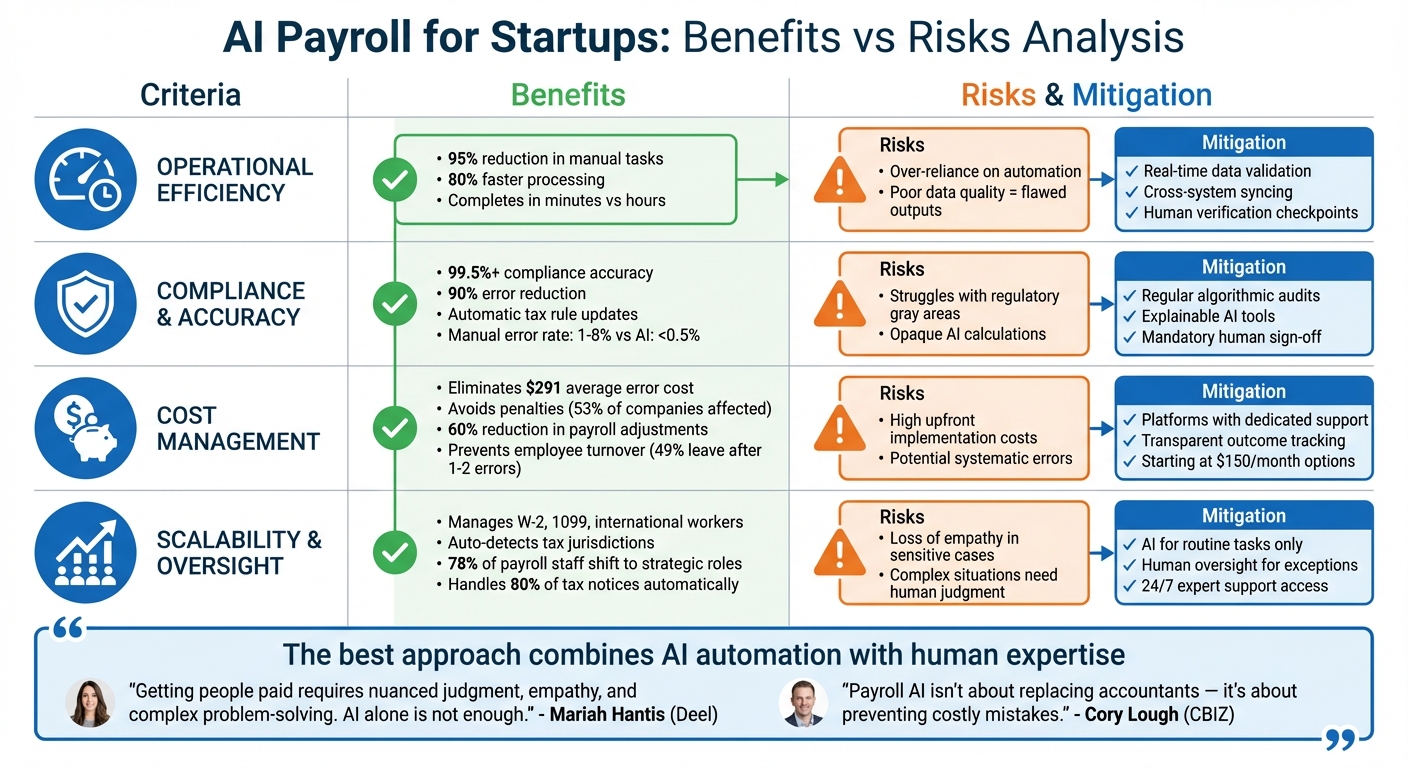
AI Payroll Benefits vs Risks: Complete Comparison for Startups
AI payroll systems bring impressive efficiency gains, but they also come with challenges that startups need to address for smooth implementation.
These systems can process payroll up to 80% faster and cut manual tasks by as much as 95%. However, their effectiveness depends heavily on the quality of the input data - bad data leads to bad results. While automation saves time, it’s critical to have accurate data. Using real-time data validation and ensuring synchronization across systems can help prevent errors.
Beyond speed and accuracy, compliance is another area where AI shines but also requires careful handling. Automated rule updates can reduce errors by 90% and compliance issues by around 70%. That said, complex situations often demand human judgment. Regular audits of algorithms and mandatory human checks are crucial. As Mariah Hantis, Senior Director of Global People Operations at Deel, explains:
Getting people paid requires nuanced judgment, empathy, and complex problem-solving. AI alone is not enough to handle such sensitive tasks without a human in the loop.
Cost savings are another big selling point. AI eliminates the average $291 cost per payroll error and helps avoid penalties that impact 53% of companies. However, startups must also consider the upfront costs of implementation and the ongoing need for human oversight. Manual payroll processes often have error rates between 1% and 8%, and payroll mistakes can be costly - not just financially but also in terms of employee trust. In fact, 49% of workers say they’d start looking for a new job after experiencing one or two payroll errors.
AI also supports scalability, allowing startups to grow their headcount without a matching increase in administrative burden. Routine tasks are automated, but humans are still needed to handle exceptions and ensure empathy in sensitive cases. As Cory Lough, Senior Solutions Consultant at CBIZ, puts it:
Payroll AI isn't about replacing accountants - it's about preventing the costly mistakes that keep them up at night.
| Criteria | Benefits of AI Payroll | Risks of AI Payroll | Mitigation Strategies |
|---|---|---|---|
| Operational Efficiency | 95% reduction in manual tasks; 80% faster processing | Over-reliance on automation; flawed outputs from poor data quality | Real-time data validation; cross-system syncing; human verification |
| Compliance & Accuracy | Automatic tax rule updates; 90% error reduction | Difficulty with regulatory gray areas; opaque calculations | Regular algorithmic audits; explainable AI tools; human sign-off |
| Cost Management | Eliminates error-fix costs; avoids common penalties | High upfront costs; potential systematic errors | Platforms with dedicated support; transparent outcomes |
| Scalability & Oversight | Manages growth without increasing headcount | Risk of losing empathy in sensitive cases | AI for routine tasks; human oversight for exceptions |
Balancing these benefits and challenges is essential for startups looking to integrate AI into their payroll processes effectively.
Conclusion
Balancing efficiency with accuracy is essential when it comes to payroll management. AI-powered payroll systems bring undeniable benefits: they can process payroll up to 80% faster, eliminate 95% of manual tasks, and reduce compliance issues by 70%. But while these systems excel at handling repetitive tasks, they aren't equipped to manage complex tax scenarios without human input.
The most effective solution combines AI automation with human expertise. For example, platforms like Lucid Financials integrate AI with professional oversight to manage bookkeeping, payroll, tax compliance, and even provide CFO-level insights. This hybrid approach allows AI to tackle routine tasks while experts step in for nuanced situations, such as managing R&D tax credits or navigating multi-state compliance challenges.
For startups, the priority should be finding a payroll solution that grows alongside their business without compromising accuracy. With plans starting at $150 per month, Lucid Financials offers features like real-time Slack support, investor-ready reports, and the assurance of having both cutting-edge technology and skilled finance professionals in your corner.
The future of payroll isn't about choosing between AI and human expertise - it’s about combining the strengths of both. By leveraging advanced AI alongside expert oversight, startups can simplify payroll complexities, maintain compliance, and redirect valuable resources toward innovation and growth.
FAQs
What data do I need to set up AI payroll correctly?
To get AI payroll up and running the right way, start by collecting accurate employee information. This includes federal and state tax details, wage rates, work locations, and how each worker is classified (like full-time, part-time, or contractor).
Make sure you also set up the necessary tax accounts and have a clear understanding of compliance requirements - especially if your business operates across multiple states. Having precise and complete data is crucial for smooth payroll processing and staying in line with regulations.
When should a human review AI payroll decisions?
A human touch is essential when reviewing AI-generated payroll decisions. This ensures accuracy, compliance, and helps catch potential errors. While AI can streamline processes, it’s not immune to mistakes, especially when anomalies or discrepancies arise. Regular human oversight not only safeguards against errors but also reinforces trust and reliability in payroll systems.
How do I estimate the total cost of AI payroll?
To get an idea of AI payroll costs, start by looking at the platform's pricing structure. Most platforms charge a monthly fee, often tied to your spending volume or the services you choose. For instance, a startup managing $20,000 in payroll might spend about $150 per month, though the actual cost can vary depending on the features you select. To get a clearer picture tailored to your business, consider using a pricing calculator or reaching out for a custom quote.