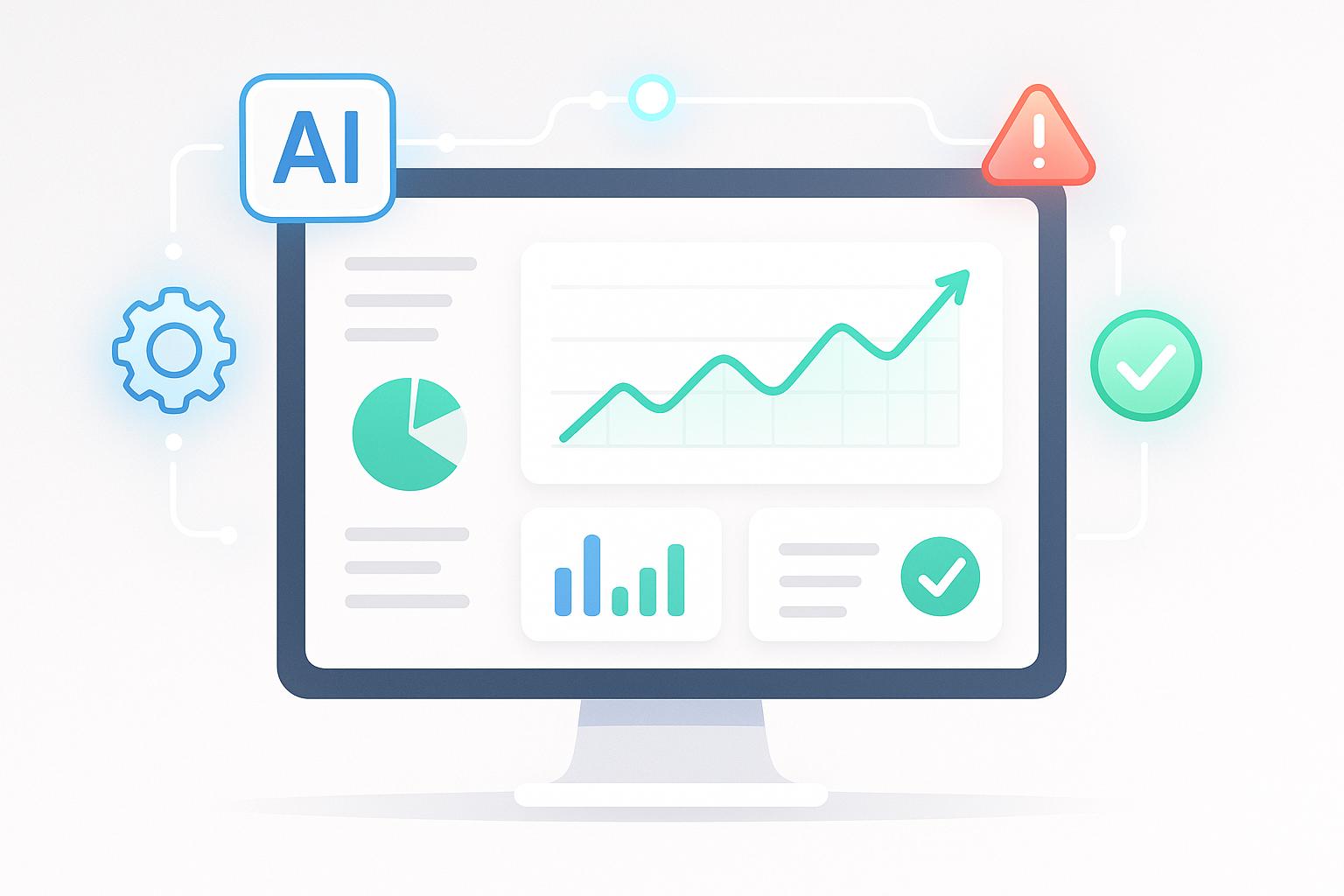
AI investor dashboards simplify financial management by automating data reporting, providing real-time insights, and offering tools to help founders make faster, informed decisions. These platforms replace outdated spreadsheets with dynamic systems that integrate financial data, predict trends, and create polished, investor-ready reports. Here's a quick rundown of the top features:
- Real-Time Data Updates: Syncs with bank accounts and tools to provide up-to-date metrics like burn rate and cash flow.
- Automated Forecasting: Uses AI to predict cash runway, revenue, and costs, allowing instant scenario analysis.
- Investor-Ready Reporting: Generates professional reports instantly, ensuring accurate and timely financials for meetings.
- Conversational AI: Answers natural language queries like "What's our runway?" directly within platforms like Slack.
- Customizable Dashboards: Tailors data views for team-specific needs, reducing information overload.
- Anomaly Detection: Flags unusual financial patterns or risks, helping prevent fraud or errors.
- Multi-Account Integration: Consolidates data from multiple accounts, including banks, crypto, and investments.
- Predictive Analytics: Runs "what-if" simulations and provides confidence ranges for better planning.
- Automated Workflows: Streamlines tasks like reconciliation and report generation, saving time and reducing errors.
- Clear Pricing & Scalability: Affordable options starting at $150/month, with tools that grow alongside your business.
Quick Comparison:
| Feature | Example Benefit |
|---|---|
| Real-Time Data | Always-current financial metrics for fast decision-making |
| Automated Forecasting | Instant cash runway and scenario modeling |
| Investor-Ready Reports | Polished financials ready for due diligence |
| Conversational AI | Quick answers to financial questions via Slack |
| Custom Dashboards | Tailored insights for specific teams |
| Anomaly Detection | Early fraud or error detection |
| Multi-Account Sync | Unified view of all accounts and assets |
| Predictive Analytics | Anticipates trends with confidence ranges |
| Automated Workflows | Reduces manual work and speeds up processes |
| Clear Pricing | Starts at $150/month with scalable options |
These dashboards empower startups to stay ahead of financial challenges, impress investors, and focus on growth.
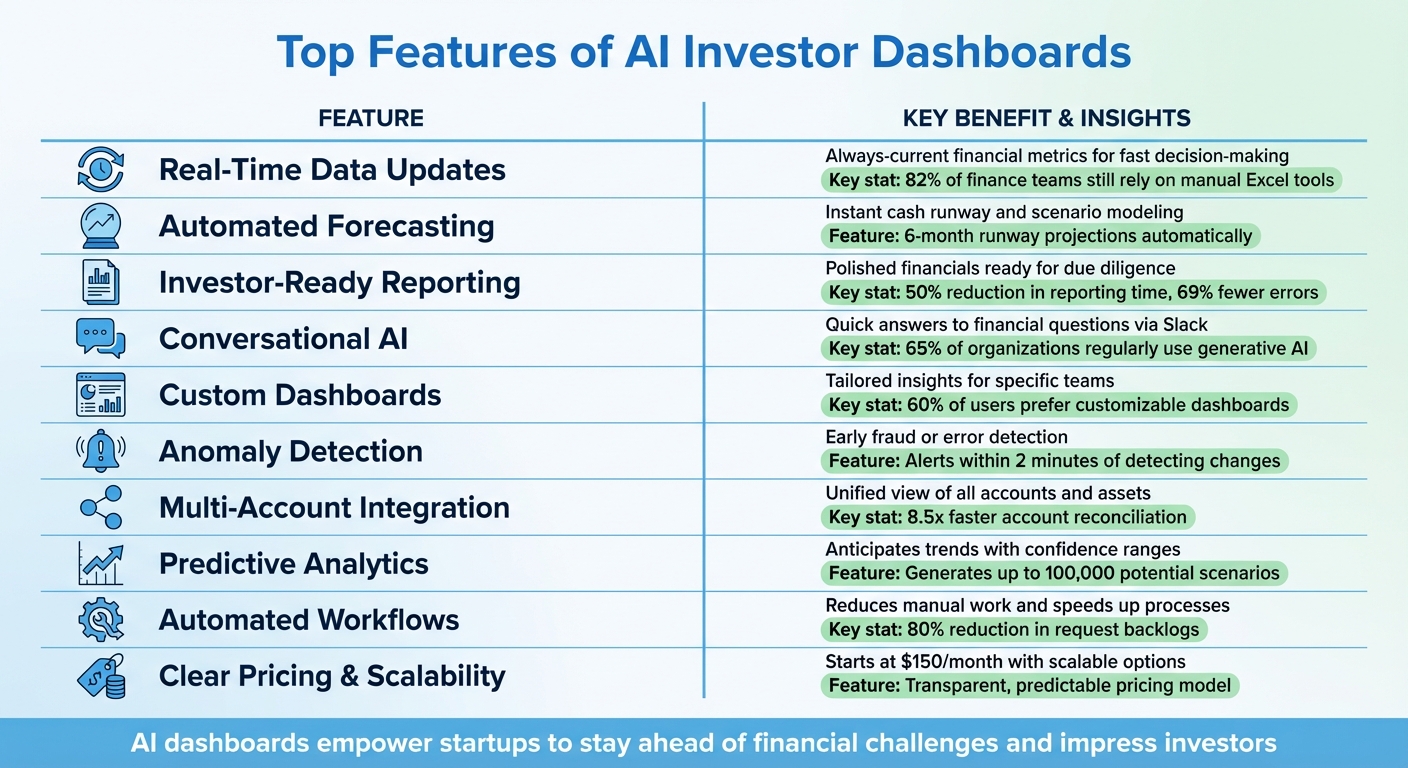
Top 10 AI Investor Dashboard Features Comparison Chart
3 Days of Reporting to 30 Minutes With AI Dashboards
sbb-itb-17e8ec9
1. Real-Time Data Updates
Real-time data updates bridge the gap between financial events and the moment you see them reflected in your reports. Instead of waiting until the end of the month to notice spending surges or revenue drops, AI dashboards continuously pull fresh data from your bank accounts, payment processors, and accounting tools. This means your cash balance, burn rate, and other key metrics always reflect the latest activity.
This shift has a big impact on decision-making. Consider this: 82% of finance teams still rely on manual tools like Excel, which often leads to delayed insights. AI-powered dashboards change that by instantly spotting bottlenecks, revenue trends, and cost patterns. Whether you're gearing up for an investor meeting or deciding on new hires, this real-time visibility allows you to answer critical questions without scrambling to update spreadsheets. The ability to act quickly gives founders and teams a significant edge.
"AI doesn't just make data more accessible; it reveals deeper insights that everyone on your team can understand and act on swiftly."
– Dustin W. Stout, Founder, Magai
By integrating data in real-time, these dashboards create a single source of truth for everyone involved - investors, board members, and internal teams alike. And since data accuracy can degrade by up to 3% each month, continuous updates ensure your financial information stays reliable and actionable.
For startups using platforms like Lucid Financials, this real-time functionality keeps your books up-to-date, automatically reconciles transactions, and ensures reports are always ready for investor scrutiny.
2. Automated Forecasting and Insights
AI-powered dashboards take the hassle out of manual forecasting by analyzing historical data, seasonality, and market trends. Instead of spending hours wrestling with spreadsheets to create cash flow projections or revenue estimates, machine learning models handle the heavy lifting. These tools update forecasts automatically as new data flows in, giving you instant access to your 6-month runway projection or burn rate forecast without waiting for your finance team to crunch the numbers.
The core of this technology lies in predictive modeling and agentic AI, which generate forecasts on the fly. For example, AI-driven platforms can analyze transaction patterns and produce real-time risk scores, cutting detection time dramatically compared to traditional methods like writing SQL queries by hand.
One standout feature is the ability to run instant what-if scenarios. Curious about how hiring three new engineers next quarter might impact your runway? Or what a 20% boost in monthly recurring revenue could mean for your bottom line? These tools turn raw data into clear, actionable forecasts, allowing for rapid scenario analysis. This kind of flexibility enables you to adjust your strategies quickly and stay ahead of potential challenges.
These platforms don’t just help with planning - they also act as an early warning system. AI algorithms can spot unusual patterns, such as sudden cash flow drops or unexpected spending spikes, before they escalate into bigger problems. They flag these anomalies with detailed explanations, helping you understand the root cause. For founders, this means catching potential issues weeks earlier than traditional monthly reviews would allow.
Integrating these advanced tools into your workflow doesn’t just enhance forecasting - it transforms your overall financial management. Platforms like Lucid Financials make it even easier by integrating directly with tools like Slack. You can request runway projections, hiring plans, or scenario models and get AI-generated answers instantly. Plus, these outputs are reviewed by finance professionals for accuracy, ensuring both speed and reliability. By automating forecasts and insights, you can stay ahead of the curve and impress investors with proactive, data-driven financial planning.
3. Investor-Ready Reporting
When you're in the middle of a fundraising round or gearing up for a board meeting, the last thing you need is the hassle of compiling outdated financial reports. AI-powered dashboards take that burden off your plate by creating professional, investor-grade reports instantly. No more waiting on your finance team to finish spreadsheets or close out last month’s books. Traditional bookkeeping often runs weeks behind, leaving you with stale data when investors ask tough questions. With AI platforms, your financials stay up-to-date, allowing you to pull real-time performance metrics on the spot. This not only ensures accuracy but also strengthens investor confidence.
This real-time access goes beyond convenience - it establishes credibility. A great example? A founder recently wowed investors during a live meeting by instantly presenting fully updated financials for October. The reaction from the venture capitalist was unforgettable.
"We pulled up the Lucid platform in a meeting with a VC and they were extremely impressed. His jaw just about dropped when he saw October was even up to date." - Giorgio Riccio, Founder, Lumino Technologies
These dashboards don’t just stop at showing current numbers. They also provide powerful tools like scenario modeling and industry benchmarks. With just a few clicks, you get comparisons of best-case, worst-case, and actual performance, alongside key metrics like customer acquisition cost (CAC) and competitor insights. What used to take hours of analysis now happens instantly. This means you can confidently tackle investor questions like, "Why did churn increase last month?" - all without waiting on a data analyst or delaying the conversation.
AI tools make a real difference: they cut reporting time by 50% and reduce error rates by 69%, speeding up your fundraising process significantly. With always-on, investor-ready reporting, you’re prepared for anything - whether it’s an unexpected investor call, a due diligence request, or a last-minute board update. Platforms like Lucid Financials take it a step further with one-click board-ready reports and real-time runway tracking, ensuring your financials are polished and ready to go, whether you’re raising capital or managing growth.
4. Conversational AI Access
Conversational AI takes financial insights to the next level by making them accessible through simple, natural language queries. Instead of navigating complex systems or waiting on your finance team, you can just ask questions like, "What's our runway?" or "Why did churn spike last week?" and get immediate answers. This feature integrates seamlessly into your existing workflow, eliminating the need for separate platforms or time-consuming processes.
Currently, 65% of organizations regularly use generative AI, and founders increasingly demand answers as quickly as they can ask questions - not through lengthy ticket queues. Tools that integrate with platforms like Slack or Microsoft Teams make this possible. These AI dashboards interpret plain English questions and convert them into governed queries, pulling data directly from systems like ERP, CRM, or accounting platforms. The result? Instant, narrative-style insights delivered right where you work.
This technology opens up financial data to everyone, especially for non-technical users who might not have SQL expertise or dashboard training. Bill Lynch, Senior Director of Data Science & Analytics at NeuroFlow, highlighted the impact of these tools when his team adopted AI-driven natural language capabilities:
"We needed a tool that was personalized and fostered data literacy. We knew it would allow us to make business users partners and co-create alongside the data team."
The productivity gains are hard to ignore. AI assistance boosts worker productivity by an average of 14%, and 95% of decision-makers using AI report significant cost and time savings. For startups, this translates to fewer internal data requests, freeing up time for teams and enabling faster, more confident decisions.
Companies like Lucid Financials are pushing this concept even further. Their Slack integration allows users to ask questions about runway, spending, or performance and receive AI-powered answers instantly. And when needed, real experts are available to step in. This natural language interface brings clarity and speed to decision-making, making it easier than ever to stay on top of your financial data.
5. Customizable Dashboards and Visuals
Every team has its own data priorities. Finance teams might zero in on metrics like cash flow or P/E ratios, while operations teams need real-time KPI tracking and anomaly alerts. Customizable dashboards make it easy for users to fine-tune layouts and select specific metrics, ensuring that each role gets the data that matters most.
The most effective AI dashboards use Role-Based Access Control (RBAC) to tailor the experience for different teams. This means every group sees only the metrics relevant to their tasks, all pulled from the same unified data source. By reducing information overload, these dashboards help users focus on actionable insights. In fact, 60% of business users prefer dashboards they can customize themselves, and companies using interactive dashboards are 28% more likely to uncover timely insights.
Modern platforms make customization incredibly user-friendly. You can adjust visuals using plain English commands like "convert this to a bar chart" or "add a column for P/E ratio", eliminating the need for coding or SQL knowledge. Drag-and-drop tools allow users to pin key KPIs at the top, toggle between detailed views and simplified summaries, and even set conditional formatting to highlight metrics that fall outside target ranges. Some AI solutions go a step further, learning from your manual tweaks to refine future dashboard layouts automatically. These features seamlessly integrate with interactive tools, giving users even more control over their data.
Filters, drill-downs, and tooltips empower users to explore data independently, cutting out IT bottlenecks. For example, investors can set custom asset-allocation targets and receive alerts if any category deviates by more than 3%. Operations teams might use these tools to monitor fleet driver performance or identify supply chain issues in real time. As Telmo Silva explains:
"A dashboard is more than a collection of charts and numbers. It is a tool that empowers businesses to track key metrics, analyze trends, manage operations, and keep real-time insights at the heart of strategic decision-making."
Lucid Financials exemplifies this approach by offering dashboards tailored to specific industries like startups, e-commerce, and medical groups. Founders can quickly switch between best-case, worst-case, and actual performance scenarios, generating audience-specific reports for board members or investors with the most relevant data front and center.
6. Anomaly Detection and Alerts
AI-driven dashboards keep a constant eye on your financial data, using advanced algorithms like isolation forests and autoencoders to detect outliers without relying on predefined rules. By comparing historical trends with current activity, these systems can flag potential issues such as a 20% variance in cash flow, irregular transactions, or sudden spikes in expenses - indicators that might point to errors or even fraud.
These systems don't just detect problems; they act fast. For instance, platforms like Visualping can send alerts within two minutes of spotting changes, such as insider transactions or unusual market activity. These alerts often include AI-generated summaries and annotated screenshots that clearly show what has changed. This speed allows you to address errors before they escalate - whether that means fixing incorrect bookings before the quarter ends or tweaking portfolios to respond to market shifts. According to benchmarks from AI investment platforms, this kind of rapid response can reduce potential losses by 30–50%.
Today's anomaly detection tools are far more sophisticated than simple threshold-based systems. They include features like Options Block Monitors to track institutional options flows, tools for identifying large-scale trading patterns and shifts in market sentiment, and sentiment analysis systems that scan news and social media for changes in investor psychology. They can even automatically identify over 150 candlestick patterns, trendlines, and Fibonacci levels across different timeframes.
To cut through the noise and focus on real issues, these systems use agentic AI that explains flagged anomalies step by step. You can also customize thresholds and integrate alerts into platforms like Slack or Microsoft Teams, ensuring your team gets critical notifications without delay. This seamless system helps finance teams act quickly and make informed decisions.
Lucid Financials takes this a step further by pairing real-time monitoring with investor-ready reporting. With instant Slack alerts, you'll know about unexpected vendor charges or revenue anomalies before they become major issues. Whether you're preparing for a board meeting or addressing a sudden expense spike, you'll be equipped to handle it promptly.
7. Multi-Account Integration
Managing finances for a fast-growing company can get messy - quickly. With multiple bank accounts, retirement funds, cryptocurrency holdings, and alternative investments like real estate or private equity, keeping track of it all can feel overwhelming. AI-powered dashboards simplify this chaos by pulling together financial data into one unified view. No more logging into dozens of platforms just to get a clear picture of your cash position.
Secure, read-only APIs like Plaid and SnapTrade sync real-time data from banks, brokerages (e.g., Fidelity, Schwab), crypto platforms (like Coinbase), and even alternative assets. For documents that can't connect via API - such as loan notices or credit agreements - AI extraction tools handle the heavy lifting, pulling key figures without requiring manual entry. Advanced platforms also integrate with ERP systems like Oracle or QuickBooks, feeding monthly trial balance summaries directly into a central dashboard.
This level of integration isn’t just about convenience - it’s about speed and accuracy. AI finance platforms can reconcile accounts 8.5 times faster and close books 85% faster than manual methods. That efficiency becomes essential when dealing with complex entity structures like LLCs, trusts, or holding companies. Kyle Fritz, Founder & Managing Partner at Acropolis Capital Partners, shared his experience:
"I'd been searching the family office software market for years and finally found a platform that seems to have hit the nail on the head... It is some of the best if not the best software we've seen".
Beyond streamlining workflows, automation reduces costly errors. Manual data entry across multiple accounts often leads to mistakes that can snowball - especially during investor due diligence. With automated syncing, you gain a real-time snapshot of revenue, expenses, and tax obligations across all entities and locations, all while keeping payroll costs in check. This consolidated view not only speeds up internal processes but also ensures investor-ready reporting, which we’ll touch on later.
Platforms like Lucid Financials make this complexity manageable by connecting directly to your financial systems and delivering accurate, consolidated reports - even through Slack. Whether you’re handling three accounts or thirty entities, you’ll always have a clear, up-to-date view of your financials - ready for your next board meeting or investor presentation.
8. Predictive Analytics
Predictive analytics takes financial planning to the next level by offering a forward-focused approach. While historical data provides a foundation, predictive analytics transforms that information into actionable insights about the future. Instead of simply reacting to trends as they emerge, you can anticipate them and adjust your strategies ahead of time.
AI models process vast amounts of historical data - covering areas like sales, revenue, expenses, and project outcomes - to uncover complex relationships that traditional methods might miss. These tools don’t just analyze numbers; they reveal patterns and connections that manual methods often overlook.
One standout feature of predictive analytics is scenario analysis. With modern dashboards, you can run "what-if" simulations to test different scenarios, such as the effects of a 10% increase in costs or a sudden dip in market demand. AI-powered platforms can generate up to 100,000 potential scenarios, drawing insights from cash flow data and operational metrics from over 140,000 unique deals. Instead of a single projection, these tools present confidence ranges that help you better understand uncertainty and plan accordingly. As Daniel Damilare Ezekiel, an analytics expert, explains:
"This shift from data hindsight to data foresight is transformative for business decision-making".
This capability integrates smoothly with real-time insights from other dashboard features, enabling smarter, more informed decision-making.
The system also improves over time through adaptive learning. As more data becomes available, AI models refine their predictions, making forecasts increasingly accurate. Tools like Lucid Financials take this a step further, delivering real-time, investor-ready projections directly through platforms like Slack. Whether you're estimating next quarter’s burn rate or modeling long-term revenue growth, predictive analytics helps translate historical data into a strategic roadmap. It also ensures your reports meet the high standards stakeholders expect during board meetings or fundraising discussions.
To get started, focus on a specific use case with measurable outcomes, such as cash flow forecasting or demand prediction. High-quality data is crucial for accurate results. Pair quantitative forecasts with qualitative insights to ensure predictions align with real-world dynamics. Lastly, prioritize explainability - ensure your team understands the reasoning behind each prediction. This balance of clarity and precision makes predictive analytics a powerful tool for smarter financial planning.
9. Automated Workflows
Automated workflows take predictive insights to the next level, simplifying financial operations by handling tasks like data collection, reconciliation, and report generation. This allows finance teams to shift their focus from tedious manual work, like updating spreadsheets, to making strategic decisions. Plus, by automating processes such as transaction reconciliation, errors are significantly reduced.
Finance teams using AI-driven platforms have seen impressive results, including an 80% reduction in request backlogs and a 30% decrease in due diligence timelines.
"What used to be weeks, now takes minutes!" – Jennifer Leidich, Co-Founder & CEO of Mercury
But it’s not just about speed - automation also supports better decision-making. For instance, real-time anomaly detection can flag critical issues, such as a sudden dip in cash flow or pipeline velocity, so you can act immediately. AI tools can even create investor-ready reports by summarizing trends in straightforward language.
Integrations with tools like Slack make automation even more practical. Your dashboard can send automated weekly summaries, create CRM tasks when churn risks are identified, or respond to financial questions in real time. Lucid Financials showcases this with their real-time reporting capabilities, demonstrating how automation can streamline workflows across an organization.
To get the most out of automation, focus on a high-impact area first - like cash flow forecasting or expense reconciliation. This approach delivers quick returns on investment and creates momentum for expanding automation efforts. Starting with these priorities ensures that investor reporting stays accurate and timely while setting the foundation for broader scaling.
10. Clear Pricing and Scalability
When it comes to AI-powered investor dashboards, having transparent pricing is a must - especially for startups working with tight budgets. It helps founders keep a close eye on their burn rate and runway without any surprises.
These AI-driven tools can be surprisingly affordable, with pricing starting as low as $150 per month. This makes advanced financial tools accessible even for startups at the pre-seed stage. As your business grows - moving from basic bookkeeping to more advanced financial insights - the right platform should grow with you. This eliminates the need for juggling multiple subscriptions, offering a predictable pricing model that supports your business at every stage.
Scalability is just as crucial. Your dashboard needs to handle increasing amounts of data without slowing down. Many modern platforms are already built to support thousands of small businesses. The best tools evolve with your needs, starting with simple descriptive analytics and eventually offering deeper insights, like decision intelligence, as your company’s strategy becomes more complex. Together, scalability and transparent pricing ensure you’re getting comprehensive value.
"As we scaled, budgeting and cash flow became critical. Lucid's CFO services give us the visibility we need, while their bookkeeping and tax support keep everything accurate and stress-free. It's been a game-changer for our operations." – Luka Mutinda, Founder and CEO @Dukapaq
Look for an all-in-one platform that combines bookkeeping, tax services, and CFO support under one roof. This approach keeps your data consistent, eliminates the hassle of managing multiple tools, and makes it easy to run instant scenario comparisons - especially during fundraising rounds.
Comparison Table
When evaluating AI investor dashboards, it's essential to weigh platforms based on features like real-time data, automation, and customization - all of which play a critical role in improving investor reporting. Below is a side-by-side comparison of five platforms, highlighting their strengths across key areas such as integrations and pricing transparency.
| Feature | Magnifi | WarrenAI | Danelfin | Composer | Sentieo |
|---|---|---|---|---|---|
| Primary Strength | Portfolio Aggregation | Value Research | Predictive Scoring | Algorithmic Trading | Institutional Research |
| Real-Time Data | Yes | Yes | Yes | Yes | Yes |
| Automation | Goal-based alerts | Fundamental reports | Trade ideas | Automated rebalancing | NLP document search |
| Customization | Natural language queries | Custom prompts | Portfolio tracking | Visual logic blocks | Unified workspace |
| Integrations | 200+ Brokerages | InvestingPro | Broker sync (Plus/Pro) | US Brokerages | Enterprise APIs |
| Transparent Pricing | High (Flat fee) | High (Tiered) | High (Tiered) | High (Flat fee) | Low (Contact sales) |
- Magnifi focuses on portfolio aggregation, connecting users to over 200 brokerages, including Robinhood, E*TRADE, and Schwab. Its pricing is straightforward: $14/month or $132/year.
- WarrenAI offers access to an extensive database of over 1,200 financial metrics and 195,000 global assets. Its tiered pricing starts at $13.99/month.
- Danelfin leverages "Explainable AI" to provide detailed insights into its 1-10 stock ratings, breaking down the fundamental and technical factors behind them. Plans begin at $22/month.
- Composer simplifies algorithmic trading with tools to build and backtest strategies - no coding required. Pricing starts at $5/month for a promotional plan or $32/month for Pro.
- Sentieo, now part of AlphaSense, caters to institutional clients with advanced NLP-powered document search. Pricing details are available through sales consultations.
For startups seeking an all-in-one solution, Lucid Financials offers a streamlined alternative. At $150/month, it combines AI-driven bookkeeping, tax services, and CFO support into a single platform. With real-time financial insights delivered through Slack, it eliminates the hassle of managing multiple subscriptions or dashboards. This integrated approach can save time and simplify investor reporting.
Conclusion
AI-powered investor dashboards have reshaped how startups handle financial management. With tools offering real-time data, automated forecasting, and conversational AI, founders can skip the manual grind and gain instant insights into critical metrics like burn rates, runway, and industry benchmarks - exactly the kind of information venture capitalists prioritize during due diligence. These advancements signal a shift toward smarter, more efficient financial practices.
The most effective platforms strike a balance between speed and precision. By blending AI automation with expert input, they deliver CFO-level insights while minimizing errors. This combination doesn’t just present data - it actively supports strategic growth decisions.
Take Lucid Financials as an example. Starting at $150/month, it integrates bookkeeping, tax services, and CFO support into a single platform. Features like Slack integration for instant answers and a promise of clean books within seven days make it far quicker than traditional approaches.
"Lucid turned our bookkeeping and taxes from a headache into a simple, reliable process. Their CFO insights give us clarity to plan growth with confidence - it feels like having a full finance team on demand." – Aviv Farhi, Founder and CEO of Showcase
This quote highlights the growing trend of AI-driven financial solutions, where automation and human expertise come together to empower startup founders.
Whether you're gearing up for fundraising, expanding your team, or simply seeking accurate financials without the usual stress, choosing a platform that merges AI efficiency with expert oversight can save time and impress investors. It’s not just about streamlining operations - it’s about building trust and confidence when it matters most.
FAQs
What data sources should an AI investor dashboard connect to?
An effective AI investor dashboard needs to connect with real-time data sources to deliver the most current insights. Essential integrations include financial metrics, market news, and operational data, as well as external tools like accounting software and financial databases. These connections ensure the information is both accurate and timely, helping users make more informed decisions.
How accurate are AI runway and cash-flow forecasts?
AI-driven runway and cash flow forecasts stand out for their precision. By processing real-time data and utilizing predictive analytics, they minimize errors and enable businesses to make quicker, well-informed decisions.
How do I keep investor reports secure with role-based access?
To protect investor reports with role-based access, set up a system that assigns permissions based on specific roles, such as finance or management. Make sure to review and update these roles regularly to account for any organizational changes. Monitoring tools are essential for tracking who accesses the reports, helping ensure compliance with security policies. Additionally, implement strict authentication protocols to verify user identities, adding another layer of security to control access to sensitive information.