If you offer Net 30, usage-based billing, or lending, credit risk starts now - not later. This guide comes down to one simple point: pick the tool that fits your bottleneck, team size, and setup time.
Here’s the short version:
- Use underwriting tools like Zest AI, Taktile, Scienaptic AI, or Provenir if you need faster credit decisions and tighter policy control.
- Use document tools like Ocrolus if staff time is getting eaten by bank statements, tax forms, or paystubs.
- Use AR and collections tools like HighRadius if overdue invoices, blocked orders, or customer limits are the main issue.
- Use enterprise systems like Moody’s CreditLens, SAS, or FICO Platform only if you already have a larger risk team, more systems, and more setup capacity.
- Start with finance visibility first if you’re early stage and not ready for a dedicated credit engine.
A few numbers stand out. The article suggests testing tools on 100–500 past applications, aiming for go-live in under 6–8 weeks for lean teams, and watching document-heavy work where tools like Ocrolus support 1,600+ file types. That tells me the main tradeoff is simple: time-to-value vs. system weight.
From Data to Decisioning: AI-Powered Credit Risk Profiling for Lenders
sbb-itb-17e8ec9
Quick Comparison
| Tool | Best use | Best stage | Setup load |
|---|---|---|---|
| Zest AI | Underwriting | Series A+ | High |
| Provenir | Decision flows across fraud, KYC, and credit | Series A–C | Medium–High |
| Taktile | Low-code policy and decision logic | Series A–C | Medium |
| Scienaptic AI | Thin-file and alternative-data lending | Series A+ | Medium |
| Ocrolus | Document review and data extraction | Seed–Series C | Low–Medium |
| HighRadius | AR, limits, and collections | Series B+ | Medium |
| Moody’s CreditLens | Commercial credit analysis | Late stage / enterprise | High |
| SAS Credit Risk Management | Full credit lifecycle and reporting | Enterprise | High |
| FICO Platform | Centralized decisioning and model control | Series C+ / enterprise | High |
My take: don’t buy a big platform if your only problem is manual review or weak AR follow-up. Fix the first choke point, keep setup light, and move up only when credit volume and reporting pressure justify it.
How to Evaluate AI Credit Risk Tools for a Startup
Start with your company stage, team size, and how much work it’ll take to get the tool live. Don’t start with the feature list. A 15-person Seed-stage fintech does not need the same setup as a 75-person Series B lender. That simple filter helps you decide which tools are even worth a closer look.
Core Features That Matter Most
Eight capabilities matter most: risk scoring, portfolio monitoring, automated decisioning, explainability, data ingestion, document parsing, alerting, and integrations.
Then pressure-test how those features work in practice. For example, does the tool refresh risk signals daily or weekly? Can you set clear approval thresholds? Will it flag weakening accounts early, before they turn into a bigger problem?
You’ll also want to look closely at explainability. The tool should give you clear reason codes and feature-importance summaries for each decision. That matters for investor conversations, enterprise due diligence, and any future bank partnership. On top of that, the platform should let you encode credit policy in both rules and models, with defined thresholds for approvals, declines, and manual-review routing.
Integrations matter more than many teams expect. Before you choose a tool, check whether it connects with the systems you already use, such as QuickBooks, NetSuite, Stripe, Plaid, Salesforce, or HubSpot.
After that, step back and ask a simpler question: does this tool match your team’s pace, data maturity, and ownership model?
Startup Fit: Speed, Complexity, and Internal Ownership
For a 10- to 30-person team, low setup overhead should be the top priority. Look for no-code policy editors, pre-built model templates, and vendor-led implementation. A good target is going from contract to production in under six to eight weeks. If a vendor usually takes six to twelve months to deploy, it’s probably too heavy for where you are right now.
For Series A/B teams with a small data or risk function, more configurable platforms can make sense. These are the tools that let you import custom models, run champion-challenger experiments, and pull segment-level cohort data. The tradeoff is simple: your team has to own more of the work. Someone needs to watch model performance, handle policy changes, and keep integrations up to date.
A practical way to compare options is to run a two-week pilot on 100–500 historical applications. Score each tool from 1–5 across the eight features, then use that scorecard to narrow the list to the few tools that are actually startup-ready.
Best AI Credit Risk Tools for Startups
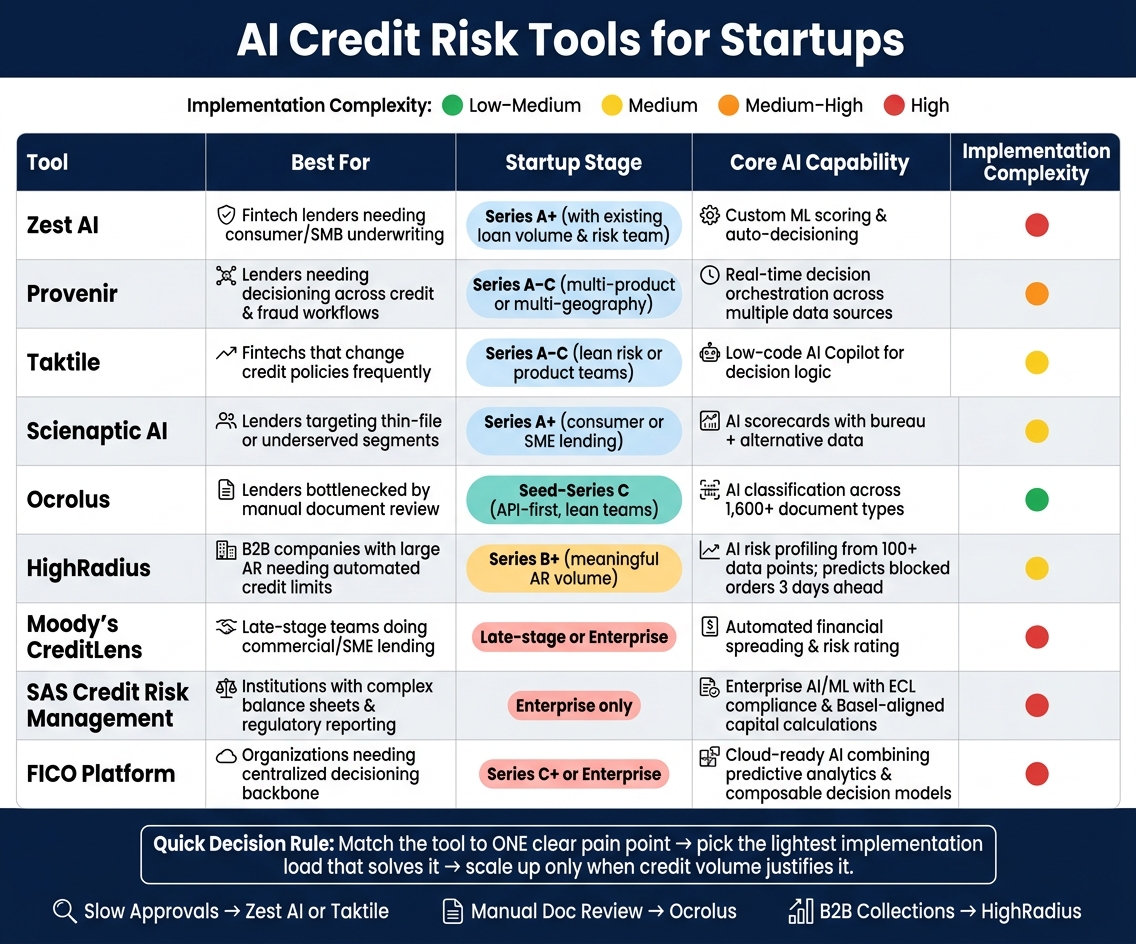
AI Credit Risk Tools for Startups: Side-by-Side Comparison
Use your shortlist to match each tool to the credit-risk job it handles best. The tools below are grouped by how startups tend to use them: underwriting engines, document-heavy workflows, and finance-ops support.
Zest AI, Provenir, Taktile, and Scienaptic AI
This group makes the most sense when a startup needs automated underwriting and tight policy control.
Zest AI uses machine learning trained on a lender’s own data to automate approvals and track portfolio performance. It’s a fit for fintechs in consumer, auto, or embedded lending that already have a risk team and a solid stream of applications.
Taktile gives risk and product managers a low-code decision engine and AI copilot to build, test, and adjust credit policies without getting stuck in an engineering queue. That makes it a strong match for Series A–C startups that need to move fast on underwriting and onboarding flows.
Scienaptic AI uses bureau data alongside alternative data streams for instant decisioning in thin-file or underserved segments. It also puts weight on explainable AI outputs, which can help when fair lending compliance and investor review are in play.
Provenir handles decision orchestration across fraud, KYC, and credit data sources in real time. It works well for BNPL or marketplace lending startups that need one layer of risk logic across several data pipelines at once.
If your workflow leans more on document review or B2B credit operations than underwriting logic, the next set is a better match.
Moody's Analytics CreditLens, SAS Credit Risk Management, HighRadius Credit Management, Ocrolus, and FICO Platform
Ocrolus is the easiest starting point in this group. It classifies more than 1,600 financial document types and automates income calculations and validation checks. It fits SMB lenders, or any startup working through borrower bank statements, tax returns, or paystubs at scale.
Moody's Analytics CreditLens offers commercial-loan financial spreading and portfolio analytics, with credit insights on more than 460 million entities worldwide. It fits Series C+ teams or startups with bank partnerships that need deep B2B or SME lending infrastructure.
SAS Credit Risk Management covers origination, scoring, stress testing, and regulatory reporting across the full credit lifecycle. This is built for institutions managing complex balance sheets, not early-stage teams.
HighRadius fits B2B SaaS or e-commerce startups that need to automate credit limits, collections, and cash application.
FICO Platform is a cloud-based system for centralized decisioning and model governance. It fits startups heading toward enterprise-grade decision infrastructure on AWS.
Lucid Financials for Risk-Aware Startup Finance Operations
Credit risk tools do a better job when the books and forecasts behind them are up to date.
Lucid Financials keeps startup books clean, forecasts current, and reporting investor-ready. It delivers clean books in seven days, real-time cash flow visibility, and on-demand answers through Slack, backed by automation with expert review. Lucid Financials supports stronger credit oversight by keeping the underlying financial data current and ready for decisions.
Comparison Table: Best Fit, AI Capability, and Implementation Load
Side-by-Side Summary for Fast Shortlist Building
The table below splits the market into four jobs: underwriting, document review, receivables control, and finance visibility. That makes it easier to spot the lowest-lift option that still fits your main bottleneck.
| Tool | Best Fit | Core AI Capability | Startup Stage | Implementation Complexity | Monitoring / Integration |
|---|---|---|---|---|---|
| Zest AI | Fintech lenders and credit unions that want consumer or SMB underwriting. | Custom ML scoring and auto-decisioning. | Series A+ with existing loan volume and a risk team. | High - multi-month project; requires historical data, LOS integration, and compliance review. | LuLu Pulse and LuLu Strategy support portfolio benchmarking and policy simulation. |
| Provenir | Lenders and fintechs that need a decisioning layer across credit and fraud workflows. | Real-time decision orchestration across multiple data sources. | Series A–C with multi-product or multi-geography risk exposure. | Medium–High - configurable, but requires data-source mapping and risk-team involvement. | Real-time decision monitoring across connected data sources. |
| Taktile | Fintechs and embedded-finance startups that change credit policies often. | Low-code AI Copilot for building, testing, and adjusting decision logic. | Series A–C; usable by lean risk or product teams without heavy engineering support. | Medium - low-code reduces engineering load, but still needs data connections and defined policies. | Real-time performance monitoring; Case Manager with human-in-the-loop review. |
| Scienaptic AI | Lenders targeting thin-file or underserved segments using alternative data. | AI scorecards ingesting bureau data plus bank transactions, financial statements, and trade credit. | Series A+ in consumer or SME lending with fair-lending compliance requirements. | Medium - integration with bureau and alternative data sources required. | Explainable AI outputs for ongoing compliance review. |
| Moody's Analytics CreditLens | Late-stage teams or enterprise lenders doing commercial or SME lending. | Automated financial spreading and risk rating from financial statements into standardized formats. | Late-stage or enterprise; assumes dedicated credit analyst teams. | High - enterprise implementation; requires credit operations and IT involvement. | Standardized outputs that feed analyst and credit committee workflows. |
| SAS Credit Risk Management | Institutions managing complex balance sheets with regulatory reporting requirements. | Enterprise credit risk analytics with AI/ML models, ECL compliance, and Basel-aligned capital calculations. | Enterprise or scale-up; not suited for early-stage teams. | High - multi-month enterprise rollout with significant IT and risk team resources. | Integrated dashboards for credit exposure, ECL, and scenario analysis. |
| HighRadius Credit Management | B2B companies with sizable accounts receivable that need automated credit limits and collections. | AI risk profiling from 100+ data points; predicts blocked orders up to 3 days in advance. | Series B+ with meaningful AR volume. | Medium - integrates with ERP and AR systems; main work is data mapping and workflow setup. | Continuous AR aging, risk scores, and collections dashboards. |
| Ocrolus | Lenders and fintechs whose bottleneck is manual document review at scale. | AI document classification and extraction across 1,600–2,000+ document types. | Seed–Series C; API-first and accessible to lean teams. | Low–Medium - connector-based; main effort is mapping document types and updating workflows. | Fraud detection and discrepancy alerts fed into underwriting and decisioning platforms. |
| FICO Platform | Organizations that need a general-purpose decisioning backbone for credit and fraud across enterprise workflows. | Cloud-ready AI decisioning combining predictive analytics, optimization, and composable decision models. | Series C+ or enterprise heading toward centralized model governance. | High - enterprise-grade; requires IT, model governance, and risk team alignment. | Connected orchestration at scale; decision flows embedded across credit, fraud, and marketing. |
If you're building a shortlist fast, the simplest path is to pair each tool with one clear pain point and then pick the option with the lightest implementation load that still does the job. In plain English: don't buy an enterprise control tower if your issue is just slow document review.
How to Choose the Right Tool and Key Takeaways
How Founders Should Narrow the Final Choice
After the comparison table, cut your shortlist based on the first problem you need to fix.
If approvals are moving too slowly, look at underwriting platforms like Zest AI or Taktile. If delinquencies are climbing, focus on portfolio-risk monitoring. If your team is stuck reviewing documents by hand, Ocrolus is the better fit. And if B2B collections are dragging, HighRadius is built for that kind of bottleneck.
Then pressure-test the choice against three practical factors:
- Deployment time
- Internal ownership
- Reporting needs
Here’s the simple way to think about it: if even a small bump in defaults would hit runway in a meaningful way, it makes sense to add specialized credit tools sooner.
But if you’re not ready for a dedicated credit engine, start with finance visibility and clean reporting. That first step often makes more sense for early-stage teams. For startups in that position, Lucid Financials helps keep books clean and reporting investor-ready, which makes it easier to see when credit volume has grown enough to justify a dedicated credit engine.
Key Takeaways
Once you’ve narrowed the shortlist, use these points as a gut check:
- AI credit tools can speed up decisions and make them more consistent. But those gains only show up when the tool matches your day-to-day workflow.
- Fit matters more than model sophistication. The most powerful platform won’t help if it depends on data infrastructure, governance processes, or team capacity you don’t have yet.
- Implementation burden is a real cost. Data migration, integration work, and process redesign pull time and attention away from growth. Time-to-value deserves as much weight as feature depth.
- Finance visibility is often the best first investment. Clean books, accurate forecasts, and investor-ready reporting - like what Lucid Financials provides - support every credit and risk decision that comes next.
FAQs
How do I know if my startup needs a credit risk tool yet?
Consider a credit risk tool when manual, static financial reviews no longer give you timely visibility into your burn rate, cash position, or growth.
If your team is struggling with cash flow gaps, payment delays, or churn - or can’t easily model scenarios like new hires or funding rounds - an AI-driven platform like Lucid Financials can give you real-time alerts and investor-ready reporting.
What data should I prepare before testing a tool?
Prepare clean, centralized data before testing an AI credit risk tool. Start by connecting your main operating and finance systems so information can sync in real time.
Pull in financial statements, transaction records, and key metrics like monthly recurring revenue, burn rate, churn, and customer acquisition cost. Then make sure the data is accurate, consistent, and labeled the same way across every source.
Before your first test, standardize U.S. dates as MM/DD/YYYY and format all currency in USD ($). That may sound small, but messy formats can throw off results fast.
How do I choose between underwriting, document, and AR tools?
Choose based on your startup’s stage and cash needs. If you can, pick one integrated platform instead of a patchwork of separate tools.
Focus on three things:
- Integration depth with your accounting, banking, payroll, and billing systems
- Forecast quality for 12–18 month projections and scenario modeling
- Expert oversight to help with GAAP compliance and flag risk signals early