AI churn prediction helps startups reduce customer churn, save costs, and improve revenue. By analyzing customer behavior data, AI can predict which customers are likely to leave and why - weeks or months in advance. This allows businesses to take targeted actions to retain high-value customers.
Key points:
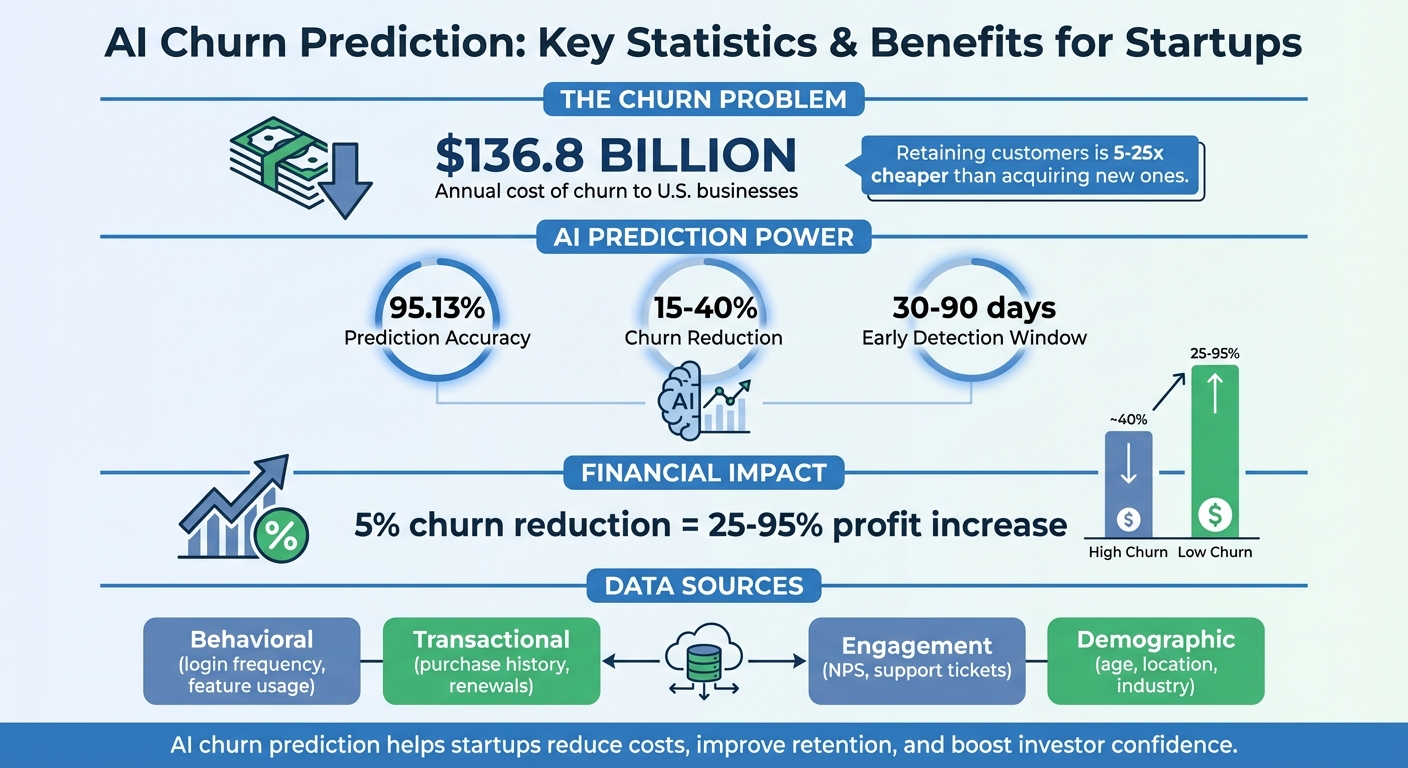
- Churn costs U.S. businesses $136.8 billion annually. Retaining customers is 5–25x cheaper than acquiring new ones.
- AI models predict churn with up to 95.13% accuracy and can reduce churn by 15–40%.
- Early detection identifies at-risk customers 30–90 days before they leave.
- Personalized retention strategies target specific pain points, saving resources and boosting customer lifetime value (CLV).
- Reducing churn by 5% can increase profits by 25–95%.
AI churn prediction also supports better financial planning by improving revenue forecasts, valuation models, and investor confidence. Startups can integrate these tools into CRMs for actionable insights and automate retention workflows for maximum efficiency.
AI Churn Prediction Benefits and ROI Statistics for Startups
I Built a Churn Prediction Model in Minutes (No Code, No Data Science Team) | Pecan AI Agent Review
sbb-itb-17e8ec9
How AI Churn Prediction Works
AI churn prediction uses machine learning algorithms to analyze large datasets and identify early signs of customer churn. These algorithms are trained on historical data where the outcome - whether a customer stayed or left - is already known. By examining thousands of past cases, the system learns which behaviors are red flags for potential cancellations. Once trained, it can assess current customers and assign each one a churn probability score - for example, a score of 0.8 indicates an 80% likelihood of leaving.
The process begins with data collection. AI systems gather information from multiple sources, such as CRM platforms (tracking support tickets and complaint frequency), billing systems (recording purchase history and renewal dates), and product analytics tools (monitoring login frequency and feature usage). This raw data is then cleaned, organized, and transformed into structured metrics, such as Weekly Active Users (WAU) or "days since last login", which are essential for accurate predictions. According to Mark Rachapoom, an expert in AI CRM software: "With good data, you can reliably identify at-risk customers 30–60 days before they cancel".
"Usage decline precedes churn, often by weeks." - Mark Rachapoom, Building the future of AI CRM software
The complexity of the algorithms varies. Logistic regression is commonly used for straightforward, interpretable results. For more complex patterns, random forests and gradient boosting are ideal, as they can handle multi-dimensional data effectively. When customer behavior involves nonlinear relationships, neural networks step in, offering deeper insights that simpler models might overlook. While each model has its strengths, the shared goal is clear: identifying customers at risk of leaving before they actually cancel.
Data Sources Used in Churn Prediction
Successful churn prediction relies on integrating four main types of customer data:
- Behavioral data: Tracks app usage, login frequency, website visits, feature interaction, and engagement with emails or notifications.
- Transactional data: Includes purchase history, subscription renewals, average order value, refunds, and service upgrades.
- Engagement and feedback metrics: Captures Net Promoter Score (NPS), support tickets, complaint frequency, resolution times, and survey feedback.
- Demographic data: Basic customer profile information, such as age, location, industry, and company size, used for segmentation.
This information is often spread across different systems - CRMs, sales records, marketing tools, support logs, and real-time usage data streams. To improve predictions, some models also incorporate external data, such as financial reports, market trends, or social media activity. Centralizing and cleaning this data is critical; without it, even advanced algorithms may deliver unreliable results.
| Data Category | Specific Data Points | Collection Source |
|---|---|---|
| Behavioral | Login frequency, feature usage, email opens, clickstreams | App/Website Analytics, Marketing Software |
| Transactional | Purchase history, renewal dates, refund requests | ERP, Billing Systems, POS |
| Engagement | Support tickets, NPS scores, chat logs | CRM, Helpdesk Software |
| Demographic | Age, location, industry, company size | Customer Profiles, Sign-up forms |
Real-time data processing is becoming more common. Instead of waiting for weekly reports, AI models now monitor live website clicks and app usage to flag at-risk customers immediately. This allows companies to intervene while the relationship can still be salvaged.
Machine Learning Algorithms for Churn Prediction
Different algorithms bring unique advantages to churn prediction. Logistic regression is ideal for generating simple, interpretable probability scores. It’s fast, transparent, and works well for straightforward relationships between variables. Random forests and gradient boosting shine when dealing with complex data, identifying subtle interactions that simpler models might miss. Meanwhile, neural networks are best for vast datasets with nonlinear patterns, making them a great choice for companies dealing with intricate customer journeys.
"Machine learning algorithms which process huge amounts of data do not follow pre-set rules and rather make predictions instead of following rules." - Ankit Pal, Content Writer and Legal Researcher, Startupfino
The choice of algorithm depends on factors like data volume and technical resources. Startups just starting out can achieve solid results with rules-based systems and high-quality data. As datasets grow and patterns become more complex, switching to ensemble methods like gradient boosting or deep learning models can improve accuracy. Regardless of the algorithm, data quality remains the most critical factor. For instance, early warning signs like usage decline are often visible 4–8 weeks before a customer decides to cancel, but only if the data is clean and comprehensive enough to detect them. By identifying these at-risk customers early, businesses can reduce churn and improve revenue, creating a foundation for proactive retention strategies.
Benefits of AI Churn Prediction for Startups
AI-powered churn prediction gives startups the ability to anticipate and address customer churn before it impacts their bottom line. Unlike traditional approaches that rely on exit surveys or cancellation requests - tools that often come into play when it’s already too late - AI can detect signs of dissatisfaction up to 90 days before a customer decides to leave. This early warning system gives startups a critical window to address concerns, showcase value, and rebuild trust, effectively turning potential losses into retained revenue.
For subscription-based businesses, where recurring revenue is a key driver of valuation, this capability can have a direct impact on growth metrics, operational runway, and investor confidence. Companies using AI churn prediction have reported 25% to 40% reductions in churn, resulting in stronger revenue streams and healthier unit economics. Let’s dive into how these benefits unfold through early detection, smarter retention efforts, and better revenue preservation.
Early Detection of At-Risk Customers
AI doesn’t just identify customers who openly express dissatisfaction; it also spots those who disengage quietly over time. While traditional methods might track basic metrics like login counts, AI analyzes deeper activation signals - specific actions tied to long-term retention. It also picks up on subtle trends, such as shorter session durations, reduced feature usage, or longer gaps between interactions - patterns that manual reviews often miss.
Using Natural Language Processing (NLP), AI can even scan support tickets and emails to detect frustration or negative sentiment before customers formally complain. Accounts are assigned a dynamic health score (0–100), updated daily, allowing teams to monitor customer relationships in real time. This is particularly crucial during onboarding, as customers who fail to engage with core features in their first 30 days are 60% more likely to churn.
Lower Costs for Retention Efforts
Beyond identifying at-risk customers, AI helps startups save money by focusing retention efforts where they matter most. Instead of sending generic "save" campaigns to all users, AI enables teams to target only high-risk accounts. By combining churn risk scores with Customer Lifetime Value (CLV), startups can prioritize their most valuable customers and avoid wasting resources on those who are unlikely to leave or contribute minimal revenue.
Involuntary churn, often caused by failed payments or expired credit cards, accounts for 20% to 40% of all SaaS churn. AI can differentiate between customers who intend to leave and those experiencing payment issues, triggering automated dunning processes to recover revenue without requiring manual intervention. For startups with limited customer success resources, this automation prevents unnecessary revenue loss while freeing up time for strategic priorities.
Personalized Retention Strategies
AI also enables highly tailored retention strategies by analyzing individual customer behaviors and pain points. Instead of offering blanket discounts, startups can address specific issues - like missing features or service quality concerns - highlighted by AI insights. In subscription models, AI can flag at-risk customers nearly a year before their renewal date, giving teams plenty of time to re-engage through personalized onboarding, feature education, or proactive support.
Retention workflows can be customized based on risk level. For example:
- High-risk, high-value accounts might receive personal outreach from account managers.
- Medium-risk customers could be placed in automated nurture campaigns.
- Payment failures might trigger mechanical recovery processes.
AI-powered voice agents also play a role, achieving a 40% to 60% answer rate and a 25% conversion rate for scheduling follow-up meetings. These timely, personalized interventions consistently outperform generic retention emails.
Revenue Growth Through Lower Churn
Reducing churn directly boosts recurring revenue, which is critical for subscription businesses. Integrating AI with CRM systems has been shown to cut churn rates by up to 15%. For a startup generating $500,000 in annual recurring revenue, this could mean retaining an additional $75,000 without spending extra on customer acquisition.
"If we take a pay-for-subscription model, we'll see that a low rate of monthly churn will heighten dramatically in quarterly/yearly reports. Since it takes more money and effort to obtain new users than to retain existing ones, companies with growing churn rates venture to fall into a money pit." – Michael Redbord, HubSpot
Financial Impact of Churn Prediction on Startups
For subscription-based startups, churn prediction isn't just about keeping customers happy - it's a critical tool for financial planning. Investors pay close attention to churn rates because they reveal how well a business can retain its revenue over time. High churn can suggest issues like poor product-market fit or inefficiencies, while low churn signals stability and growth opportunities. Beyond customer retention, AI's ability to predict churn offers financial advantages such as steady revenue streams and increased investor confidence. By using AI to quantify future revenue, startups can reshape their financial planning strategies.
Churn's financial impact goes beyond monthly revenue metrics. Reducing churn directly increases Customer Lifetime Value (CLV), a key metric used in startup valuations. When investors see consistent retention trends supported by AI insights, they feel more confident in long-term revenue projections. This reduced risk perception can lead to higher valuation multiples during funding rounds. Additionally, these insights empower startups to make smarter operational and strategic decisions.
Improving Financial Planning and Forecasting
Accurate churn predictions make revenue forecasts and budgeting more reliable by replacing outdated averages with real-time risk scores for individual accounts. This precision improves monthly or annual recurring revenue forecasts, which are essential for decisions about hiring, product development, and marketing investments. By incorporating churn risk scores into financial reports, startups demonstrate a proactive approach to managing revenue risks. For example, identifying secure versus at-risk revenue streams helps finance teams adjust budgets and allocate resources more effectively.
Even small improvements in retention can have a massive impact. A 5% boost in retention can increase profits by 25% to 95%. For early-stage startups operating with tight margins, this can mean the difference between reaching profitability or needing additional funding. AI-driven churn prediction helps startups achieve these gains by focusing retention efforts where they matter most financially. These enhanced forecasts also improve valuation models, giving startups a competitive edge.
Using Churn Insights in Valuation Models
Churn insights play a key role in valuing subscription-based startups. Lower churn rates increase Customer Lifetime Value by extending how long customers stay engaged and boosting overall revenue potential. Startups with low churn rates are especially attractive to investors because they signal operational maturity and reduced revenue risk. AI tools can link churn probabilities to CLV, helping startups focus retention efforts on their most valuable accounts. Combined with improved financial forecasts, lower churn rates support higher valuation multiples by minimizing perceived risk.
Retention rates also reflect product-market fit. When customers stick with a product, it shows they see real value in it, suggesting that growth comes from effective operations rather than just aggressive marketing. In sectors where churn can reach 20% to 40% annually, the ability to predict and address churn is a major competitive edge that can significantly boost valuation multiples.
Finally, explainable AI (XAI) builds investor trust by offering transparency into why a customer might churn, rather than relying on unclear "black box" algorithms. When founders can clearly explain the factors driving churn predictions, it strengthens the credibility of their forecasts and highlights the effectiveness of their retention strategies.
Using Lucid Financials for Investor-Ready Reporting

After integrating churn prediction into your startup, the next step is presenting those insights in a way that resonates with investors. While many founders have access to the data, they often struggle to demonstrate financial sophistication.
This is where Lucid Financials steps in. By combining AI-powered accounting with CFO-level reporting, it seamlessly integrates churn data into your financial dashboards and investor reports. This makes retention metrics a key part of your financial story, transforming churn insights into a strategic advantage for investor communication.
AI-Driven Financial Visibility
Lucid Financials provides real-time financial insights by pairing churn data with your bookkeeping. It flags at-risk revenue streams and projects churn losses directly on your dashboard. Instead of waiting for end-of-month reports, you can simply ask via Slack, "What’s the churn impact on our MRR forecast?" and instantly receive visual projections showing potential improvements of 15–20% with effective retention strategies.
The platform also sends automatic alerts through Slack when critical churn thresholds are hit. For example, it might notify you when 10% of high-risk customers are jeopardizing $50,000 in MRR. By syncing with tools like QuickBooks, Lucid overlays churn probabilities onto cash flow forecasts, delivering churn-adjusted financials in just seven days.
These real-time insights don’t just stay on dashboards - they evolve into polished, board-ready reports that align your operational data with what investors want to see.
Investor-Grade Reporting and Forecasting
Lucid automates professional-grade reports that embed churn insights where they matter most. These reports include cohort analysis tables that break down retention rates, scenario models comparing base-case versus optimized churn rates, and executive summaries addressing questions like, "What strategies are in place to improve retention?". Using standard U.S. formats, the reports also feature graphs mapping churn trends against revenue forecasts, showing how a 1% churn reduction could increase valuation by 5–10%.
Lucid’s AI-driven forecasting tools take it a step further by incorporating churn probabilities into revenue projections, burn rate calculations, and runway estimates. For instance, the platform can demonstrate how reducing churn from 12% to 7% could extend your runway and add $200,000 to Year 1 revenue. With real-time Slack queries and always-on reporting, Lucid ensures you’re always ready for investor scrutiny.
How to Implement AI Churn Prediction
You don’t need a massive team or budget to get started with AI churn prediction. By leveraging your existing data and tailoring the process to your current business stage, you can make meaningful progress.
Identify and Collect Customer Data
Start by breaking down data silos within your company. Churn signals are often scattered across platforms like Google Analytics (marketing), Salesforce or Pipedrive (sales), Zendesk or Slack (support), and Stripe or Chargebee (billing). The goal? Bring all this data into a single warehouse to get a clear picture of customer interactions.
Focus on three main types of data:
- Behavioral data: Track patterns like login frequency, feature usage, and session duration.
- Interaction data: Look at support ticket volume, email tone, and chat history.
- Transactional data: Monitor metrics like monthly recurring revenue, payment issues, and contract lengths.
For example, studies show that customers who make more than four support calls are far more likely to churn.
Next, define what an "active" customer looks like for your business - this could mean someone who logs in within 30 days or regularly uses a key feature. This definition will serve as the target variable for your AI model. Modern AI tools can even analyze unstructured data, like meeting notes or irregular usage trends, to generate reliable predictions.
Select the Right AI Tools
Your choice of AI tools depends on your resources and expertise. If you don’t have a dedicated data science team, consider AutoML platforms. These tools handle feature engineering and model selection, making them ideal for startups. On the other hand, businesses with technical expertise can build custom models using algorithms like XGBoost or Random Forest, which can be tailored to specific needs.
Measure the success of your models with metrics like AUC-ROC (aim for scores above 0.8), precision, and recall. And remember: retaining customers is far cheaper than acquiring new ones - estimates suggest it costs 5 to 25 times less. Even a modest investment in churn prediction can yield significant returns.
Set a prediction window that aligns with your sales cycle. For instance, identifying churn risks three months ahead gives your team enough time to act. Once the model is ready, integrate its outputs into your CRM to make the data actionable.
Integrate Churn Insights into Operations
Predictions are only useful when they lead to action. Embed churn risk scores into your workflows by setting up CRM triggers. For example, you can alert sales reps when high-value accounts hit a certain risk level. Categorize customers into "High", "Medium", and "Low" risk groups, and adjust your strategies accordingly. High-risk accounts might need personal outreach, while medium-risk groups could benefit from automated campaigns.
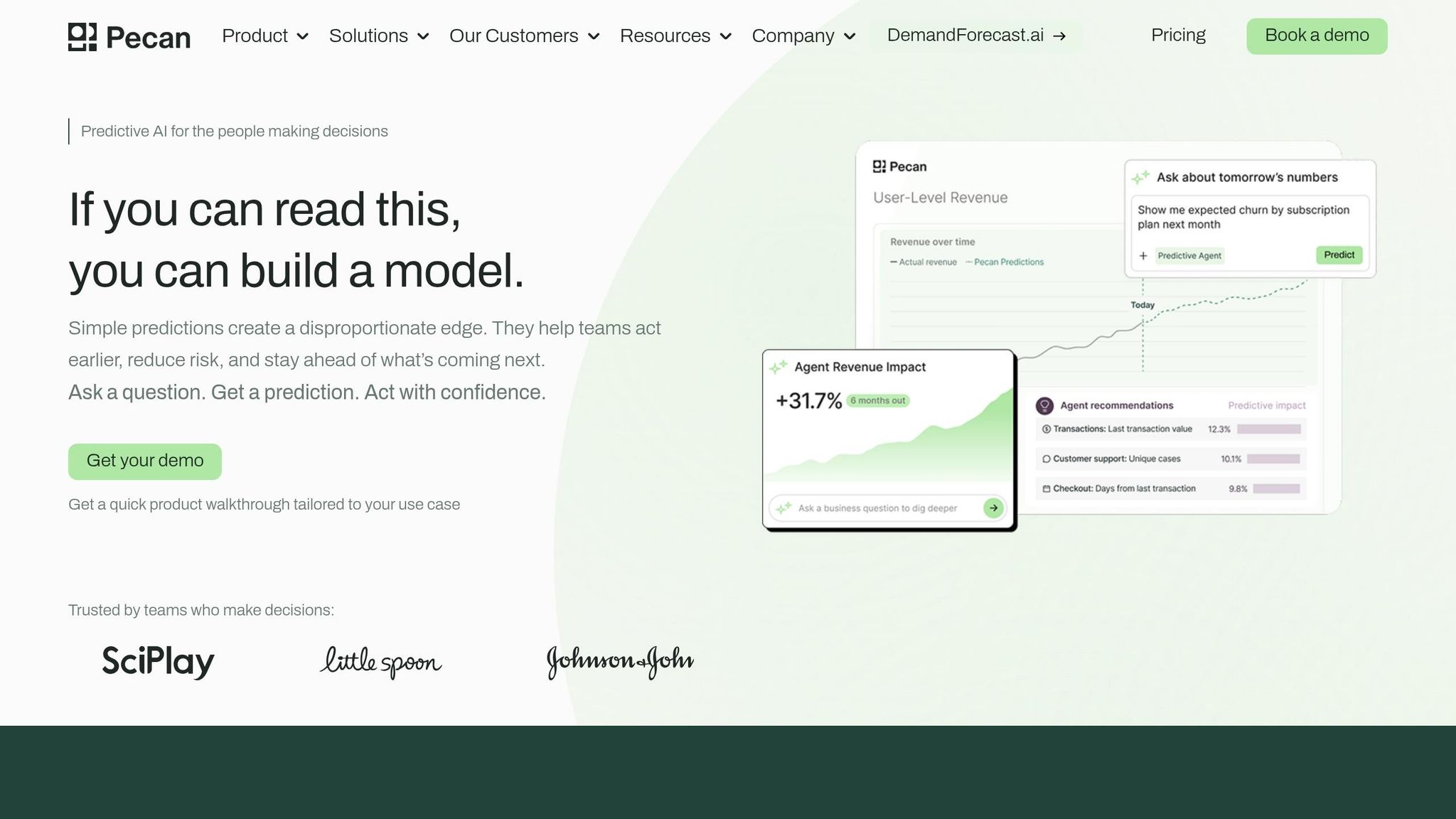
Take Hydrant, a wellness brand, as an example. In July 2024, they implemented a Pecan AI churn model to analyze six months of purchase history. CEO John Sherwin used the results to send targeted offers to at-risk customers. The outcome? A 2.6× higher conversion rate and 3.1× higher average revenue per customer compared to untargeted efforts.
"The system helped identify players who specifically needed a 'nudge' to return, thereby preventing wasted marketing spend on already dedicated players." - Evyatar Livny, VP of Marketing Technologies, SciPlay
To maximize impact, combine churn probability with Customer Lifetime Value (CLV). This approach helps you focus your retention budget on the most profitable at-risk accounts. Finally, set up automated retraining for your model. Customer behavior changes over time, influenced by market trends and competitors, so regular updates ensure your predictions stay accurate. By integrating churn prediction into your operations, you create a system that continuously improves retention over time.
Conclusion
AI-powered churn prediction transforms customer retention into a precise, proactive strategy. By identifying at-risk customers weeks - or even months - before they leave, startups can channel their limited resources where they matter most: high-value accounts on the brink of churning. Considering that acquisition costs often surpass retention expenses, even a modest 5% improvement in retention can drive profits up by 25–95%.
But the benefits go beyond just keeping customers. Churn prediction strengthens your financial footing. With accurate insights into customer behavior, businesses can enjoy better revenue forecasting, improved cash flow management, and investor-ready metrics. These tools not only help during fundraising but also demonstrate to potential investors that you understand your unit economics and can scale efficiently. This blend of financial clarity and retention strategy lays the groundwork for sustainable growth.
Even for startups with limited resources, implementing churn prediction is achievable. Start by consolidating customer data, selecting AI tools that align with your technical capabilities, and integrating churn insights into your CRM workflows. The real value lies in acting on predictions - whether through personalized outreach, pricing adjustments, or addressing product issues that push customers away.
For those seeking to merge churn insights with financial planning, Lucid Financials provides AI-powered forecasting and investor-grade reporting. This ensures your metrics remain actionable, enabling you to turn retention gains into measurable financial results.
Churn prediction isn't just about retaining customers - it’s about creating a business that’s more profitable, predictable, and attractive to investors. Start small, measure your results, and let AI guide smarter decisions as you grow. By pairing proactive retention strategies with sound financial planning, you build a growth engine that supports long-term success and investor confidence.
FAQs
What data do I need to start churn prediction?
To kick off churn prediction, start by collecting data that reveals patterns in customer behavior and financial activity. Focus on key metrics like usage patterns, engagement levels, transaction history, revenue contributions, and payment records. Including data from customer interactions - such as support tickets and feedback - can further refine prediction accuracy. A comprehensive dataset allows AI to identify trends and anticipate churn, giving startups the insights needed to create proactive, data-based strategies for retaining customers.
How far ahead can AI predict churn reliably?
AI has the ability to predict customer churn as far as 47 days ahead. This early warning system gives businesses ample time to act, enabling them to implement targeted retention strategies and address at-risk customers before they decide to leave.
How do I turn churn scores into retention actions?
To transform churn scores into actionable retention strategies, leverage AI insights to pinpoint customers most at risk of leaving. After identifying these high-risk accounts, take targeted steps such as personalized outreach, exclusive offers, or dedicated support efforts. Tailor your approach to address specific warning signs - like a drop in product usage or obstacles to renewal - so you can re-engage these customers and boost retention rates effectively.