Most startup finance AI projects fail for one simple reason: the books are not ready. If I were choosing a framework today, on September 24, 2026, I’d start with the bottleneck in front of me: dirty data, one urgent finance problem, a finance team that is still growing up, or control needs.
Here’s the short version:
- Readiness-First fits when data is messy and systems do not sync well.
- Use-Case Prioritization fits when I need one near-term win, like real-time financial insights or expense coding.
- Finance Maturity fits when I need AI to match the stage of the finance team.
- Governance-First fits when AI touches payroll, tax, investor reporting, or cash movement.
A few numbers make the point clear:
- Nearly two-thirds of companies were piloting or using AI in accounting and FP&A by 2026.
- Teams that cleaned data before rollout saw a 68% drop in reporting errors.
- Early-stage startups can save more than $80,000 per year with AI-based finance modeling.
- 88% of Excel finance models have at least 1% errors.
So if I want AI to help finance, I would not start with the flashiest tool. I would start by asking:
- Is my data clean?
- Which use case matters most right now?
- Can my finance team support this?
- What needs human approval?
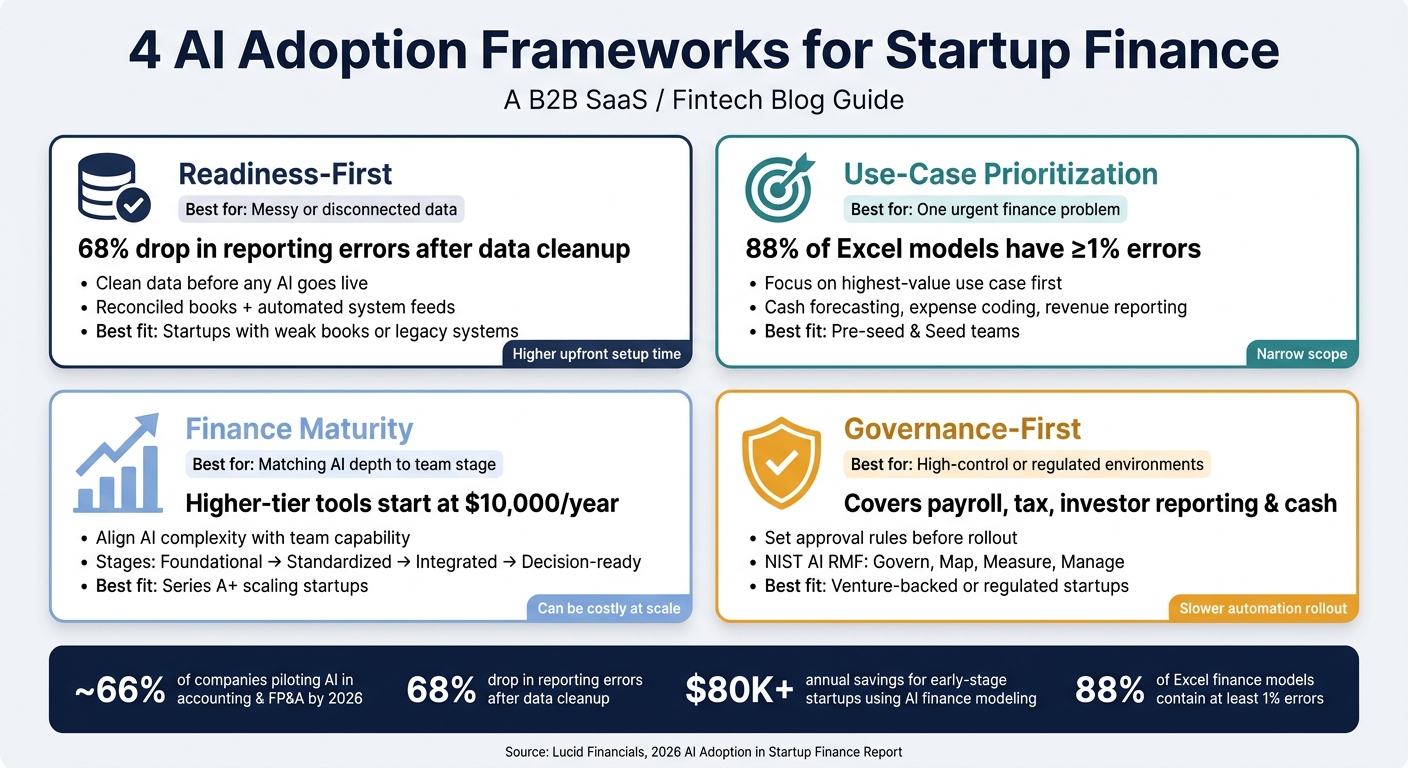
4 AI Adoption Frameworks for Startup Finance: At a Glance
Quick Comparison
| Framework | Best When | Main Upside | Main Tradeoff | Best Fit |
|---|---|---|---|---|
| Readiness-First | Data is messy | Fewer bad outputs | More setup time up front | Startups with weak books or disconnected systems |
| Use-Case Prioritization | One finance problem needs attention now | Fast ROI | Narrow scope | Pre-seed and Seed teams |
| Finance Maturity | Team/process stage is the main limit | Matches AI depth to team stage | Can cost more as needs grow | Startups scaling after early stage |
| Governance-First | Control and audit needs come first | Better oversight | Slower rollout | Regulated or investor-sensitive teams |
If I had to sum up the whole article in one line, it would be this: pick the framework that matches the finance problem you have today, not the AI plan you wish you had.
sbb-itb-17e8ec9
1. Readiness-First Framework
The Readiness-First Framework starts with one hard rule: clean up the data before any AI tool goes live. In plain English, that means reconciled books, steady transaction categories, and automated feeds from accounting, banking, and payment systems. If your team is still keying numbers into spreadsheets by hand, fix that pipeline first.
Data readiness
In this framework, the data audit comes first. No shortcuts. That’s what separates it from frameworks that start with use cases or governance. Here, the data layer needs to be steady before anything else can move.
Business value
The payoff shows up fast once that base is in place. Finance leaders who rolled out AI tools after cleaning their data saw a 68% measurable drop in reporting errors. AI financial modeling can also save early-stage startups more than $80,000 a year by cutting the need for full-time finance hires.
Those gains aren’t abstract. They usually show up in the areas finance teams care about most:
- runway
- hiring plans
- scenario planning
Implementation effort
This approach asks for more work up front. Auditing records and mapping system connections takes time, but it helps stop errors later. Think of it like fixing the foundation before adding another floor.
Once the data is clean, setup gets much easier. Simple tools can be configured in hours, while more connected platforms usually take one to two weeks. That same setup also puts review and approval controls in place.
Governance and scalability
AI can handle data consolidation, calculations, and basic analysis. But strategic financial decisions, investor negotiations, and complex accounting still need experienced human judgment.
That’s why the framework uses validation protocols. These checks compare AI outputs against historical performance and industry benchmarks instead of taking model outputs at face value. As reporting volume grows, that control helps keep the process steady.
If the data layer is already stable, the next step is deciding which use case should come first.
2. Use-Case Prioritization Framework
If your data layer is stable, the next call is simple: which AI use case will pay off first?
This framework starts with business value, not data cleanup. That’s what sets it apart from the Readiness-First Framework. The best option depends on three things: the value it can deliver, the data you already have, and how fast you can get it live.
Business value
For early-stage startups, cash flow forecasting often comes first because it shapes runway planning. If you don’t know how long your cash lasts, everything else gets harder.
Revenue reporting is another strong early use case. Clean reporting supports board updates and investor conversations, and that matters more than most teams want to admit. There’s also a good reason to be cautious with manual models: 88% of Excel-based finance models contain at least 1% errors.
Data readiness
Each use case needs different inputs, so the smartest move is to match the tool to the data you already have. Here’s a simple way to size that up:
| Use Case | Primary Business Value | Data Requirements | Implementation Effort |
|---|---|---|---|
| Cash Forecasting | Runway visibility & burn rate alerts | Bank feeds, accounting software | Low–Moderate (hours to 1 week) |
| Expense Classification | Error reduction & automated bookkeeping | Transaction data, historical logs | Low (hours) |
| Revenue Reporting | Investor and board reporting | CRM (Salesforce/HubSpot), Stripe | Moderate (1–2 weeks) |
| Anomaly Detection | Data integrity & governance | Historical performance data | Low |
Implementation effort
Effort goes up with complexity. Expense classification and anomaly detection can often be set up in hours. Cash forecasting usually takes up to a week. Revenue reporting tends to take one to two weeks because it often means syncing CRM data with payment data.
The practical move? Start with the use case that gives you clear value without a lot of new data work.
Governance and scalability
Human review still matters. AI can speed things up, but finance teams should use alerts and benchmark checks to verify outputs before anything lands in board decks or investor materials.
Once the first use case is working, the next step is figuring out how mature the finance function is for broader AI adoption.
3. Finance Maturity Framework
Once you've picked the use cases to go after, the next step is simple: can your finance team support them right now?
If a strong use case still leads to weak output, the issue usually isn't the idea. It's maturity. This framework looks at what your finance function can handle today and builds from there. That means checking process standardization, data quality, integrations, team capability, and governance.
AI adoption should match current capability, not ambition. If core finance processes are still shaky, advanced tools tend to fall apart.
Business value
Value tends to grow as maturity grows.
At the early stage, the main gain is accuracy. At the standardized stage, it's automation. At the integrated stage, it's forecasting. And at the decision-ready stage, it's scenario support.
The business case at each stage should be tied to clear metrics, such as:
- Close time
- Exception rates
- Forecast variance
- Hours saved
- Human-review rates
Data readiness
Use this table to match maturity level with AI work that can actually hold up in day-to-day finance operations.
| Maturity Level | Typical State | Appropriate AI Uses | Main Constraint |
|---|---|---|---|
| Foundational | Spreadsheet-heavy, incomplete reconciliations | Data capture, document extraction, basic categorization | Poor or inconsistent source data |
| Standardized | Documented processes, repeatable close | Reconciliations, invoice processing, exception detection | Limited integration and historical depth |
| Integrated | Connected accounting, banking, payroll, billing | Variance analysis, cash forecasting, reporting automation | Data ownership and change management |
| Decision-ready | Timely, trusted data with established controls | Scenario modeling, driver-based forecasting | Need for explainability and human review |
Before moving up a level, check the basics.
Is every financial data source owned by someone? Can transactions be traced back to where they started? Are there duplicate vendors or stale integrations?
Those checks matter more than they may seem. A forecast built on unreconciled books or inconsistent revenue classifications can look confident while pointing the team in the wrong direction.
Implementation effort
In early-stage rollouts, the bulk of the work is often cleanup, not the tech itself. Finance teams may need to standardize the chart of accounts, connect systems, and document approval rules before AI can do much good.
As maturity improves, the effort changes. The focus shifts more toward workflow configuration, integration testing, and staff training. Advanced forecasting projects add another layer: model validation, historical data preparation, and ongoing monitoring.
A phased rollout is usually the better path than a company-wide launch. Start with one repeatable process, set a baseline, check the output, and then expand.
Governance and scalability
Before scaling AI, define data ownership, approval thresholds, escalation paths, and audit trails.
Low-risk suggestions can be watched by exception. High-risk actions need direct human approval.
When control is the main constraint, the next framework starts with governance.
4. Governance-First Framework
When finance processes are already steady, governance often becomes the main bottleneck. For some startups, the issue isn't data or lack of use cases. It's control. The minute AI touches tax, investor reporting, payroll, or cash decisions, the conversation shifts to what's allowed and who signs off. This framework fits startups that can use AI now, but can't trust it on its own yet.
Governance-First puts accountability, approved-use policies, risk thresholds, and human review in place before rollout. A good way to structure that work is with the NIST AI Risk Management Framework and its four functions: Govern, Map, Measure, and Manage.
Business value
The main payoff here isn't speed. It's trust.
A governance-first approach helps startups expand AI use without weakening financial accuracy or investor confidence. For example, an AI tool might draft a monthly variance analysis, but a finance owner still approves the final interpretation before it goes to the board.
The tradeoff is plain: governance can slow launch. But it often cuts rework and cleanup costs as transaction volume grows and more people start paying attention.
Data readiness
Before you approve any AI finance use case, answer three basic questions:
- Who owns each data source?
- What data is sensitive?
- What can the vendor use for model training?
You also need to confirm whether payroll records, tax filings, or investor materials are part of what gets processed.
Data quality and data classification are not optional in this setup. Deloitte recommends data-quality controls, preservation of model inputs and outputs, and management of changes to models and datasets to support transparency and auditability.
Implementation effort
A lean team can get started with a simple setup: a one-page AI register, a named finance owner, a standard vendor questionnaire, an approved-tools list, and a monthly control review.
Start small. Begin with read-only cash-flow explanations, then move into reconciliations and ledger writes.
The work scales with risk. Once AI can post journal entries, initiate payments, affect tax filings, or produce external financial statements, the bar goes up fast.
Governance and scalability
The way to scale governance is through standardization, not endless manual review. A central AI inventory, risk-tiered use cases, reusable approval templates, and automated access logging help low-risk tools move faster while keeping tighter controls on high-impact systems.
Use risk level to decide the control level.
| Use Case Category | Examples | Required Control Level |
|---|---|---|
| Low-risk | Draft cash-flow commentary, summarize results | Minimal: named owner, read-only data, logged output |
| Restricted | Cash forecasts, tax-credit identification, investor reports | Validated data, documented assumptions, human approval |
| Strict | Journal-entry posting, wire transfers, tax filings | Prohibited without explicit sign-off and audit trail |
Review vendors, models, access permissions, and performance every quarter.
How the Four Frameworks Stack Up: Value, Readiness, Effort, and Control
No framework wins across the board. Each one gives you something and asks for something in return. In plain English: some help you move fast, while others give you more control. Some drive near-term ROI, while others are built for scale.
The table below lines up all four so you can spot where each one fits.
| Readiness-First | Use-Case Prioritization | Finance Maturity | Governance-First | |
|---|---|---|---|---|
| Primary question | Is our data clean and integrated? | Which financial problem are we solving right now? | Does this tool scale with our funding stage? | How do we keep AI outputs accurate and compliant? |
| Best adoption stage | Pre-rollout audit | Early-stage (Seed / Series A) | Scaling (Series A to Enterprise) | All stages, especially venture-backed or regulated |
| Main financial use cases | Data consolidation, system integration | Fundraising prep, runway management, hiring planning | FP&A, departmental budgeting, board reporting | Audit trails, variance analysis, CFO oversight |
| Data prerequisites | High - audited records, consistent categorization | Moderate - basic historical data | High - multi-departmental data | High - historical benchmarks for validation |
| Human oversight | Technical (data and accounting team) | Strategic (founder / CEO) | Operational (finance team / VP Finance) | Critical (CFO / external auditors) |
| Implementation effort | High - upfront data cleaning | Low to moderate | Moderate to high - phased rollout | Ongoing - continuous validation |
| Principal benefit | Eliminates bad-input problems | Immediate ROI on a specific task | Long-term scalability | Risk mitigation and investor credibility |
| Principal limitation | Time-consuming initial setup | Can create fragmented data silos | Can be expensive at scale ($10,000+/year) | May slow down rapid automated decisions |
| Best-fit startup profile | Startups with messy legacy data | Pre-seed / Seed focused on one goal | Series A+ with growing complexity | Highly regulated or late-stage startups |
Use this as a quick gut-check on your main constraint before you weigh the tradeoffs.
In practice, most startups won't pick just one framework and call it a day. They tend to stack them. For example, a pre-seed team may begin with Use-Case Prioritization to build investor-ready models fast, then bring in Readiness-First habits once the data starts getting messier. A Series A company that’s hiring fast and adding layers to the business will often need Finance Maturity thinking at the same time as Governance-First controls.
That’s the main job of this table: help you spot the biggest gap first. Is it data quality? A single urgent use case? Stage fit? Governance? Once you know that, the pros and cons below become a lot easier to judge.
Pros and Cons of Each Framework
Each framework makes a different tradeoff between speed, control, and cost. So the right pick depends on your main constraint. Some teams need results fast. Others need tighter control, cleaner data, or a setup that fits their stage. The comparison above shows the full picture; this section boils each option down to its core tradeoff.
The Readiness-First Framework fixes bad-input problems before they snowball. That's the big upside. The downside is simple: cleanup takes time, and that pushes back AI rollout.
The Use-Case Prioritization Framework gives you the fastest ROI because it focuses on one urgent problem first, like runway management or churn prediction. That keeps effort low and helps teams move fast. The tradeoff is narrower scope. You solve one priority at a time, not everything at once.
The Finance Maturity Framework lines up AI depth with the startup's stage. That makes it a good fit for teams that don't want to overbuy too early. The catch is price. Higher-tier tools can start at $10,000/year, which can be a lot for a lean startup.
The Governance-First Framework gives finance teams the most control and the clearest audit trail. That's a big deal when trust in the numbers matters. And with 88% of Excel-based finance models containing at least 1% errors, automated checks and audit trails can improve confidence in reporting. The tradeoff: automation tends to move more slowly.
Use the summary below to compare the four frameworks at a glance.
| Framework | Biggest Pro | Biggest Con | Best Stage |
|---|---|---|---|
| Readiness-First | Clean data and integration | High upfront time and setup effort | Growth stage |
| Use-Case Prioritization | Fastest ROI | Addresses only one priority at a time | Seed |
| Finance Maturity | Scales with the startup lifecycle | Higher-tier tools can be expensive | Pre-seed to Series A |
| Governance-First | Highest control | Slower automation | Late stage / regulated |
Conclusion
No single framework works for every startup. The best fit usually comes down to your biggest constraint.
So the starting point should match the main bottleneck in front of you: data quality, the first use case, finance maturity, or governance.
Start with the problem. Then check the data behind it. Rank use cases based on value and risk. Set clear ownership and approval rules so people know who decides what.
Seen this way, each framework has a different job. Readiness-First checks whether the data is solid. Use-Case Prioritization helps you choose the first win. Finance Maturity sets the pace. Governance-First puts guardrails around high-risk actions.
The aim is simple: better decisions, made faster, with fewer errors and clear accountability when something needs a second look.
For startups that need clean books and investor-ready reporting, Lucid Financials fits this model.
FAQs
How do I choose the right AI adoption framework for my startup?
Start with your main financial challenges, not a feature list. Pick your top three priorities, then choose a framework based on how well it tackles those issues head-on.
It also helps to look at your growth stage, how well the framework fits with your current systems, and the quality of your data. Put a clear financial framework first, and lean on a hybrid approach that blends AI automation with human expertise.
What should I clean up before using AI in finance?
Before using AI in finance, focus on data hygiene.
Start by removing duplicate entries, fixing mismatches across bank feeds, accounting software, and payment processors, and mapping labels to a master chart of accounts. If those systems don’t line up, AI can turn a small mess into a bigger one.
It also helps to clean up vendor lists, fill in missing information, and use the same format across records, such as MM/DD/YYYY for dates. Then cross-check your key metrics so your CRM and accounting records match. That way, you’re working from one clean set of numbers instead of two competing versions of the truth.
When does finance AI need human approval?
Human approval matters any time AI-generated financial work can affect long-term business goals, fiduciary duties, or accounting standards.
That means human oversight should be required for decisions tied to runway, spending, hiring, compliance, investor reports, audits, fundraising, acquisitions, tax reporting, exceptions, flagged anomalies, and other high-risk or low-confidence items.
AI can take care of routine processing. But when the stakes are high, people need to own the strategy and make the final call.