Agile finance reshapes how startups manage their finances, moving away from rigid annual budgets to flexible, real-time decision-making. Startups face constant changes in cash flow, burn rates, and customer acquisition costs, making traditional financial methods less effective. Agile frameworks like Scrum, Kanban, SAFe, and tools like AI-powered Lucid Financials help teams make faster, data-informed choices, improve cash runway, and stay investor-ready.
Key Takeaways:
- Scrum/Kanban: Best for small teams needing rapid iterations and transparency.
- SAFe: Ideal for scaling and coordinating enterprise-level finances with a focus on long-term value streams.
- Lucid Financials: AI-driven platform offering real-time insights, clean books, and compliance for startups starting at $150/month.
Quick Comparison:
| Framework/Platform | Best For | Key Strengths | Limitations |
|---|---|---|---|
| Scrum/Kanban | Early-stage startups | Fast cycles, transparency | Struggles with complex needs |
| SAFe | Growing, regulated organizations | Scales well, aligns teams | Requires time and executive support |
| Lucid Financials | Startups of all sizes | AI-powered, real-time insights | Focused on financial operations |
These tools and frameworks empower startups to make smarter, faster financial decisions tailored to their growth stage and challenges.
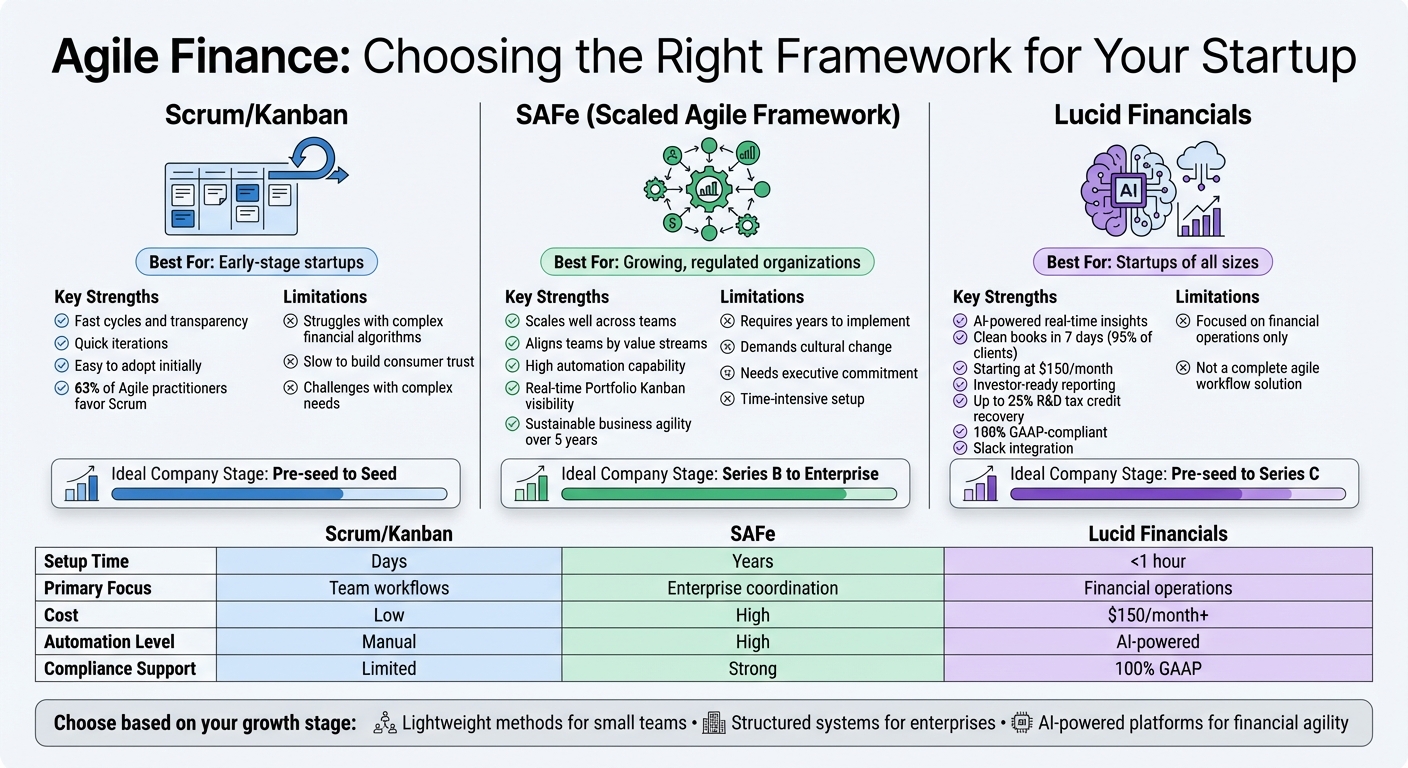
Agile Finance Frameworks Comparison: Scrum, SAFe, and Lucid Financials for Startups
Agile Finance Explained: Beyond Annual Budgets 🚀
sbb-itb-17e8ec9
1. Scrum and Kanban for Financial Operations
Scrum and Kanban bring distinct advantages to finance teams in startups. Scrum operates with fixed sprints lasting two to four weeks and includes defined roles like the Scrum Master and Product Owner. This structure works well for tasks such as rolling out new accounting systems or managing yearly budgets. On the other hand, Kanban’s continuous workflow and work-in-progress limits are ideal for handling urgent needs like investor reports or unexpected audits.
Interestingly, 63% of Agile practitioners favor Scrum, making it the most widely used team-level framework. Some startups also lean toward Scrumban, a hybrid method that merges Scrum’s structured retrospectives with Kanban’s visual workflows. This combination helps teams balance long-term projects with the flexibility to respond to immediate needs.
Real-Time Insights
Both Scrum and Kanban rely on visual tools to enhance transparency and identify bottlenecks. By linking documentation with real-time data, finance teams can quickly spot areas where work is delayed - whether it’s during month-end closes or while preparing investor reports. This visibility allows teams to adjust on the fly, which is crucial in fast-changing environments. The ability to make quick, data-driven decisions is a cornerstone of agile financial management.
Ease of Integration
These visual tools also integrate seamlessly with platforms like Jira, Azure DevOps, or Asana. This means teams can stick to their existing workflows while finance gains a unified view to oversee operations. The goal is to create a single source of truth that connects individual tasks to broader financial objectives - without forcing every team to adopt the same processes.
Scalability
For startups eyeing growth, frameworks like Scrum of Scrums (SoS) and Nexus offer ways to scale agile practices. Scrum of Scrums is well-suited for coordinating up to 10 teams, while Nexus focuses on managing 3 to 9 teams through a shared product backlog. However, it’s important to ensure that agile practices are consistent before scaling; otherwise, challenges can multiply. These frameworks lay the groundwork for more advanced coordination, which will be discussed in the following section.
2. Scaled Agile Framework (SAFe) for Enterprise Financial Coordination
As startups grow, managing complexity without losing agility becomes essential. This is where the Scaled Agile Framework (SAFe) steps in, offering a way to coordinate enterprise-level operations effectively. SAFe shifts finance from rigid, project-based budgeting to a dynamic model called value stream funding. Instead of funding temporary initiatives, this approach supports long-term teams, enabling businesses to adjust resources flexibly as market conditions evolve. By aligning financial practices with the iterative nature of agile, SAFe ensures both adaptability and strong financial oversight.
Scalability
Traditional budgeting often locks companies into fixed expenditures, making it difficult to respond to shifting priorities. Siddharth from Agile Seekers highlights the contrast:
SAFe replaces this model with Lean-Agile budgeting, which funds long-lived value streams rather than one-off projects.
This flexibility allows finance teams to reallocate resources quickly, based on real-time feedback, rather than being constrained by annual budget cycles. Companies adopting SAFe have reported achieving sustainable business agility over a five-year period.
| Feature | Traditional Budgeting | SAFe Lean-Agile Budgeting |
|---|---|---|
| Funding Focus | Individual Projects | Long-lived Value Streams |
| Decision Authority | Centralized / Top-down | Decentralized (within guardrails) |
| Visibility | Siloed / Annual cycles | Portfolio Kanban / Real-time |
| Adjustment Frequency | Annual / Rigid | Continuous / Adaptive |
| Primary Metric | Cost / Task completion | Business Value Delivered |
Real-Time Insights
SAFe’s Portfolio Kanban tool complements its funding model by offering real-time visibility into investments. This tool provides decision-makers with a clear, side-by-side comparison of potential and ongoing investments using up-to-date data. Finance leaders can track metrics such as "Business Value Delivered" and "Investment Horizons" to test their assumptions before committing resources fully. By eliminating the uncertainty of traditional annual planning, this approach creates a unified, reliable source of information across global operations.
Compliance and Governance
In industries with strict regulations, SAFe introduces financial guardrails to maintain fiscal discipline. These guardrails outline clear policies for fund usage and approval criteria, empowering Agile Release Train (ART) leaders to make swift decisions within defined boundaries. This is particularly important given that 62% of public company board members report that regulatory challenges significantly impact their ability to execute strategies. Siddharth explains:
Financial governance balances budget-setting with delegated decision-making.
Instead of relying on annual reviews, SAFe uses quarterly inspect-and-adapt cycles. This is especially valuable in high-risk environments, where compliance leaders rate business risk levels at 7.9 out of 10.
3. Lucid Financials
By leveraging technology, financial operations can become more efficient and adaptive. While methodologies like Scrum and SAFe offer structured approaches for agile finance, Lucid Financials takes a technology-driven path. This AI-powered platform combines bookkeeping, tax services, tax credits, and CFO support, specifically tailored for fast-growing startups.
Scalability
When startups experience rapid growth, traditional accounting services often struggle to keep up. Lucid Financials, however, delivers clean, accurate books within seven days for 95% of its clients. For instance, a SaaS company scaling from 10 to 100 employees managed a fivefold revenue increase - from $1,000,000 to $5,000,000 annually - without requiring additional setup. The platform’s AI-driven system adjusts automatically to handle the complexities of multi-entity structures and increasing transaction volumes, all without proportional cost increases. This ensures financial operations stay seamless, providing investor-ready reporting at any revenue level, whether it’s $1,000,000 or $50,000,000 annually.
Real-Time Insights
Lucid Financials integrates with Slack to deliver instant financial updates, such as formatted reports or metrics like $1,250,000 in revenue. By processing live data from linked accounting systems, the platform provides immediate insights into cash runway, burn rates, and spending trends. In one scenario, a startup identified a $150,000 tax credit opportunity during a funding round using Lucid’s real-time visibility. This allowed them to redirect R&D spending effectively. The platform’s automated checks for tax credit eligibility have enabled startups to reclaim up to 25% of their R&D expenses in real time, empowering agile decision-making across the board.
Ease of Integration
Setting up financial systems shouldn’t slow down fast-moving teams. Lucid integrates seamlessly with tools like QuickBooks, Stripe, and Gusto, allowing implementation in less than an hour. Additionally, it embeds CFO-level insights directly into Slack, where many teams already collaborate. Founders can receive proactive alerts about issues like expense categorization errors or unusual spending patterns. By making financial data easily accessible within existing workflows, Lucid supports quick, informed decisions without the need for separate dashboards or scheduled meetings.
Compliance and Governance
For startups at Series A and beyond, staying compliant while maintaining speed is critical. Lucid combines AI automation with professional expertise to ensure 100% GAAP-compliant books and automated tax filings that adhere to US regulations, including IRS Section 174 R&D credits. Features like role-based access, immutable audit trails, and real-time compliance dashboards help startups stay on top of governance. For example, a startup preparing for a $20,000,000 Series B round used Lucid’s tools to produce audit-ready reports that satisfied investor due diligence requirements. Unlike traditional quarterly reviews, Lucid provides continuous oversight, helping teams avoid penalties while maintaining the agility required in competitive markets. This constant compliance monitoring is as critical to agile finance as iterative planning is to product development.
Pros and Cons
Different approaches to agile finance come with their own benefits and challenges, making it essential to choose the right fit for your specific needs.
Scrum and Kanban are excellent for fast-paced environments, especially for early-stage startups. They shine in enabling rapid iterations and quick learning cycles. As Dipali Trivedi points out, starting with a Minimum Viable Product (MVP) accelerates learning. However, these frameworks often fall short when dealing with the complexities of financial platforms that depend on sophisticated algorithms. Additionally, building consumer trust in financial services takes time, which these frameworks may not fully address.
Expanding on the principles of Scrum and Kanban, SAFe is designed for enterprise-level coordination. It tackles large-scale challenges by creating a unified system of truth across fragmented legacy infrastructures and aligning teams around value streams instead of functional silos. For instance, a highly regulated organization successfully implemented SAFe over five years, achieving high levels of automation in financial closing and harmonized data across global operations. That said, SAFe comes with its own hurdles, including the need for sustained executive involvement and a significant cultural shift over multiple years. Hao Li, iSPCT and Principal Consultant, highlights the challenges finance teams face:
Finance often contends with talent shortages, error-prone manual processes, and data silos from fragmented legacy systems. This makes it difficult to keep the lights on under very tight schedules.
On the other hand, Lucid Financials offers an AI-powered solution tailored for startups. It delivers clean books in just seven days, real-time runway tracking, and instant scenario modeling. With pricing starting at $150/month, it’s an accessible option for startups ranging from pre-seed to Series C. Features like Slack integration and 24/7 support eliminate the need for extra dashboards or meetings, streamlining financial operations. However, its scope is primarily limited to financial data and compliance, making it more of a complementary tool rather than a complete agile workflow solution.
Here’s a breakdown of how these options compare:
| Framework/Platform | Key Strengths | Key Limitations |
|---|---|---|
| Scrum/Kanban | Quick iterations, fast learning, easy to adopt initially | Struggles with complex financial algorithms; slow to build consumer trust |
| SAFe | Harmonizes data, aligns teams by value streams, enables high automation | Requires years to implement; demands cultural change and executive commitment |
| Lucid Financials | AI-powered speed, real-time insights, affordable at $150/month, investor-ready reporting | Focuses solely on financial operations, not broader agile workflows |
These comparisons highlight how agile finance can reshape decision-making for startups. The right choice depends on your company’s growth stage and specific financial challenges.
Conclusion
The frameworks we've covered offer different approaches to achieving agile finance, tailored to organizations at various stages of growth. The key is to choose a framework that aligns with your company’s current needs and the financial challenges you’re facing.
For early-stage startups, the focus should be on speed and learning through iteration. Approaches like Scrum and Kanban are ideal for their ability to support rapid cycles of improvement. Starting with a Minimum Viable Product (MVP) can help accelerate learning, while targeting a specific beachhead market - a narrower group of customers - allows you to build trust before expanding.
On the other hand, large, regulated organizations often require the structure and depth provided by SAFe. Implementing SAFe involves a commitment to cultural shifts and sustained effort, but it enables better data harmonization and iterative control. Hao Li, iSPCT and Principal Consultant, emphasizes this point:
Finance in highly regulated organizations plays a vital role in steering strategic direction and driving operational excellence with high quality data insights.
For companies that prioritize financial operations, tools like Lucid Financials can simplify processes. Offering AI-driven bookkeeping, real-time runway tracking, and scenario modeling for $150/month, Lucid Financials delivers clean financial records in just seven days. It even integrates with Slack for real-time updates, keeping teams informed and agile.
Ultimately, the right framework depends on your company’s size, growth stage, and the complexity of its financial needs. Lightweight methods suit smaller teams, structured systems work best for larger enterprises, and AI-powered platforms like Lucid Financials can bring agility to financial operations. Select the approach that empowers your organization to make swift, informed, and data-driven decisions.
FAQs
How do I choose between Scrum, Kanban, or SAFe for my finance team?
Choosing the right framework - Scrum, Kanban, or SAFe - depends on your team’s size, workflow, and goals:
- Scrum works well for teams that thrive on iterative cycles and need adaptability to handle changing priorities.
- Kanban is perfect for managing tasks visually and maintaining a continuous flow of work without fixed iterations.
- SAFe caters to larger organizations that require alignment across multiple teams and departments.
Take a close look at your team’s structure and objectives. Whether you prioritize incremental delivery (Scrum), a steady workflow (Kanban), or large-scale coordination (SAFe), aligning the framework to your needs is key.
What metrics matter most for real-time finance decisions?
When it comes to making informed financial decisions on the fly, certain metrics are essential. At the top of the list are cash flow, burn rate, and liquidity. These indicators provide a clear picture of a company's financial health and its ability to sustain operations.
Tracking these metrics alongside forecast accuracy and revenue growth allows businesses to adapt their strategies as needed. This is especially important for startups operating in fast-changing markets. By integrating real-time data into dashboards, companies can make quicker adjustments, minimize forecasting errors, and better manage cash flow in unpredictable conditions.
How can Lucid Financials help with runway and investor readiness?
Lucid Financials helps businesses stay prepared for both runway management and investor pitches by offering tools for real-time budget adjustments and crafting detailed financial models. These features highlight a company's financial discipline and flexibility - key factors in attracting funding and earning investor trust.