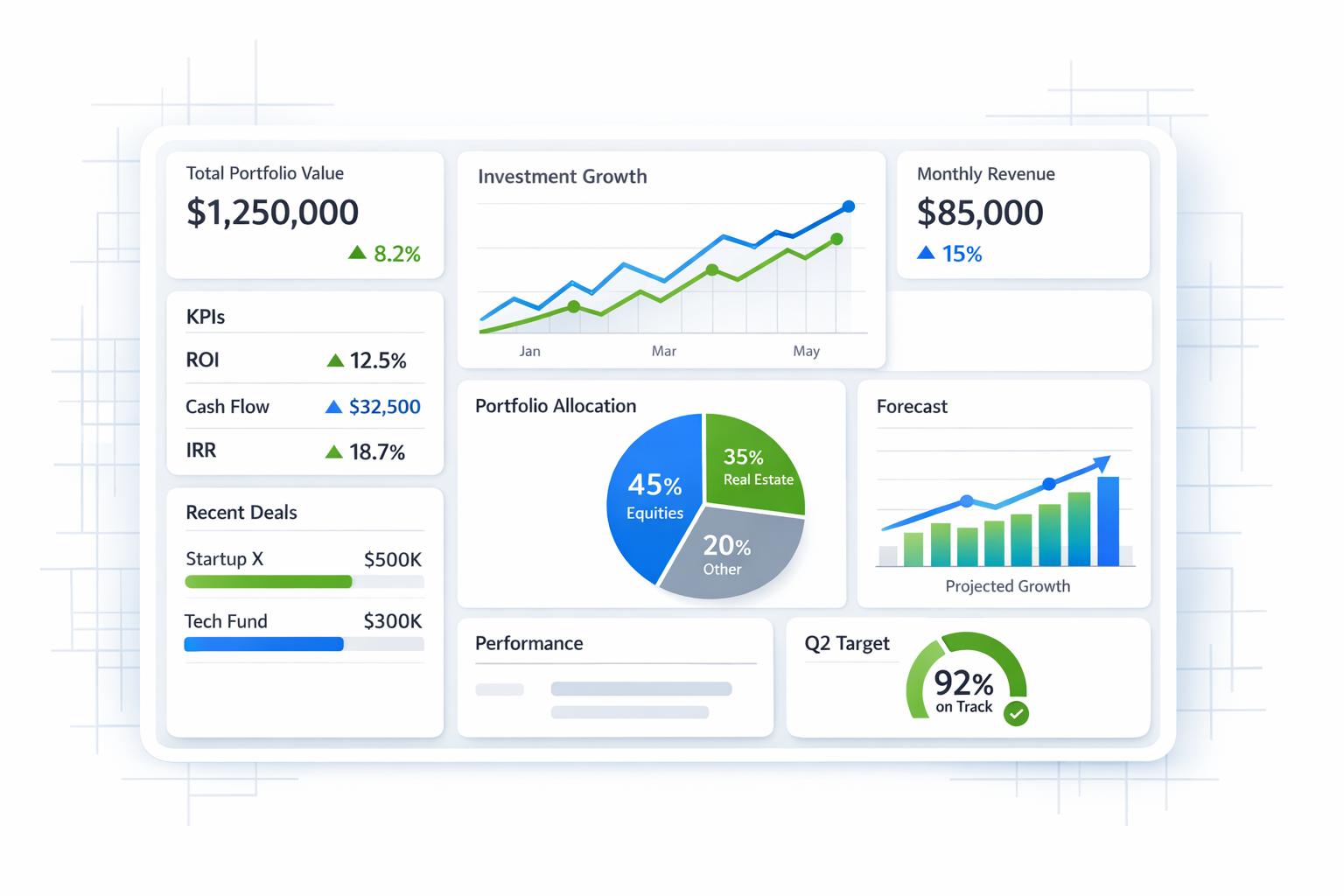
Startups thrive on speed and precision. Real-time financial reporting provides instant access to financial data, helping founders make informed decisions, avoid cash flow issues, and impress investors. With automated tools, startups can cut errors by up to 50%, save time, and reduce costs by up to 30%. Here's what real-time reporting can do for your business:
- Immediate insights into key metrics like burn rate, runway, and revenue.
- Faster decision-making with up-to-the-minute data.
- Improved cash flow management by spotting issues early.
- Higher accuracy through automation, reducing manual errors.
- Increased efficiency by automating repetitive tasks.
- Better teamwork with shared access to financial data.
- Early risk detection to prevent financial pitfalls.
- Stronger financial planning with dynamic forecasting.
- Investor readiness with always-accurate reports.
- Cost savings by automating processes and reallocating resources.
Real-time systems, like Lucid Financials, integrate with tools like Slack to provide instant updates, helping startups stay agile and focused on growth. With 82% of businesses failing due to poor cash flow, adopting real-time reporting is a smart move to stay competitive.
Modern AI ledgers for Accounting & Finance Teams: Replace QuickBooks & Automate with Jeff Seibert
1. Instant Access to Financial Data
Traditional financial reporting often leaves founders waiting weeks for updates, which can lead to missed opportunities and worsen cash flow problems. Real-time financial systems, on the other hand, provide immediate insights, allowing founders to make proactive adjustments as needed.
With these systems, founders can instantly check cash balances, revenue streams, and expenses. This means they can respond right away to sudden dips or spikes, taking corrective action before issues spiral out of control. For example, real-time data keeps founders constantly aware of critical metrics like burn rate, runway, and cash position, enabling them to address potential problems early before they escalate.
Platforms like Lucid Financials showcase the power of instant access. Founders can simply query Slack to get real-time updates on key metrics like runway, expenses, or revenue trends. This kind of accessibility turns financial management into an ongoing, proactive process rather than a periodic chore.
"As we scaled, budgeting and cash flow became critical. Lucid's CFO services give us the visibility we need, while their bookkeeping and tax support keep everything accurate and stress-free. It's been a game-changer for our operations." – Luka Mutinda, Founder and CEO @Dukapaq
This level of proactive management isn’t just about operational efficiency - it also builds trust. Stakeholders like investors, board members, and team leads can verify the company’s financial health at any time, fostering accountability and supporting smarter decision-making throughout the organization.
For startups operating on tight margins, real-time access is more than a convenience - it’s essential. Immediate visibility into metrics like customer acquisition cost (CAC), gross margin, and recurring revenue allows founders to act quickly, whether it’s to avoid shortages or seize growth opportunities that can push the business forward.
2. Faster Decision-Making
In fast-paced markets, delays can be costly. Real-time financial reporting reshapes how quickly startups can adapt, respond to challenges, and seize opportunities. Instead of waiting weeks for monthly updates, founders can now make crucial decisions using up-to-the-minute data - sometimes within hours or even minutes. This speed allows startups to tackle problems head-on as they emerge.
With instant access to financial data, you can adjust marketing budgets immediately when revenue dips, accelerate hiring after landing a new contract, or renegotiate payment terms before cash flow becomes a problem.
Take customer acquisition costs, for example. A sudden spike could drain your runway. Traditional reporting might reveal this issue weeks later - too late to prevent overspending. Real-time systems, however, flag the problem right away, giving you the chance to pause campaigns, refine targeting, or shift budgets before the situation worsens.
AI-powered tools make financial management exponentially faster. They can generate detailed financial scenarios in seconds, letting founders compare best-case, worst-case, and actual outcomes in real time. This enables quicker, more confident decisions about growth strategies.
"Their CFO insights give us clarity to plan growth with confidence - it feels like having a full finance team on demand." – Aviv Farhi, Founder and CEO @Showcase
The competitive edge becomes even sharper when considering industry benchmarks. Real-time access to metrics like customer acquisition cost (CAC) and burn rate allows immediate comparisons to industry standards. If your CAC suddenly exceeds the norm, you can investigate and make adjustments right away, rather than waiting for quarterly reviews to reveal the issue.
Lucid Financials demonstrates this speed advantage with its Slack integration. Founders can query their financial status in real time - asking questions like "What’s our current runway?" or "How did last week’s marketing spend perform?" - and receive instant, accurate answers. This eliminates the delays that come with manual reporting processes.
Beyond individual decisions, real-time data enhances team collaboration. When everyone has access to current financial metrics, team-wide decision-making becomes faster and more effective. Marketing can tweak spending based on real-time ROI, sales can refine pricing strategies using current margin data, and operations can allocate resources according to up-to-date cash flow - all without waiting for formal reports.
The stakes are high: 82% of businesses fail due to poor cash flow management. Real-time reporting directly addresses this risk by ensuring decisions about spending, cash allocation, and growth investments are grounded in current realities, not outdated assumptions. Spotting and responding to cash flow trends early can significantly reduce the risks startups face.
3. Better Cash Flow Management
Real-time reporting takes cash flow management to a whole new level, giving startups instant visibility into their finances. With this immediate access, you can catch potential cash flow issues early - before they snowball into bigger problems. Think of it as having a constant pulse on your financial health, ensuring you're never caught off guard.
Traditional monthly reports often leave businesses playing catch-up. By the time you realize client payments are delayed or expenses are higher than expected, you might already be in a tough spot. Real-time systems, on the other hand, flag these patterns as they happen, allowing you to take swift action - like chasing overdue invoices or postponing non-essential spending.
For startups operating on tight budgets and limited runway, this kind of proactive cash management is critical. Even minor disruptions can have major consequences. Real-time reporting helps you stay ahead by providing a clear, up-to-the-minute view of your financial position, reducing the risk of surprises.
Automated systems make this possible by tracking every transaction as it happens. You can see when payments land in your account, when expenses are deducted, and how these movements impact your cash flow. This detailed visibility not only helps you spot trends but also enables smarter spending decisions, something that periodic reporting simply can't match.
Forecasting cash flow also becomes more precise with real-time data. Instead of relying on outdated snapshots, you can plan for upcoming expenses - like payroll or equipment purchases - and identify potential funding gaps well in advance. This forward-looking approach means you're prepared, not scrambling, when cash flow gets tight.
Real-time insights also empower better resource allocation. Knowing exactly how much cash is available and when major expenses are due lets you focus on investments that fuel growth while avoiding wasteful spending. This disciplined approach can extend your runway and support sustainable scaling.
Take Lucid Financials, for example. Their Slack integration allows founders to instantly check critical metrics like cash position, burn rate, and runway. No need to wait for monthly reports or crunch numbers manually. With AI-driven insights, the platform highlights trends and generates scenarios to aid confident cash flow planning - giving you the tools to make informed decisions every day.
Automated systems also cut reporting errors by up to 50%. When data is captured and reconciled automatically, you eliminate the manual mistakes that can lead to costly miscalculations. For startups, where every dollar counts, this accuracy is non-negotiable.
4. Higher Financial Accuracy and Fewer Errors
Real-time financial systems do more than just improve cash flow management - they significantly reduce errors, bringing a new level of precision to bookkeeping. Manual processes are prone to mistakes like transposed numbers, missed transactions, or duplicate entries. By automating data capture and reconciliation, real-time systems can cut financial reporting errors by as much as 50% compared to manual methods.
These systems instantly capture transactions from sources like bank accounts, payment processors, and invoicing platforms. Instead of waiting for someone to log payments or expenses manually, the system records them right away and matches them against your books. This real-time reconciliation ensures that discrepancies - whether it's a duplicate charge or a mismatched payment - are flagged immediately rather than being discovered weeks later during month-end reviews.
Automation also provides built-in safeguards. If a payment doesn’t align with an invoice or an expense seems unusual, the system alerts you instantly. This proactive approach helps prevent small errors from snowballing into larger financial issues.
The benefits of this accuracy go beyond just numbers. Accurate, up-to-date financial data builds trust with investors and stakeholders, allowing them to make decisions with confidence. For startups, this trust can be a game-changer, enabling quick responses to opportunities or challenges.
Compliance is another key advantage. Accurate records help startups meet regulatory requirements and avoid penalties from errors in tax filings or financial reports. Well-organized documentation also makes audits much smoother, reducing stress and risk for your team.
A great example of this in action is Lucid Financials. Their AI-powered platform combines automation with expert oversight, delivering clean books within just seven days and maintaining always-on, investor-ready reporting. As Refael Shamir, Founder and CEO of Letos, puts it:
"The platform saves us hours every month, and their expert team makes sure nothing slips through the cracks."
This level of accuracy lays the groundwork for better cash flow analysis, budgeting, and forecasting. With precise data, startups can make informed decisions, plan ahead, and allocate resources wisely. For businesses where every dollar counts and investor relationships are critical, this isn’t just helpful - it’s essential for survival and growth. By ensuring financial accuracy, startups not only build stakeholder trust but also create a more collaborative and efficient team environment.
5. Greater Efficiency
Real-time financial reporting is changing the game for startups by automating tasks that once ate up countless hours. Forget the drudgery of manual data entry, reconciliation, and report generation - these systems take over the routine, leaving your team free to focus on scaling your business.
The productivity boost is hard to ignore. Real-time reporting can increase efficiency by as much as 40% by cutting out repetitive tasks. Things like invoicing, tracking expenses, reconciling bank accounts, and processing payroll happen automatically, with data flowing smoothly between your business systems.
Advanced tools powered by AI take it a step further, speeding up more complex tasks like tax filings, optimizing R&D credits, and financial planning. These tools can generate financial scenarios on the spot, compare projections, and prepare investor-ready reports - all without needing manual input. The result? Faster decision-making that ripples across your entire operation.
Erez Lugashi, Founder and CEO of Abilisense, sums up the impact:
"Tracking finances used to be overwhelming. With Lucid handling bookkeeping, taxes, and CFO support in one place, everything is organized, automated, and easy to manage. It's given me real peace of mind."
Automation also improves accuracy across departments. When your financial system syncs directly with tools for inventory management, CRM, and payroll, data flows seamlessly, cutting out duplicate entries and reducing human error. This integration doesn’t just save time - it ensures your resources are spent where they matter most: growing your business.
The beauty of this automation is that it scales with your startup. What once required hiring extra finance staff or outsourcing to pricey accounting firms can now be managed by intelligent systems designed to grow alongside you. This isn’t just about saving time - it’s about building a foundation for sustainable growth.
6. Better Team Collaboration and Transparency
Real-time financial reporting breaks down barriers between departments in startups. When every team has access to up-to-date financial data, they can operate from a single, reliable source rather than relying on outdated or conflicting information. This shared access doesn't just improve cash flow management and decision-making - it equips every team member with insights they can act on. Whether it's marketing, sales, or product development, having real-time figures at their fingertips speeds up decisions and eliminates delays caused by outdated reports. This streamlined approach fosters clearer communication and ensures everyone is aligned on strategy, leading to smarter financial choices.
This level of visibility reshapes how teams interact and make decisions. For example, marketing teams can monitor their campaign budgets in real time, sales teams can track revenue goals as they evolve, and product teams can keep an eye on development costs relative to available resources.
Transparency like this builds trust across the board. When employees, founders, and investors can check the company’s financial health in real time, it reduces uncertainty and boosts confidence in leadership decisions.
But it’s not just about seeing the numbers - it’s about aligning everyone toward common objectives. With instant access to key metrics like burn rate, runway, and revenue forecasts, teams naturally focus on decisions that support the bigger picture. Sales teams can prioritize the most impactful targets, operations can fine-tune spending, and strategies can shift dynamically based on real-time performance.
On top of that, automated real-time systems cut reporting errors by as much as 50%, giving teams confidence in the data they’re using. Reliable numbers are essential - when data is questioned, collaboration often falters.
For startups, where teamwork across functions is critical for growth, democratizing financial information is a game-changer. By giving everyone - not just finance teams - access to the same insights, startups empower all team members to contribute meaningfully to strategic discussions and act more swiftly.
Collaboration thrives when teams can evaluate scenarios together. Real-time systems allow for instant generation and comparison of financial projections, helping everyone visualize potential outcomes and decide on the best course of action. This collective decision-making strengthens commitment and execution across the organization, driving sustainable growth through agile teamwork.
sbb-itb-17e8ec9
7. Early Risk Detection
Real-time financial reporting is changing the game for startups, making it easier to spot and tackle financial threats as they arise. Instead of uncovering problems weeks or months after they've already caused harm, you can address issues in the moment and stop them from spiraling out of control.
The advantage of instant visibility is that you’re no longer stuck relying on outdated monthly reports. Imagine your marketing team accidentally launching an unapproved campaign that’s quickly draining your budget. With real-time reporting, you’d catch it within hours, not at the end of the month when the damage is done. Or, if a key client delays payment or revenue suddenly dips, these systems flag the issue immediately, giving you the chance to adjust your strategy. This kind of immediate feedback sharpens your ability to keep a close eye on cash flow.
For startups working with slim margins, cash flow monitoring becomes a lifeline. Spotting shifts in spending patterns early can help you avoid running out of funds when it matters most.
These systems are particularly effective at identifying risks like revenue declines, fraudulent transactions, delayed payments, and unusual expenses. Left unchecked, these issues can threaten your business, but with real-time alerts, they become manageable.
Automation adds another layer of protection by flagging risks as they happen. Real-time platforms analyze your financial data continuously and send alerts through tools like Slack, so you can respond immediately without waiting for manual reviews. For example, Lucid Financials combines automation with expert oversight, reducing errors and improving the speed and accuracy of risk detection.
Another game-changer is the ability to simulate financial scenarios to predict potential risks. By modeling different outcomes, you can make informed decisions to prevent future problems rather than scrambling to fix them after the fact. These early warnings not only avert crises but also align with your broader financial strategy.
Here’s why this matters: 82% of businesses fail due to poor cash flow management. Real-time visibility and quick action can mean the difference between catching a solvable issue and facing a crisis that jeopardizes your startup’s survival.
Benchmarking and automated alerts work hand in hand to strengthen risk detection. With access to real-time industry benchmarks, you can spot deviations in metrics like Customer Acquisition Cost (CAC). At the same time, automated alerts notify you of cash flow problems or budget overruns before they escalate.
Without early risk detection, startups face delayed reactions, mounting losses, cash shortages, missed chances to correct course, and even reduced investor confidence - all of which increase the risk of failure. Real-time financial reporting offers a proactive way to avoid these pitfalls and keep your business on solid financial footing in an unpredictable world.
8. Improved Financial Planning and Forecasting
Real-time financial reporting takes the uncertainty out of planning by providing precise, up-to-date metrics. With accurate data at your fingertips, forecasting becomes far more reliable, reducing errors by up to 50%. This means your financial projections are based on solid numbers, not guesswork.
When cash flow statements, revenue trends, expense tracking, and accounts receivable data are updated in real time, they become the cornerstone of effective planning. This comprehensive overview allows you to quickly spot patterns and address potential financial needs before they escalate. For instance, if you notice a steady rise in customer acquisition costs or a seasonal dip in revenue, you can adjust your budget and forecasts immediately, rather than scrambling to react weeks later.
Real-time data also makes it possible to generate multiple scenarios on demand, giving startups the flexibility to plan for best-case, worst-case, and most likely outcomes. This capability is especially valuable when exploring growth opportunities or preparing for market changes. AI-powered tools can automatically create and compare these scenarios, enabling you to make informed decisions about where to allocate resources for maximum impact.
With real-time visibility, resource allocation becomes more strategic. You can fine-tune budgets based on current performance and emerging opportunities. This agility ensures you’re not overspending in areas that aren’t delivering results, while allowing you to invest more in initiatives that are driving success.
For businesses scaling their operations, having real-time financial data is critical for making confident decisions. Whether it’s deciding when to hire additional team members or determining how much to invest in marketing, access to current burn rate and runway data ensures your choices align with your financial realities. This is especially important considering that 82% of business failures are linked to poor cash flow management.
"As we scaled, budgeting and cash flow became critical. Lucid's CFO services give us the visibility we need, while their bookkeeping and tax support keep everything accurate and stress-free. It's been a game-changer for our operations." - Luka Mutinda, Founder and CEO, Dukapaq
Real-time forecasting also simplifies investor relations. You can prepare polished fundraising materials and board-ready reports without scrambling for last-minute updates. With forecasts grounded in current performance metrics, you meet investors’ expectations for transparency and accuracy, building trust and credibility.
"Their CFO insights give us clarity to plan growth with confidence - it feels like having a full finance team on demand." - Aviv Farhi, Founder and CEO, Showcase
Integrating real-time data into financial planning and analysis (FP&A) has become the norm, allowing startups to make faster decisions and create more accurate forecasts. This approach empowers businesses to respond to market shifts, test pricing strategies, and seize profitable opportunities more quickly. With these insights, your forecasting doesn’t just react to changes - it actively drives your strategic planning.
9. Constant Investor Readiness
Being prepared for investors at all times is a game-changer for your startup’s financial strategy. When you’re scrambling to put together financial reports, it can delay crucial investor meetings. Real-time financial reporting eliminates this hassle by keeping your data up to date, allowing you to generate investor-grade reports and forecasts instantly. Whether it’s a best-case, worst-case, or actual scenario, you’ll have the numbers ready when you need them.
Having current and accurate financial data presented professionally signals strong financial controls and organizational maturity to potential investors. This becomes particularly critical during due diligence. Outdated or inconsistent numbers can not only derail deals but also harm your reputation with investors.
With real-time systems, you can respond to investor questions in hours rather than days. Automated processes reduce reporting errors by up to 50%, while insights into key metrics like burn rate and runway provide the confidence you need in investor conversations. You’ll be able to clearly demonstrate how spending patterns impact your timeline and show how additional funding could fuel growth, giving investors the reassurance they’re looking for.
But it’s not just about the numbers. Real-time systems also give you access to strategic market insights. You can instantly pull industry benchmarks, including metrics like customer acquisition cost (CAC), valuation multiples, and competitor data. This added context helps you position your startup effectively, answering investor questions with a market-savvy perspective.
Board meetings also benefit from this approach. When everyone works from the same up-to-date data, there’s no time wasted explaining outdated reports or fixing discrepancies. Instead, discussions can focus on strategy and growth. You can generate investor and board reports instantly, ensuring clear and consistent communication with stakeholders. This transparency builds trust and strengthens long-term relationships.
Lucid Financials simplifies these processes further. Their AI-powered platform continuously generates board-ready reports and investor-grade forecasts, combining real-time data with expert oversight. This ensures your financials are always accurate and accessible, giving investors the confidence to dive deeper into your business.
It’s worth noting that 82% of business failures are linked to poor cash flow management. Real-time reporting provides the visibility you need to avoid this outcome, enabling informed decision-making and effective communication with investors. This can even extend your operational runway when you’re seeking additional funding.
Today’s investors expect this level of financial sophistication. Without it, startups face longer due diligence processes and greater scrutiny. By staying consistently investor-ready, you position your startup as a professional and well-managed opportunity - exactly the kind of business serious investors are eager to support.
10. Cost Savings and Better Resource Use
Real-time financial reporting takes the hassle out of tedious tasks by automating them and providing instant transaction insights. This not only simplifies workflows but also helps cut costs, allowing businesses to reallocate resources toward growth-oriented initiatives.
Automation slashes overhead expenses. Startups using real-time financial reporting have reported up to a 30% drop in accounting and administrative costs, thanks to more efficient processes. Beyond saving money, automation also reduces the likelihood of costly errors.
Fewer errors mean fewer headaches - and real savings. Automated systems can lower mistakes by up to 40% compared to manual data entry. This translates to less time spent fixing issues, reduced compliance risks, and fewer penalties.
Another big win? Real-time reporting ensures better financial oversight. It provides instant access to cash inflows and outflows, enabling your team to track every dollar with precision. By automating routine tasks, finance teams can shift their focus to delivering strategic insights rather than getting bogged down by repetitive processes.
When integrated with other business systems like payroll and inventory, the savings multiply. These integrations eliminate duplicate work, reduce manual input, and streamline operations. Over time, this approach not only lowers dependence on external auditors but also cuts compliance-related costs and storage expenses tied to paper documentation. Together, these efficiencies pave the way for sharper financial insights and smoother operations.
Lucid Financials takes these benefits to the next level with its AI-powered tools, making financial management up to 100x faster. Starting at just $150 per month, Lucid Financials offers a complete package, including bookkeeping, tax management, and CFO-level insights. It's a smart way for startups to stay lean while scaling efficiently.
Comparison Table
Compare standard and real-time financial reporting side by side.
| Feature | Standard Financial Reporting | Real-Time Financial Reporting |
|---|---|---|
| Data Update Frequency | Monthly, quarterly, or annually | Instantly as transactions occur |
| Data Accessibility | Periodic access requiring compilation | 24/7 instant access to current insights |
| Decision-Making Speed | Delayed, based on historical data | Immediate decisions using current data |
| Financial Accuracy | Higher risk of manual errors | Up to 50% fewer errors through automation |
| Cash Flow Visibility | Reactive, periodic snapshots | Proactive, continuous monitoring |
| Risk Detection | After-the-fact identification | Early warning system for potential issues |
| Investor Readiness | Requires time to prepare reports | Always-on, instant report generation |
| Operational Efficiency | Manual processes, time-consuming | Automated workflows, streamlined operations |
| Cost Savings | Higher labor and administrative costs | Up to 30% reduction in accounting expenses |
| Integration Capabilities | Often siloed systems | Seamless integration with business tools |
| Compliance Management | Manual checks and reconciliation | Automated compliance monitoring |
| Financial Planning | Static, periodic forecasting | Dynamic scenario planning and comparisons |
This side-by-side comparison highlights how real-time financial reporting transforms the way startups manage their finances. With instant updates, 24/7 access, and automated workflows, real-time reporting eliminates many of the delays and inefficiencies tied to standard reporting methods.
For instance, automated systems can cut errors by up to 50%, ensuring greater accuracy in your financial data. Similarly, real-time reporting supports continuous cash flow monitoring and early risk detection, giving startups the ability to act quickly on potential issues. These advantages mean decisions are based on current data, not outdated snapshots.
The cost benefits are also hard to ignore. By automating processes and reducing manual labor, startups can lower accounting expenses by up to 30%. This not only saves money but also frees up resources to focus on growth.
Real-time reporting doesn’t just enhance operational efficiency - it positions startups to seize opportunities and adapt to challenges without delay. Tools like Lucid Financials make this possible by offering an AI-powered platform that delivers real-time insights, streamlining operations while keeping your financial strategy agile and resilient.
Conclusion
In today’s fast-moving market, real-time financial reporting has become a cornerstone for startups aiming to stay competitive. Statistics show that poor cash flow management is a major challenge for startups, making instant access to accurate financial data not just helpful, but essential.
The advantages are clear: startups equipped with real-time insights can quickly adapt to market shifts and prevent costly mistakes, bolstering their operational strength. This constant flow of financial information also builds trust with investors, streamlining fundraising efforts and showcasing the financial health that stakeholders value.
Another major benefit is scalability. Automating repetitive tasks through real-time systems allows startups to redirect resources toward strategic growth. This efficiency becomes even more critical as financial operations grow more complex, further reinforcing investor trust.
AI-driven tools like Lucid Financials take these benefits to another level. By accelerating financial management processes - up to 100 times faster - and offering a full range of services, from basic bookkeeping to high-level financial insights, platforms like Lucid Financials simplify operations and provide unparalleled clarity.
For startups focused on growth, real-time financial reporting isn’t just an added bonus - it’s the backbone of confident decision-making, investor trust, and scalable success. These insights lay the groundwork for startups to thrive and adapt in an ever-changing, competitive landscape.
FAQs
How can real-time financial reporting help startups manage cash flow more effectively?
Real-time financial reporting empowers startups to manage their cash flow effectively by providing current insights into income and expenses. With this information, founders can identify patterns, prevent overspending, and plan for future growth with greater confidence.
Access to accurate, up-to-the-minute data enables startups to make better budgeting decisions, maintain adequate cash reserves, and quickly adapt to unexpected financial shifts. This forward-thinking approach is essential for keeping finances on track and ensuring steady growth.
What sets real-time financial reporting apart from traditional reporting?
Real-time financial reporting offers immediate insights into your company's financial standing, unlike traditional methods that depend on periodic updates like monthly or quarterly reports.
By using real-time reporting, you gain instant access to accurate data, enabling quicker and more informed decision-making. This not only cuts down on delays but also reduces errors, keeping you ready for investor meetings or strategic planning at any moment. On the other hand, traditional reporting, while still valuable, can leave you working with outdated information, creating potential gaps in understanding.
How does real-time financial reporting help startups get ready for investor meetings?
Real-time financial reporting equips startups with precise, current financial data right when they need it. This means you're ready to confidently discuss your company’s financial health, growth trends, and spending habits during investor meetings.
With instant access to well-organized, clear reports, you can respond to investor questions on the spot and showcase a solid understanding of your financials. This kind of preparation not only builds confidence but also portrays your startup as a professional and investment-ready venture.