
Eligible physician owners can deduct $5 per square foot of qualifying home office space, up to $1,500 a year - not per clinic. First, check that the space meets IRS rules for exclusive, regular business use.
With enough business income, the simplified method produces:
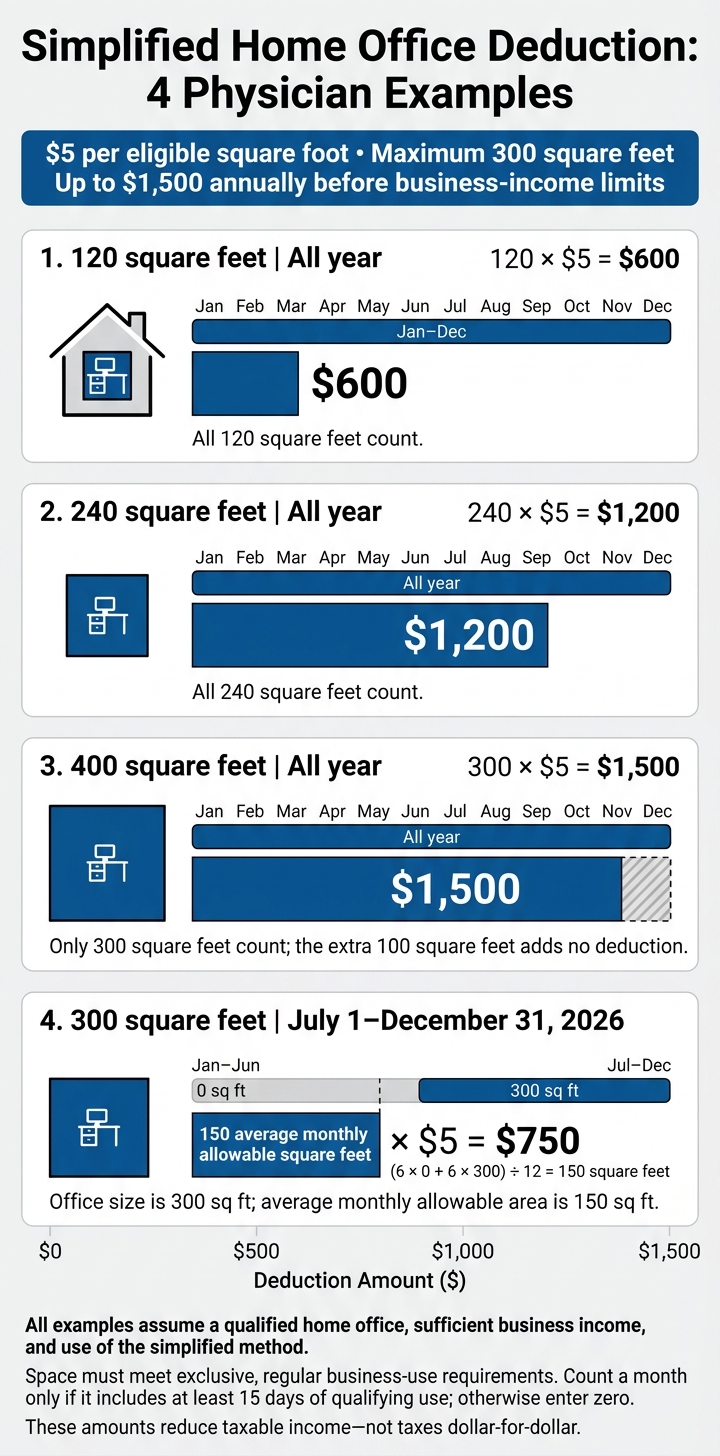
- 120 square feet, all year: $600.
- 240 square feet, all year: $1,200.
- 400 square feet, all year: $1,500 because only 300 square feet count.
- 300 square feet, July through December: $750.
Multiple businesses using the same home share the 300-square-foot cap. Partial-year use and business-income limits can reduce the deduction, and unused simplified-method amounts don’t carry forward.
The deduction reduces taxable income - not taxes dollar-for-dollar. Before filing, compare the simplified and regular methods, document space and use dates, and confirm the reporting or reimbursement rules for your medical practice.
Turn your home office into a tax deduction!
sbb-itb-17e8ec9
4 Hypothetical Examples by Office Size and Start Date
Simplified Home Office Deduction: 4 Physician Examples
All four examples assume a qualified home office, enough business income to use the deduction for private practices, and the simplified method. Only office size and start date change, making the cap easy to see.
120 and 240 Square Feet: $600 and $1,200 Deductions
120-square-foot office. A physician has a dedicated 120-square-foot room used exclusively and regularly for business all year: 120 × $5 = $600. All 120 square feet count because the office is below the cap.
240-square-foot office. Another physician uses a dedicated 240-square-foot home office for business administration all year: 240 × $5 = $1,200. The deduction doubles because both offices are still under the 300-square-foot cap.
400 Square Feet: A $1,500 Deduction
400-square-foot office. A physician uses 400 qualifying square feet all year, but only 300 square feet count under the simplified method: 300 × $5 = $1,500. The extra 100 square feet adds no deduction.
300 Square Feet Starting July 1: A $750 Deduction
300-square-foot office, partial year. A physician begins qualifying use on July 1, 2026, and continues through December 31, 2026. Use 0 for January through June and 300 for July through December, then average over 12 months: 150 × $5 = $750.
The start date matters because the simplified method uses average monthly allowable square footage. Count a month only if it includes at least 15 days of qualifying use. Otherwise, enter zero for that month.
Next, the cap stays the same even when the physician owns more than one clinic. This applies even to complex multi-location medical groups with consolidated reporting needs.
Multiple Clinics Do Not Increase the Home Office Cap
Separate businesses using the same home share one 300-square-foot cap - they don’t each get a home-office allowance. Each activity must also meet the home-office eligibility rules on its own. Here’s how this works for a physician using a home office for two separate activities.
2 Clinics and Consulting: 340 Square Feet
In this hypothetical, a sole proprietor with two staffed, off-site clinics uses 180 square feet at home for practice administration and 160 square feet for consulting, for a total of 340 square feet. Both activities qualify throughout the year and have sufficient business income. Because the simplified method caps the deduction at 300 square feet, the two activities share one cap.
Divide the 300-Square-Foot Allowance Between Businesses
Allocate the 300 square feet proportionally: about 158.82 square feet to administration and 141.18 square feet to consulting. At $5 per square foot, the unrounded allocations produce deductions of about $794.12 and $705.88, for a combined $1,500 before business-specific income limits.
The IRS allows a reasonable allocation, but neither business can claim more space than it actually uses. Don’t count the same space twice.
After dividing the allowance, compare deduction methods to see which produces the better result.
Choose a Deduction Method and Keep Records
Office size affects your deduction. Next, compare methods to see which gives you the better result.
Compare the Simplified and Regular Methods
Compare both methods each year. High home expenses or a large office may make the regular method a better choice. Here’s how the calculations, records, and tax treatment differ.
| Issue | Simplified method | Regular method |
|---|---|---|
| Calculation | $5 per eligible square foot | Actual allowable home expenses allocated to business use |
| Area limit | 300 square feet; maximum $1,500 before income limits | No equivalent 300-square-foot cap |
| Records | Measurements, eligibility, use dates, allocations, and business income | The same records, plus bills, receipts, mortgage records, and depreciation schedules |
| Actual home expenses | Not used to calculate the home-office deduction | Includes the business share of eligible home expenses, such as interest, taxes, insurance, utilities, repairs, and depreciation |
| Depreciation | No home depreciation deduction or depreciation recapture for years when you use the simplified method | Depreciation may apply; keep basis and depreciation records |
| Annual selection | Available each year; your choice is fixed for that year once you file | Choose one method per tax year; a simplified-method election cannot be changed after you file the original return |
Make the simplified-method election on a timely filed original federal return, including extensions. Once you file, you can’t change that year’s choice.
You may still itemize mortgage interest and real estate taxes, subject to the usual limits.
Keep records that support your chosen method for the year.
Record Office Area, Use Dates, and Business Allocations
Keep one annual file with the records below. The simplified method cuts expense tracking - not the need to prove eligibility.
- Area and use: Measurements, a floor plan or photos, and proof of exclusive, regular use for a qualifying business purpose.
- Dates: Eligibility start and stop dates, monthly square footage, and changes in room size or function. Count a month only if qualified use lasts at least 15 days.
- Businesses: Each qualified activity, its period of use, and the basis for reasonable allocations.
- Calculation: The worksheet for your chosen method, plus receipts and depreciation records if you use the regular method.
- Income limit: Business income that supports the applicable limitation. Simplified-method deductions disallowed by that limit don’t carry forward.
Coordinate Entity Books With Tax Records
For practices with multiple entities, keep bookkeeping and tax records aligned.
Lucid Financials can organize entity books and tax records for complex medical practices, but you still need separate documentation of home-office eligibility.
Conclusion: Review Eligibility, Limits, and Records Each Year
In these examples, the simplified method produces $600 for 120 square feet, $1,200 for 240 square feet, and $1,500 for 400 square feet under the 300-square-foot cap; a qualifying 300-square-foot office first used July 1 and used through December produces $750.
These examples are for planning, not guaranteed results. Having multiple clinics does not increase the 300-square-foot cap for the same home. Business income also limits the deduction.
Before filing each year, check eligibility, compare methods, and update your measurements, use dates, and allocations. Ask your CPA to verify entity reporting and reimbursements so you don’t deduct the same expense twice.
FAQs
Can I qualify if I also have an office at my clinic?
Yes. Having an office at your clinic doesn’t automatically disqualify you. Your home office must be used exclusively and regularly as your principal place of business or to meet with patients.
You may still qualify if you handle your primary administrative or management duties at home and see patients at a clinic. Check with your CPA to confirm that your work activities and home office meet IRS requirements.
Can I claim a home office deduction as an S corporation owner?
Physicians who own S corporations can generally get a tax deduction for qualifying home office costs, but how they claim it depends on their entity structure and work arrangements.
As an owner-employee, costs you pay personally are generally treated as unreimbursed employee business expenses, which typically aren't deductible on your federal individual return. Instead, your S corporation may reimburse qualifying costs through an accountable plan and deduct those reimbursements.
Your home office must be used regularly and exclusively for business and meet other applicable requirements. Consult your CPA to confirm eligibility, the proper reporting method, and the records you need under current tax rules.
Can I deduct a home office used for both telehealth and administration?
Yes - generally, if you use the space regularly and exclusively for business. Both telehealth and administrative work can qualify. But the deduction covers the same qualifying home office area - you can’t claim separate deductions for each activity. Using that space for nonqualifying purposes can limit your deduction.