
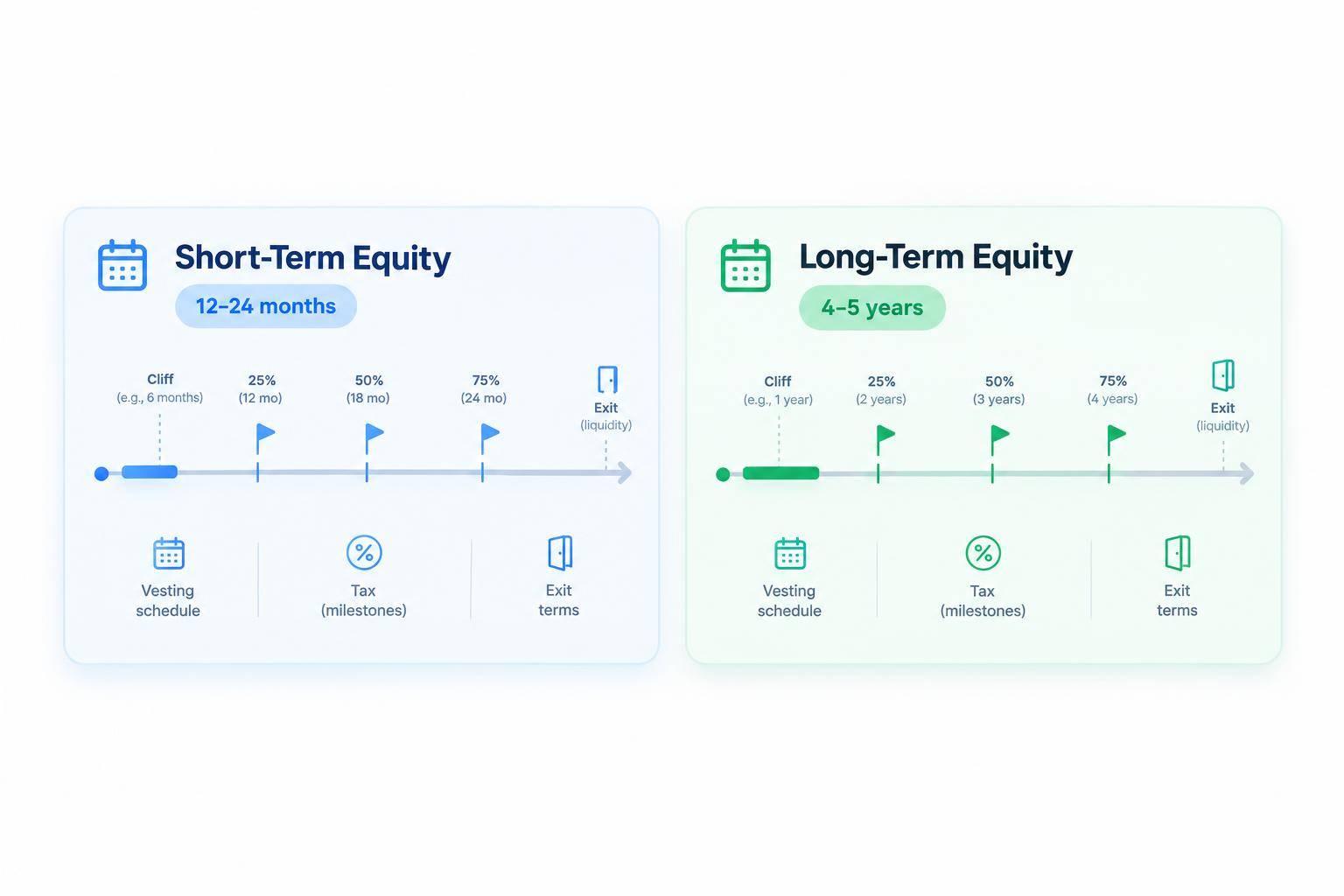
I’d choose 12–24-month vesting for a short assignment and three years or more for a longer service commitment. Neither schedule guarantees results or retention - and vesting doesn’t always mean you own shares or receive cash.
My starting point: decide what earns the award. Time-based vesting rewards service, milestone-based vesting rewards defined results, and hybrid vesting combines the two. Then check ownership eligibility, taxes, payment timing, departure terms, accounting costs, and dilution before issuing it.
Quick Comparison
| Factor | Short-term vesting | Long-term vesting |
|---|---|---|
| Typical duration | 12–24 months | 3–4 years |
| Cliff | None or a short cliff, such as 3–6 months | Often 12 months |
| Installments | Usually monthly or quarterly | Usually monthly or quarterly after the cliff |
| Retention | Unvested incentive ends sooner | Keeps unvested value tied to service longer |
| Administration | Shorter tracking period | More years of tracking |
| Main risk | Incentive ends before lasting value develops | Less appeal to employees expecting a short stay |
For perspective, a 1,200-unit award could be 100% vested after two years on a two-year schedule, versus 50% on a four-year schedule. <u>That changes when rights are earned - not necessarily when shares or cash arrive.</u>
Vesting Schedules Explained: How Startup Equity Works | Employee Stock Options Guide
sbb-itb-17e8ec9
Short-Term vs. Long-Term Time-Based Vesting
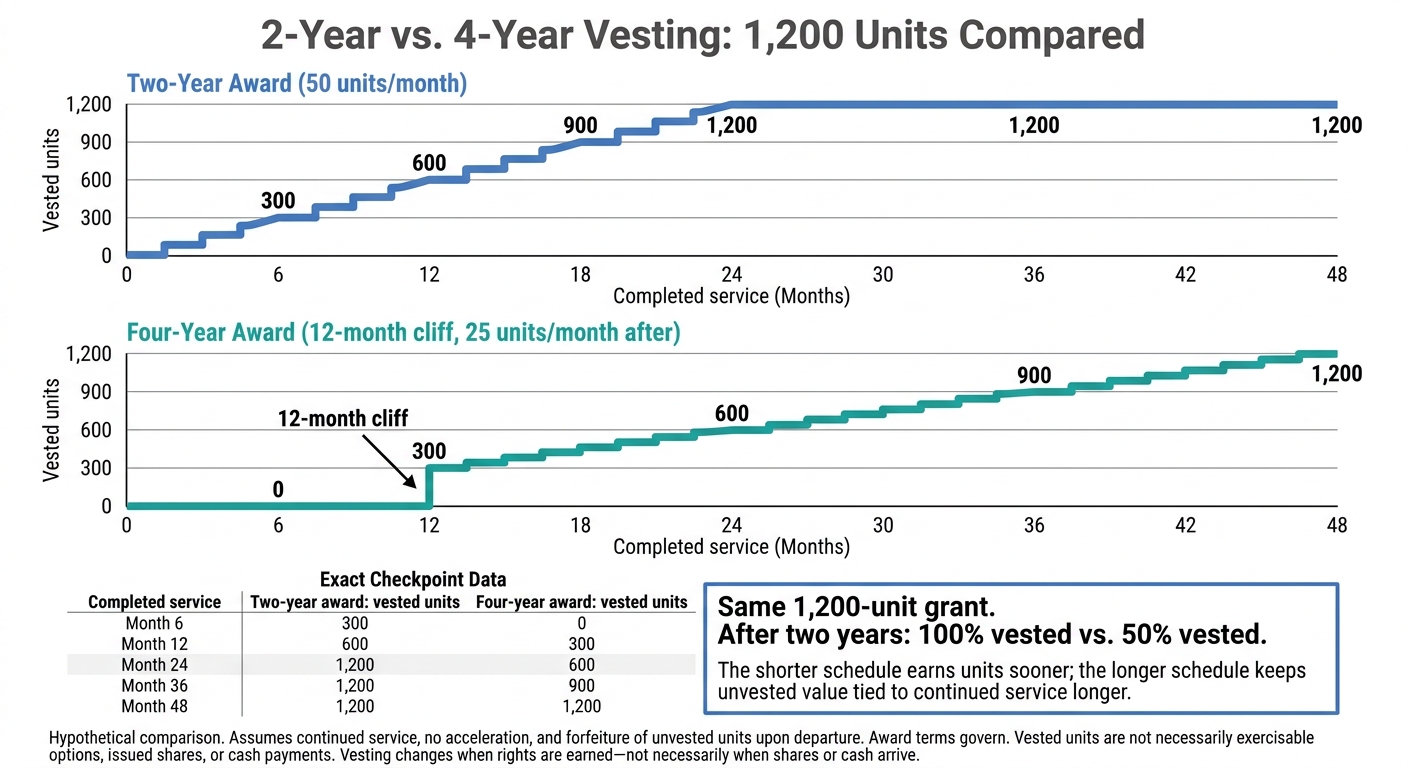
2-Year vs. 4-Year Vesting: 1,200 Units Compared
Time-based vesting rewards continued service, not results. Milestone and hybrid awards add performance conditions, and the agreement sets the exact terms. This distinction shapes the installment schedule, cliff, retention period, and when value is earned.
| Factor | Short-term vesting | Long-term vesting |
|---|---|---|
| Duration | Typically 12–24 months | Typically 3–4 years |
| Cliff | None, or a short cliff such as 3–6 months | Often 12 months |
| Installments | Monthly or quarterly; larger portions may vest earlier or later | Usually monthly or quarterly after the cliff |
| Retention | Employees earn value sooner, but the incentive also ends sooner | Ties unvested value to continued service for longer |
| Administration | Less time to track, but installment and departure records still need to be precise | Requires longer tracking of installments, departures, amendments, and expiration |
| Main risks | Weaker retention after full vesting; less time to link rewards to lasting value | Less appeal for short-tenure employees; more exposure to changes in company value or role |
Longer vesting can spread issuance or exercise across more years, but it doesn't reduce total dilution. Model dilution using the instrument, share reserve, and fully diluted share count.
How the schedule works in practice depends on both the grant size and the vesting period.
Short-Term Vesting: 12–24-Month Examples
A shorter schedule fits an interim executive, a fixed-term assignment, or a short retention need. Monthly or quarterly vesting creates predictable earning; a short cliff delays the first vested installment.
Long-Term Vesting: Multi-Year Schedules
A common startup pattern is four-year vesting with a one-year cliff, then monthly or quarterly vesting. It supports longer continuity, but may appeal less to someone expecting a short tenure.
Example: 1,200 Units Over 2 vs. 4 Years
Hypothetical comparison: Assume continued service, no acceleration, and forfeiture of unvested units upon departure. The two-year award vests 50 units monthly without a cliff. The four-year award vests 300 units at month 12, then 25 monthly through month 48. These are vested units - not necessarily exercisable options, issued shares, or cash payments - and remain subject to the agreement.
The shorter schedule delivers value earlier; the longer one holds more value back for retention.
Completed service Two-year award: vested units Four-year award: vested units Month 6 300 0 Month 12 600 300 Month 24 1,200 600 Month 36 1,200 900 Month 48 1,200 1,200
Once the schedule is set, the next question is whether the award fits the entity, tax, and accounting rules.
Time-Based vs. Milestone-Based vs. Hybrid Vesting
Vesting length and vesting conditions are separate choices. A short-term grant can depend on milestones, while a long-term grant can depend on service. The same 12–24-month or multi-year schedule can use service, milestones, or both.
| Factor | Time-based | Milestone-based | Hybrid |
|---|---|---|---|
| Control | Service is clear; company events remain outside employee control | Higher for individual deliverables; lower for company-wide results | Depends on the service and performance mix |
| Tracking | Low | Medium to high | High: tracks both service and performance |
| Retention | Incentive lasts through the service period | May encourage short-term results | Can reward both continuity and results |
| Administrative complexity | Low | High | High |
| Best fit | Predictable service requirements | Objectively measurable outcomes | Continuity and execution both matter |
If the employee can't control the outcome, add objective adjustment rules or a service-based fallback.
Milestone Vesting: Set Measurable Goals
Separate deliverables from business results. For financial milestones, spell out the baseline, target, measurement period, metric source, and accounting basis.
Decide upfront how the payout works: threshold-based scaling, all-or-nothing vesting, or forfeiture if the target is missed.
Hybrid Vesting: Combine Service and Results
Make clear whether the award requires both service and performance conditions or uses separate service and performance tranches. For combined conditions, set a deadline for meeting both. For separate tranches, specify whether failure to meet one affects the other.
Once you've chosen the vesting type, make sure the agreement matches the entity, tax, and accounting rules.
Tax, Legal, and Accounting Requirements
Once the vesting schedule is set, check it against tax, legal, and accounting rules. Vesting length does not determine tax treatment; the award terms, issuer, and recipient status do. Review the plan and related agreements. Confirm authorized equity, board approvals, valuation support, and securities-law compliance. Make sure award terms, ownership rights, and reporting and withholding duties line up across plan, award, tax, and payroll records.
Check Ownership Eligibility and Entity Rules
Identify the issuing entity, then check ownership restrictions and recipient eligibility before approving the grant. Phantom equity and MSO structures still need counsel review; neither bypasses ownership rules.
Review Tax Events and Election Deadlines
Restricted property generally creates taxable compensation at vesting unless a valid Section 83(b) election shifts taxation to the transfer date. File an eligible election within 30 days after the property transfer and keep proof of filing. This election does not apply to RSUs.
Check upfront taxes and available cash before making the election: tax paid may be lost if the shares are later forfeited. Nonqualified options generally create ordinary income at exercise, while RSUs generally create ordinary income at settlement. Incentive stock options follow separate rules, including potential alternative minimum tax.
Track withholding and settlement deadlines. Have deferred-payment features reviewed for Section 409A compliance, including relevant phantom-equity arrangements.
Next, spell out what happens if the recipient leaves or the company is sold.
Define Departure and Change-in-Control Terms
Set termination, acceleration, repurchase, exercise, and payout rules for each exit event: resignation, dismissal, death, disability, retirement, employment transfer, or sale. Address forfeiture, treatment of vested awards, repurchase pricing, option exercise windows, and expiration.
Single-trigger acceleration depends on the transaction itself. Double-trigger acceleration generally requires both a transaction and a qualifying termination. Neither happens automatically.
Define “cause,” “good reason,” and “change in control.” Specify whether awards will be assumed, replaced, paid out, or canceled. For performance awards, explain how goals will be measured, whether awards will be prorated, and what adjustments apply after departure or sale.
Forecast Compensation Expense, Cash Costs, and Dilution
Model vesting, forfeitures, exercises or settlements, compensation expense, cash needs, and dilution separately. Under ASC 718, equity-classified awards generally use grant-date fair value, with expense recognized over the requisite service period. Expense does not always match the month of vesting. Liability-classified awards may require remeasurement, while cash-settled awards can create payment obligations without issuing shares.
At each close, reconcile award, valuation, payroll, equity, and general-ledger records. Assign expense, liabilities, and ownership to the correct entity, and support consolidated reporting where applicable.
Conclusion: Choose a Schedule for the Role and Entity
Compare vesting length, performance conditions, and compliance limits. Then choose a schedule that fits the role and entity.
Match the schedule to the role and the value created - not just how long you want someone to stay. Add performance conditions only when the recipient controls the outcome and the company can verify the results.
Use the table below to find the simplest schedule that fits the work.
| Schedule | Time horizon | Result alignment | Admin load | Main risk |
|---|---|---|---|---|
| Shorter time-based | Shorter | Limited; rewards continued service | Low | Vesting ends before lasting value is created |
| Longer time-based | Longer | Limited without performance conditions | Low to moderate | Continued service does not guarantee results |
| Milestone-based | Short- or long-term | High with clear goals the recipient controls | Moderate to high | Unclear goals or goals that depend on outside factors cause disputes |
| Hybrid | Short- or long-term | Balances service and results | Moderate to high | Overlapping conditions become hard to explain and track |
Set milestone and hybrid duration around the work, not the label. Put in writing who measures results, how partial achievement counts, and what happens if priorities change.
Before issuing awards, confirm ownership eligibility and available equity pool capacity. Document the award, exit, and change-in-control terms. Model value, expense, cash, and dilution under downside, base, and upside cases. Then get legal and tax review and provide written instructions for any required elections and deadlines.
FAQs
Can I negotiate my equity vesting schedule?
Many U.S. startups use four-year vesting with a one-year cliff, but you may be able to negotiate the terms based on your role and contribution. Senior and executive roles may offer more room to negotiate performance-based triggers or acceleration provisions.
Startups often follow role-based policies to keep exceptions consistent. Make sure any agreed-upon changes appear in your formal grant agreement and match company policy.
Can my company change my vesting terms after a grant?
Vesting terms are usually set when a grant is issued, based on your equity agreement and company plan documents. Companies may change grant sizes or issue additional grants, but they typically don’t change an existing grant’s vesting schedule.
Exceptions require a formal, written business reason and board approval. Changing a grant can also trigger complex accounting and compliance reporting requirements under ASC 718.
How should I compare equity offers with different vesting schedules?
Compare each offer with the U.S. market standard: a 4-year vesting term, a 1-year cliff, and monthly vesting after that. Check whether vesting depends on milestones or puts more shares toward the end of the schedule. Also review whether the terms are fixed and whether the offer includes double-trigger acceleration clauses.
Stock options require you to pay a strike price to exercise them; RSUs don’t. Tax timing also differs, so compare when each award may trigger taxes. Look beyond the grant size: the vesting schedule should fit how long you expect to stay and the performance goals you plan to meet.