
Angel funding means trading future ownership for cash today. My starting point: know how much runway you need, what the money will fund, and how the terms could change your ownership.
Here’s what I’d check before accepting a deal:
- Investor fit: Does the investor fund startups at your stage and in your industry?
- Deal terms: Compare priced equity, convertible notes, and SAFEs, including dilution and investor rights.
- U.S. rules: Review securities requirements and any healthcare ownership limits with counsel.
- Financial readiness: Prepare a cash forecast, cap table, tax records, and measurable milestones.
One limit matters: the sources cover 1 angel round with 8 investors in July 2025 - not a market-wide study. I’d treat it as one example, not proof of likely returns or success.
My bottom line: <u>check the terms and your numbers before signing</u>.
How to Find Angel Investors for Your Startup (2026)
sbb-itb-17e8ec9
2. Funding Terms, Ownership, and U.S. Rules
Angel Funding: Priced Equity vs. Convertible Notes vs. SAFEs
At the seed stage, funding terms shape dilution, control, and compliance.
Priced Equity, Convertible Notes, and SAFEs
Once you’ve chosen the round structure, the deal form determines when dilution happens, how conversion works, and whether repayment is required.
| Instrument | Key ownership and conversion features |
|---|---|
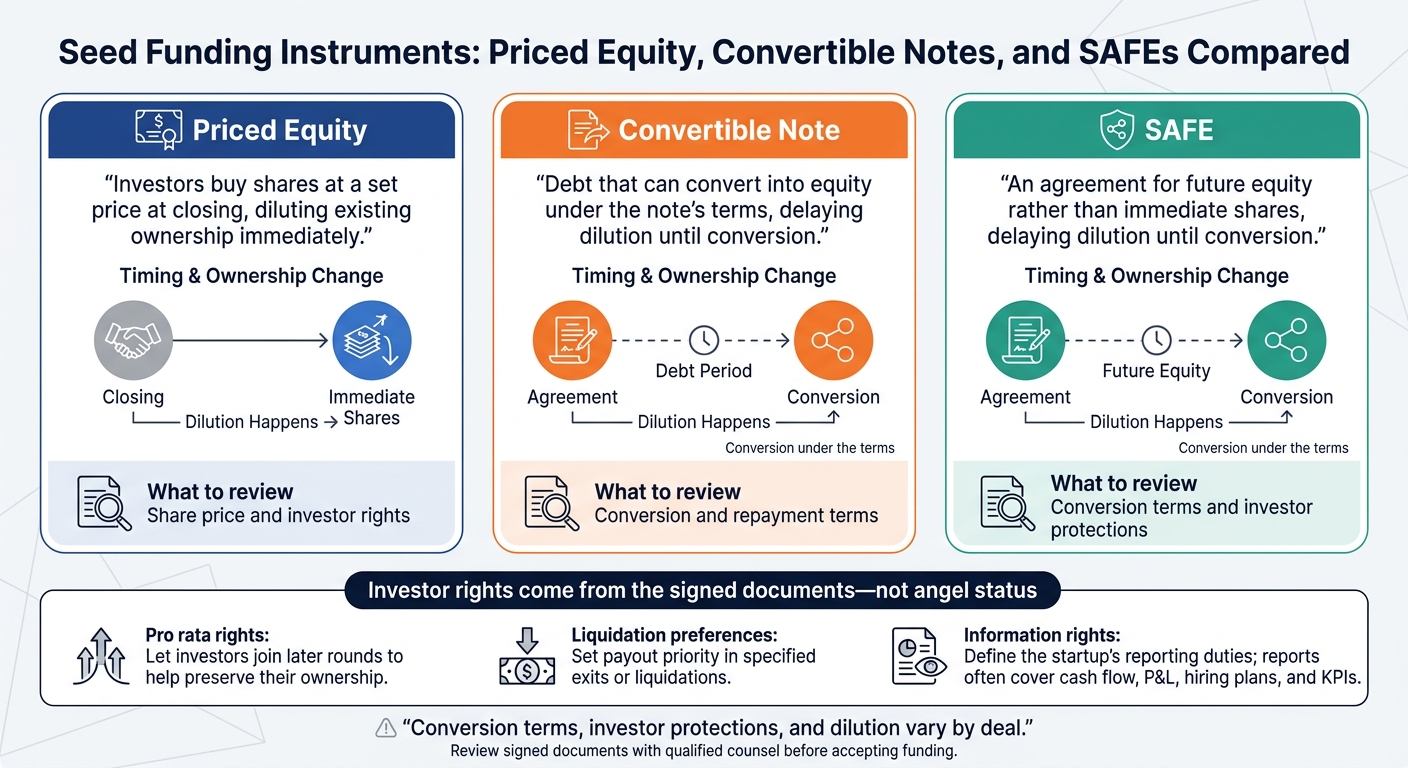
| Priced equity | Investors buy shares at a set price at closing, diluting existing ownership immediately. |
| Convertible note | Debt that can convert into equity under the note’s terms, delaying dilution until conversion. |
| SAFE | An agreement for future equity rather than immediate shares, delaying dilution until conversion. |
Read the documents closely. Conversion terms, investor protections, and dilution vary by deal.
Investor Rights and Shared Funding Rounds
Angel rounds can involve syndication, where several investors join a single round. Investor rights come from the signed documents, not from angel status.
Pro rata rights let investors join later rounds to help preserve their ownership. Liquidation preferences set payout priority in specified exits or liquidations. Information rights define the startup’s reporting duties - and the work those duties require. Reports often cover cash flow, P&L, hiring plans, and KPIs.
These rights and reporting duties must also fit within U.S. securities rules.
Securities Laws and Healthcare Ownership Limits
Choose the securities exemption before soliciting investors. Angel investments typically rely on Regulation D exemptions, especially Rule 506(b) and Rule 506(c). Rule 506(b) generally bars general solicitation. Rule 506(c) allows it if purchasers are accredited investors and their status is reasonably verified.
For healthcare startups, keep clinical ownership separate from nonclinical investment structures. State rules on ownership, fee-splitting, and clinical control may still apply. A management-company structure does not automatically avoid those restrictions. Consult securities, healthcare, and tax counsel before taking capital.
Those rules shape what founders can measure, disclose, and track before closing.
3. Research Findings: Investment Trends and Outcomes
Investment Activity and Follow-On Funding
The supplied sources document one angel round, not a late-2026 market trend or a broader pattern of investment in particular sectors. Treat the earlier case as a single funding example.
Returns, Losses, and Measures of Success
The sources lack enough data to estimate returns, losses, exits, or survival. These outcomes need separate definitions: survival means a startup remains in business; follow-on funding means it secures another investment; exits include acquisitions or public listings; and realized return measures the proceeds investors actually receive relative to their investment.
Research Limits and Cause-and-Effect Claims
The evidence describes what happened, but it does not show cause and effect. It does not separate the effects of angel capital from other factors that shape startup performance.
The next section shifts to founder preparation: runway, milestones, records, and reporting.
4. Financial Preparation for Angel Investor Meetings
Funding Needs, Runway, and Milestones
Once the structure is set, connect your funding request to a revenue model that can scale and repeat, work the team can carry out - not just the founder - and measurable milestones.
Build a monthly cash forecast that accounts for payroll and hiring. Then test how long your cash will last under different spending scenarios.
Business Results and Ownership Records
Support those milestones with customer demand and current business results. Use reporting to show how efficiently you use capital, how the business is gaining traction, and why it can hold its position against competitors.
Keep your cap table current and prepare dilution scenarios. If you run multiple businesses or locations, include an ownership map, distinguish consolidated results from each entity’s profitability, and document transactions between entities.
Financial Records and Investor Reporting
Before meetings, reconcile your financial statements and tax records. Then put together your financial forecasts and an up-to-date investor reporting package.
Lucid Financials combines bookkeeping, tax services, and CFO support to help founders prepare clean, investor-ready reporting for due diligence.
5. Conclusion: Investor Fit and Financial Readiness
The limited evidence in these sources points to investor fit and founder readiness. Look for investors who match your sector, operating needs, and legal structure. These findings are narrow and stage-specific, so apply them only when the geography, industry, and funding stage align.
Next, check whether your funding terms and records are ready for due diligence. Before accepting funding, confirm any healthcare ownership rules that apply and understand dilution and investor rights. Tie the round to measurable milestones backed by reliable financial records.
FAQs
How much equity should I offer angel investors?
When seeking seed funding, aim to offer 15% to 25% equity in exchange for capital. Offering more than 30% can leave you with too little ownership after later funding rounds.
During negotiations, Lucid Financials offers always-on, investor-ready reporting and real-time answers through Slack, helping you keep clean books and track growth metrics.
What happens if my convertible note matures before funding?
If your convertible note matures before you close a new funding round, you’re technically in default. Contact your note holders promptly to negotiate a maturity extension or conversion to equity. Taking action can help you avoid legal complications or a loss of control.
Lucid Financials provides clear, investor-ready financial reporting that gives note holders a view of your company’s financial health and helps build investor confidence during these discussions.
How can I evaluate an angel investor’s track record?
Check investors’ portfolios, typical check sizes, and how often they invest on Crunchbase or PitchBook. Use this information to see whether they fit your startup’s stage, sector, and funding needs. Prioritize investors who have invested in the past 3 to 6 months.
To dig deeper, use Recency, Frequency, and Monetary (RFM) analysis to rank leads based on their engagement history. Review meeting transcripts for comments about deal structures and how much risk they’re willing to take.