
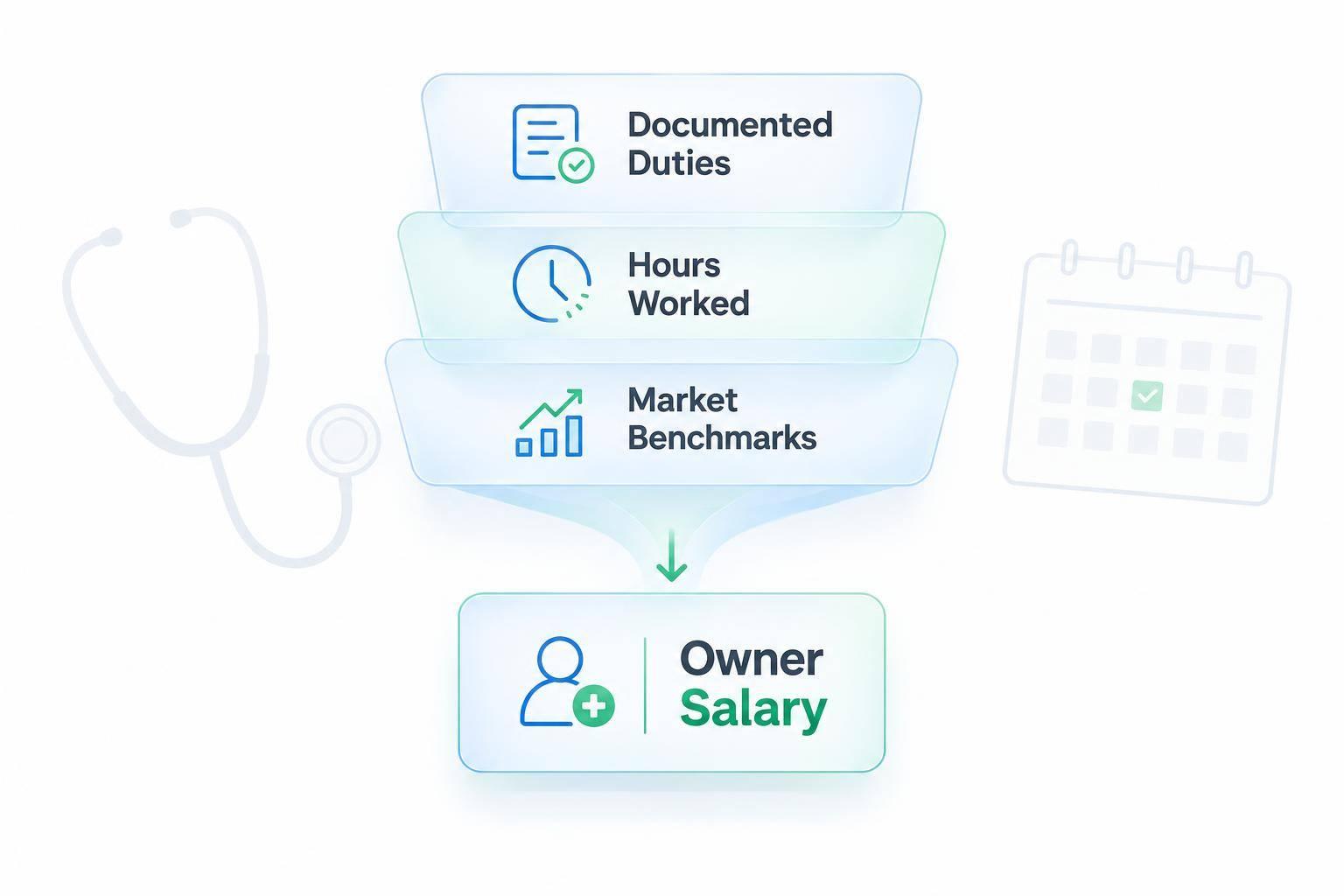
I’d set a medical S-corp owner’s salary based on the work performed - not a fixed percentage of profits. The IRS has no approved salary-to-distribution ratio. Start with documented duties, hours, and market pay, then pay for those services through payroll.
Here’s the process I’d follow:
- Price the work: Compare clinical and management duties with matching pay data, without counting the same hours twice.
- Approve and pay: Document salary and bonuses, run payroll, and keep distributions separate.
- Keep support: Save time logs, pay benchmarks, approvals, and payroll records. For multiple entities, show which entity received the work and paid for it.
- Review before year-end: Check pay with your CPA each year and when duties change. Keep employment-tax records for at least four years after the tax is due or paid, whichever is later.
<u>The goal is a salary you can explain and support</u> - with records that connect your work to your pay.
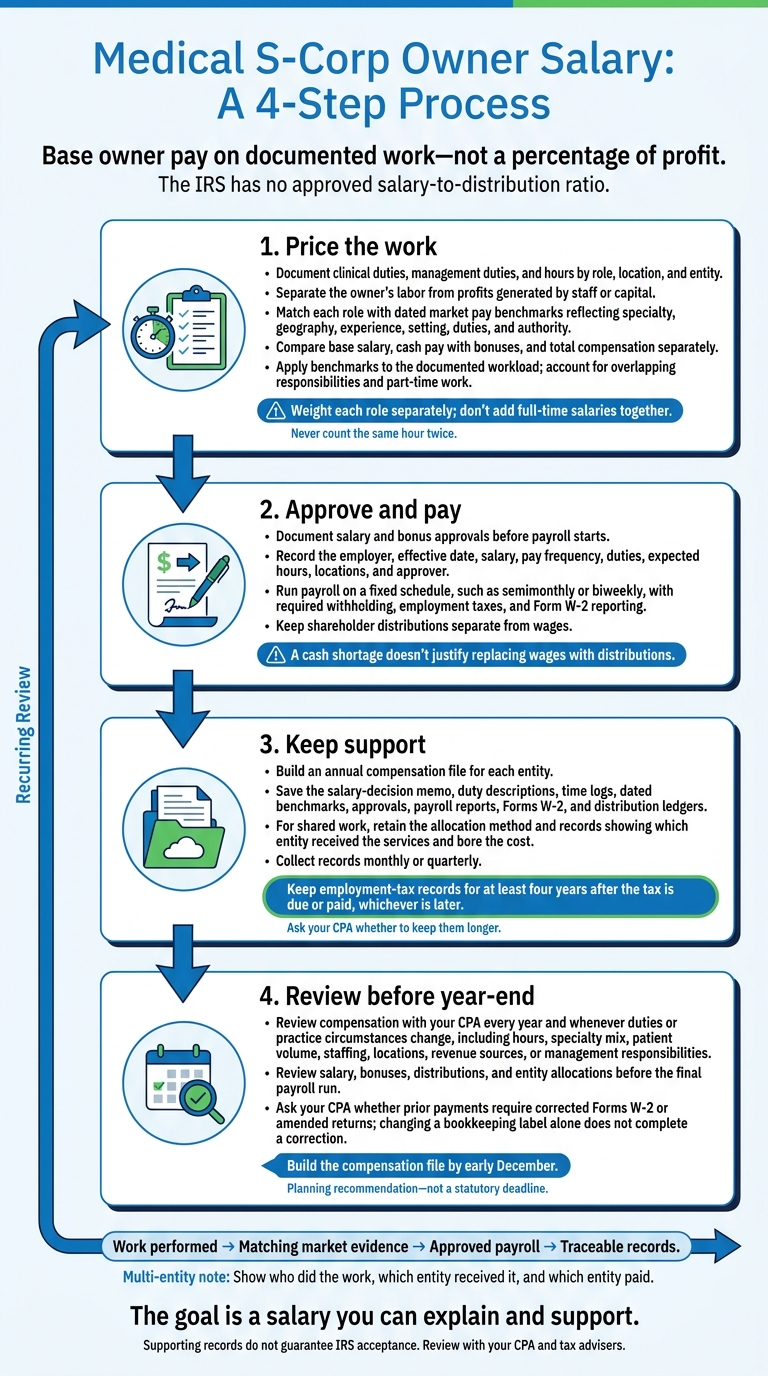
Medical S-Corp Owner Salary: A 4-Step Process
Step 1: Document the Owner’s Work and Compare Market Pay
Separate Clinical Duties, Management, and Ownership
Start with a role summary that covers the owner’s specialty, procedures, patient volume, charting, and call coverage. Include hiring, supervision, scheduling, compliance, payer relations, budgeting, and location oversight. Keep the owner’s labor separate from profits generated by staff or capital.
Then document how that work is divided across time, locations, and entities.
Track Hours by Role, Location, and Entity
Keep a weekly or monthly log showing the date, hours, role, location, entity, and task. Check it against schedules, calendars, and management records, including work done after hours. Use a documented method to divide shared tasks, and never count the same hour twice.
Fewer patient-care hours don’t necessarily mean fewer management hours, especially when the owner supervises clinicians across multiple locations. Use the log to match each role with a pay benchmark that reflects the work performed.
Choose Market Pay Benchmarks That Match the Work
Compare each role with reliable surveys, recruiting data, employment offers, or third-party compensation studies from the same period. MGMA data can help benchmark specialty pay and compensation components. Government wage data can help benchmark management roles. Match geography, experience, setting, duties, and authority, and compare base salary, cash pay with bonuses, and total compensation separately.
Use this table as a template for your records - not as pay guidance.
Owner duties Estimated hours Comparable market role Benchmark source and date Compensation adjustment Patient care and procedures 24/week Specialty physician Current specialty and regional survey data; record publication date Adjust for specialty, call, procedures, and part-time schedule Clinical oversight and quality review 4/week Medical director Current medical-director compensation survey or offer; record date Adjust for number of clinicians, risk, and scope of authority Staffing, scheduling, and compliance 5/week Practice administrator or operations manager Current healthcare management benchmark; record date Adjust for staff count and regulatory complexity Multi-location budgeting and vendor oversight 3/week Regional practice executive Executive compensation data or comparable employment offer; record date Adjust for number of locations, revenue, travel, and decision rights Example allocation only; not market pay data or a salary recommendation. This template weighs roles; it is not a salary formula. Replace these hours with documented time and record the publication or offer date for every benchmark.
Weight each role separately; don’t add full-time salaries together. Apply each benchmark to the documented workload. Account for overlapping responsibilities, part-time availability, business size, and the owner’s authority. Record the pay range and explain the selected amount, including responsibility, benefits, bonuses, and comparable employee pay. Collections and profits add context, but neither alone measures the owner’s full role. Use a cashflow reporting platform to track these metrics alongside your compensation records.
sbb-itb-17e8ec9
Step 2: Approve Owner Pay and Run Payroll
Record Salary and Bonus Approvals
Use the documented duties, hours, and market benchmarks from Step 1 to approve owner pay. Document compensation before payroll starts. Include the owner, employer, effective date, annual base salary, pay frequency, duties, expected hours, locations, and approver. Reference the compensation analysis, and keep board minutes, written consent, or any other required corporate approval. Document each bonus separately, with its amount or formula, covered period, business basis, approval date, and payment date. Total pay must remain supportable as reasonable compensation.
Set a fixed payroll schedule, such as semimonthly or biweekly. Before making distributions, budget for wages, payroll taxes, rent, debt service, and other obligations. A cash shortage doesn't justify replacing wages with distributions. If cash is tight, ask the CPA and payroll provider how to pay wages on schedule. Record any temporary adjustment and the return to regular payroll.
Keep Wages Separate From Distributions
Pay for clinical and management services through payroll, including required withholding, employment taxes, and Form W-2 reporting. Record shareholder distributions separately in equity accounts and compare them with wages paid.
For staffed, multi-location practices with multiple legal entities, have tax advisers confirm the employing entity, payroll filings, and intercompany allocations. Keep an allocation schedule that matches services and locations to the entity bearing the cost. Common ownership or consolidated financial reporting alone does not authorize consolidated payroll. These records also support the annual review and year-end filing.
Review Pay Each Year and When the Practice Changes
Review compensation every year and whenever hours, specialty mix, patient volume, staffing, locations, revenue sources, or management duties change. Do this before year-end when possible, so adjustments can run through payroll and appear accurately on Form W-2.
If earlier draws or distributions may have been wages, give the CPA the payment history and payroll records. Ask whether corrected Forms W-2 or amended returns are needed. Relabeling a bookkeeping entry doesn't complete the correction. Keep the approval memo, payroll reports, and bonus support together in the compensation file.
Step 3: Keep Records That Support Owner Pay
Save Duty, Time, and Market Pay Records
Once pay is approved, keep records showing why the amount was reasonable. Build an annual compensation file for each entity with the duties, hours, and market benchmarks used to set pay. Start with a short memo explaining the salary decision, the evidence behind it, and any changes from the prior year. Link the memo to source records - not just a spreadsheet. These records explain your reasoning, but they do not guarantee IRS acceptance.
| Supporting record | Common gap |
|---|---|
| Role descriptions, organizational charts, and management meeting records | Titles without evidence of actual responsibilities |
| Time logs, calendars, and patient-schedule summaries without unnecessary patient identifiers | Hours claimed without time logs or schedules |
| Dated benchmarks showing source, geography, specialty, percentile, and adjustments | Unsupported salary estimates |
| Payroll reports, Forms W-2, and distribution ledgers | A salary conclusion disconnected from actual payments |
Collect records monthly or quarterly instead of piecing together the year later. Explain how each benchmark fits the owner’s clinical and management work. Keep employment-tax records for at least four years after the tax is due or paid, whichever is later. Ask your CPA whether to keep them longer. For multi-location practices, organize these records by entity and location so payroll, duties, and benchmarks are easy to trace.
Connect Location Records to Entity Reporting
For staffed practices, the file must show who did the work and which entity paid for it. Keep a location schedule covering staffing, revenue, operating complexity, and owner involvement - including travel, hiring, and supervision - to support owner pay and entity allocations. Connect each location to the correct entity’s books and multi-dimensional reporting by location.
Reconcile wages, bonuses, reimbursements, and distributions with payroll, bank activity, and ledger accounts. For shared management work, keep the allocation method, supporting time records, and any management-services agreement. Record intercompany charges consistently and check for double-counted hours or compensation. Reviewers should be able to trace which entity received the work and bore the cost.
Get Help Organizing Financial Records
Lucid Financials provides CPA-led bookkeeping, tax, and CFO support for staffed medical practices and multi-entity owners. The service helps keep books clean and compensation files organized. It does not replace duty records, market benchmarks, or the compensation analysis performed with the owner’s CPA and tax advisers.
What Should Your S-Corp Salary Be as a 1099 Physician?
Conclusion: Review Owner Pay With Your CPA
Base owner pay on documented work - not a percentage of profit. Use matching market data, and keep payroll treatment separate from distributions.
Review the documentation each year and whenever the practice changes.
A shift from patient care to supervision across locations can change the benchmark and entity allocation.
Build the compensation file by early December to leave time for adjustments before the final payroll run. Before year-end, review salary, bonuses, distributions, and entity allocations with your CPA, and make any needed payroll corrections. Document the decisions and set a date for the next review.
FAQs
How should I value management work without close salary comparisons?
Document what you do, how much time it takes, and what it would cost to hire someone to do it. Don’t rely on generic salary comparisons. Keep clinical work, administrative duties, and profit distributions separate.
For administrative work, list the tasks you control, such as staffing, purchasing, or overseeing multiple locations. Then estimate what you’d pay a qualified professional to handle those duties. Use those documented job requirements and the size of your practice to determine the value of your management work.
How should I split my salary across practice entities?
Base your salary allocation on the time, effort, and responsibilities you devote to each entity - not a fixed split applied across the board. Separate clinical duties from management work, record compensation in employment agreements, and treat it as a business expense rather than an ownership distribution.
Clearly identify which entity employs you for each payroll payment. Reconcile each entity’s accounts so intercompany charges aren’t counted twice. Review these arrangements with your CPA to check compliance and keep reporting consistent.
Can I lower my salary if my practice loses money?
Before lowering your salary, check what’s driving the losses: collections timing, gaps in staffing coverage, overtime or backlog, or shared-cost allocation. Don’t assume payroll can be safely reduced. Any salary cut must also follow the documented separation between pay for clinical or management work and ownership distributions.
If your duties continue, the business may still need to pay someone to cover that work, even while losing money. Keep profit separate from available cash when deciding what to do next.