
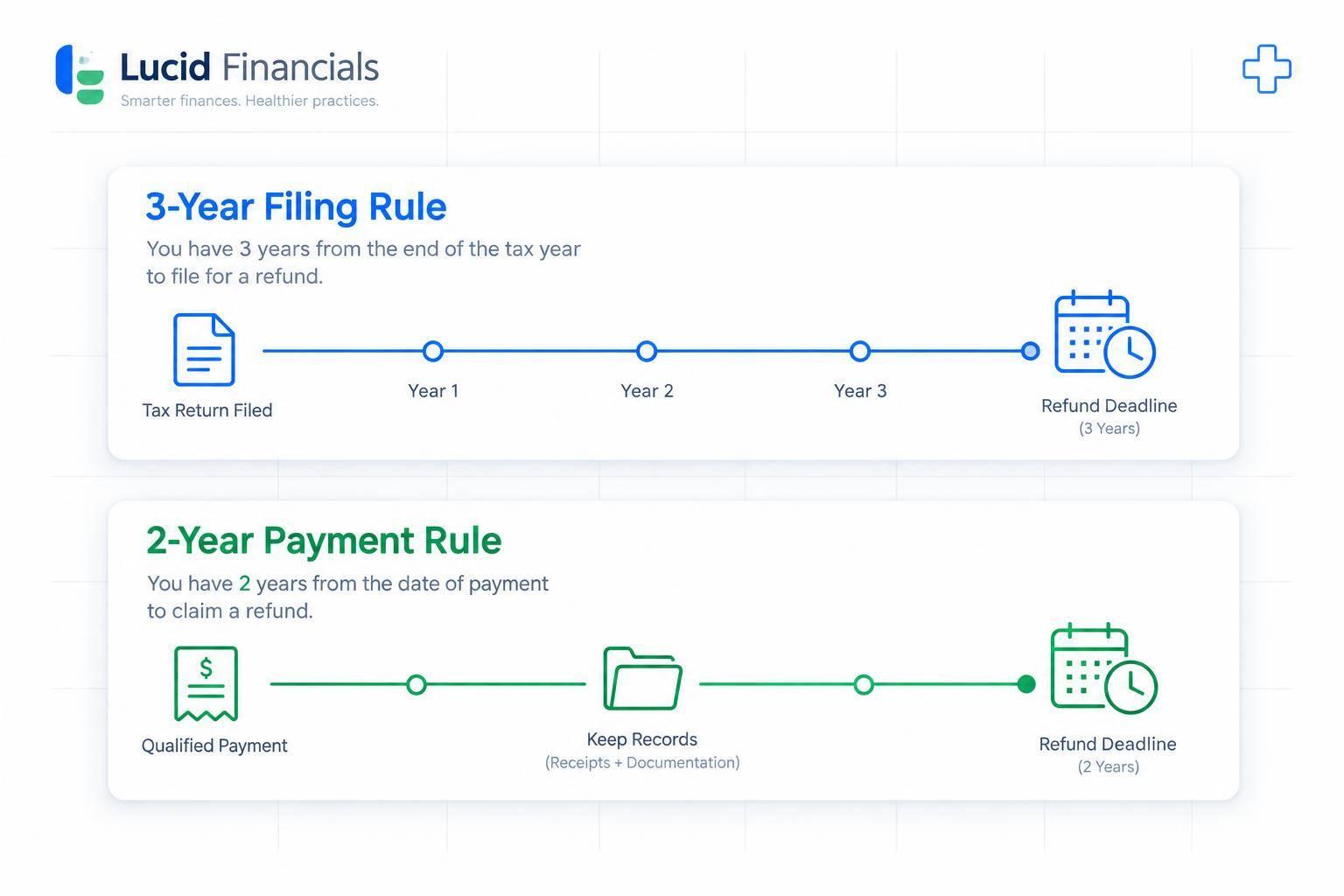
Medical practice owners generally have until the later of 3 years after filing a return or 2 years after paying the tax to claim a federal refund. Before filing, a CPA should check both deadlines - and the separate lookback rule that limits which payments can be refunded.
A timely claim does not make every past payment refundable. A later tax payment may create a later claim deadline without bringing older payments back into reach.
Quick Comparison
| Rule | Claim deadline | General refund lookback |
|---|---|---|
| 3-year filing rule | 3 years after filing the return | Payments within 3 years before the claim, plus any filing-extension period |
| 2-year payment rule | 2 years after paying the tax | Payments within 2 years before the claim |
Early-filing rules, deemed payment dates, and special relief can change the calculation. The review should also cover:
- Extensions and postponements: Check their effect on filing deadlines, payment dates, and refund limits.
- Special claims: Losses, credits, and certain other claims may follow different rules.
- Separate returns: Owner, entity, and payroll corrections require their own procedures. State deadlines need a separate check.
The next step: prepare a written schedule showing each claim’s deadline, payment dates, refund limit, and required form.
3-Year Filing Rule vs. 2-Year Payment Rule
Section 6511 sets two tests. First, the claim must meet the later of the 3-year filing deadline or the 2-year payment deadline. Then, the lookback period limits how much tax can be refunded.
| Rule | Starting date | Time period | Records to verify | General refund lookback |
|---|---|---|---|---|
| 3-year filing rule | Filing date | 3 years | Return filing date, extension status, IRS acceptance date, and claim date | Generally, tax paid within 3 years before the claim, plus any extension period |
| 2-year payment rule | Date the tax was paid | 2 years | IRS transcript and proof of each payment date | Generally, tax paid within 2 years before the claim |
Meeting the deadline is only the first test. You also need to check which payments fall within the refund lookback period.
3 Years From the Return’s Filing Date
An early-filed return counts as filed on its regular due date. If you have a valid extension and file within that extension, the actual filing date controls. Before filing Form 1040-X, verify the due date, extension, IRS acceptance date, and claim date.
2 Years From the Tax Payment Date
For private practice owners, the key is each payment’s statutory payment date, not simply the date it posts to the bank account. Track withholding, estimated payments, extension payments, return payments, and later balance-due payments separately. Each can have a different statutory payment date.
A later balance-due payment can give you a later payment-based deadline. But it does not make all older payments refundable again. Once the 3-year filing period has passed, recovery is generally limited to tax paid within the 2 years before the claim. A filing extension does not lengthen that payment-based period.
sbb-itb-17e8ec9
Find the Later Deadline and Apply the Refund Lookback
Tax Refund Deadlines: 3-Year vs. 2-Year Rules
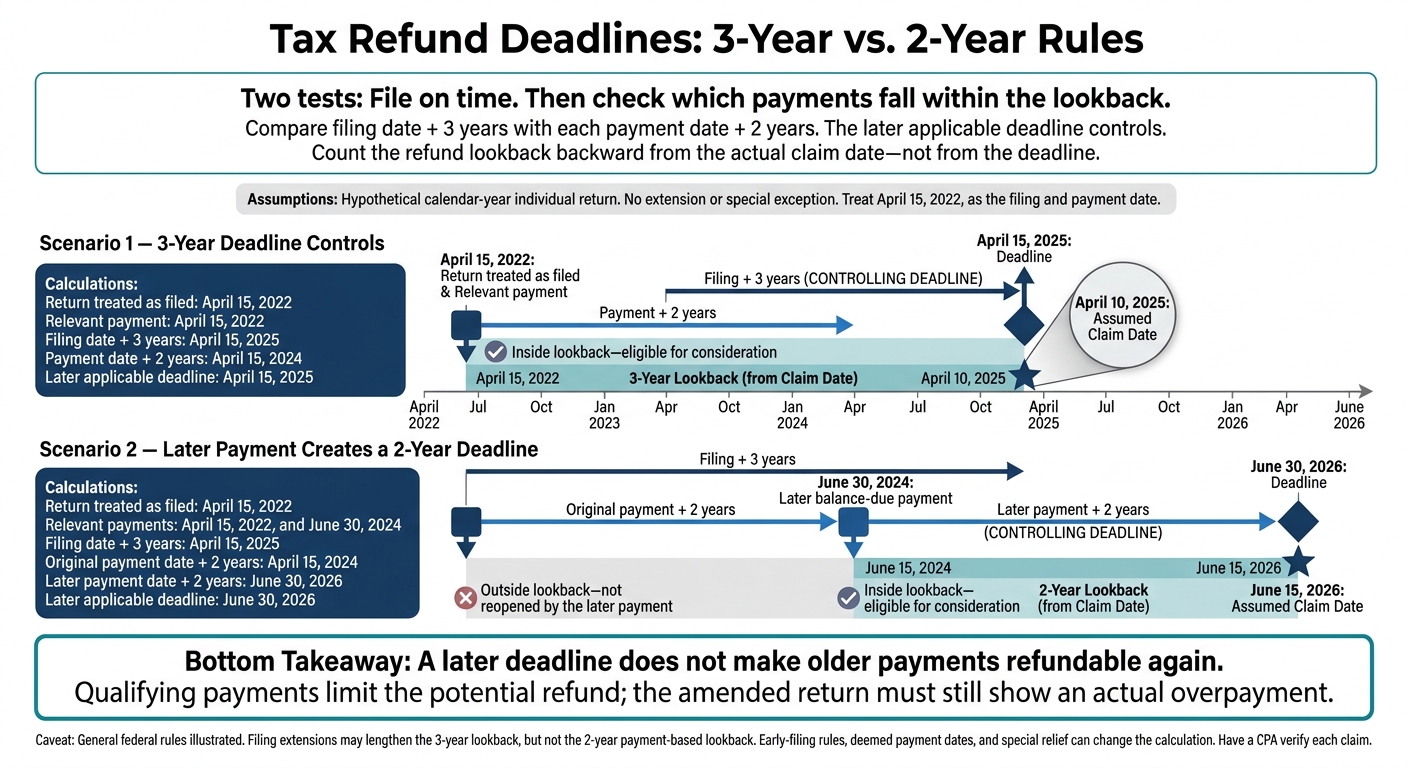
Once you know which rule applies, use the actual claim date and payment history to calculate both deadlines: the filing date plus 3 years and each payment date plus 2 years. The later applicable date controls. Then work backward from the claim date to see which payments fall within the refund lookback.
Compare 2 Hypothetical Refund Timelines
These examples assume a calendar-year individual return, no extension, and no special exception. Treat April 15, 2022, as the filing and payment date. The same method applies to a missed deduction or credit on a practice owner’s return.
Calculation 3-year deadline controls Later payment creates a 2-year deadline Return treated as filed April 15, 2022 April 15, 2022 Relevant payment dates April 15, 2022 April 15, 2022, plus a balance-due payment on June 30, 2024 Filing date + 3 years April 15, 2025 April 15, 2025 Each payment date + 2 years April 15, 2024 April 15, 2024; June 30, 2026 Later applicable deadline April 15, 2025 June 30, 2026 Assumed claim date April 10, 2025 June 15, 2026 Applicable lookback window Generally payments made on or after April 10, 2022, plus any applicable filing-extension period Generally payments made on or after June 15, 2024
The deadline determines whether you filed the claim on time. The lookback determines which payments you can recover.
Determine Which Payments Can Be Refunded
For a claim filed within the 3-year period, the lookback is generally 3 years plus any filing-extension period. After that, it generally covers only the 2 years before the claim. Count backward from the claim date, not the tax year or original due date.
In the first timeline, the April 15, 2022, payment falls inside the lookback. In the second, the June 30, 2024, payment qualifies for consideration, but the April 15, 2022, payment falls outside the window. The later deadline does not reopen that older payment.
Ask your CPA for a payment schedule that lists each payment’s type, amount, legal tax-paid date, and lookback result. Match the schedule against IRS transcripts and payment confirmations. Qualifying payments set the refund cap; the amended return must still show an actual overpayment.
Next, check whether an exception, extension, or return type changes that result.
Check Exceptions and Rules for Each Return Type
Once you know the lookback window, check whether a special rule changes the deadline or refund amount. The 3-year and 2-year rules are just the starting point. Special claim types can change both the deadline and the refund cap.
For practice-owner losses, credits, disaster relief, and payroll corrections, ask your CPA to verify the applicable rule, filing date, payment dates, and claim basis.
Special Rules for Losses, Credits, and Tax Relief
Loss, credit, and carryback claims can have different filing periods and refund limits. Bad-debt and worthless-security claims generally have a 7-year period from the return due date for the loss year. Foreign tax credit claims may also have a longer period in some circumstances. Document the rule that applies, eligibility, the calculation, and all affected years.
Disaster, combat-zone, and financial-disability rules can extend or suspend deadlines. The exact effect depends on the IRS notice, qualifying dates, and statutory eligibility.
Filing Extensions vs. Authorized Postponements
Extra time to file doesn't necessarily mean extra time to pay - or recover older payments. Keep the extension acceptance or relief notice with your payment records.
Check whether the rule changes the filing date, the payment date, or both.
| Relief type | Filing and payment obligations | Possible refund effect |
|---|---|---|
| Ordinary filing extension | Extends filing time only; payment usually remains due on the original date. | May lengthen the 3-year lookback, but not the 2-year payment period. |
| Disaster or qualifying military-action postponement | May move covered filing and payment deadlines. | Covered refund deadlines may move; verify lookback treatment. |
| Other statutory relief | Depends on the specific provision. | May change the claim period or lookback. |
Separate Procedures for Owner, Entity, and Payroll Claims
Deadline rules still depend on the return type. After checking the deadline, choose the correct return procedure.
Use Form 1040-X for owner items, an amended business return or administrative adjustment request (AAR) for entity items, and Form 941-X for payroll items. Match each claim to its return-specific deadline, period, payment rules, and claim-specific restrictions.
Conclusion: Review Dates and Records With Your CPA
Once you’ve identified the later-of deadline and lookback window, ask your CPA for a written deadline schedule for each refund claim before filing. Include proof of filing, due dates, extension confirmations, postponement notices, and every payment date and amount. Add withholding and estimated-tax records to verify deemed-payment dates, then reconcile IRS transcripts and EFTPS confirmations with your books.
For each claim, list both deadlines, the controlling date, the lookback limit, and the amount you may recover. Have your CPA document any exception and confirm the required claim form or procedure.
If your claim covers multiple returns or locations, track each filing separately. Use one row per taxpayer, return, period, and jurisdiction - each may have a different deadline. Keep owner, entity, and payroll claims separate, and check state deadlines on their own. Assign a CPA reviewer and set an internal filing target weeks before each deadline.
Lucid Financials can help organize your books, payment records, and credit documentation for this review.
FAQs
What if I never filed the original return?
Contact your CPA right away to confirm your filing requirements and check whether your return was submitted and accepted. A return marked as prepared, an unfiled draft, or a tax withdrawal does not mean you’ve met those requirements.
Your CPA can help resolve missing filings, address potential agency notices, and update your practice records with the proper documentation.
Can I protect my refund claim while awaiting records?
Record which documents are missing and who must provide them. Keep the status marked “awaiting records,” not complete. Don’t let software estimate or fill in missing information.
Contact your CPA or adviser promptly to discuss the filing deadline and next steps. Save the documentation you have and keep a clear, factual log of outstanding records so unresolved issues stay visible.
How do I prove my refund claim was filed on time?
Keep the submitted return, third-party filing confirmation (such as a tax authority’s acceptance acknowledgment), and a filing date verified by your CPA. Draft returns, internal records, or payroll provider dashboards alone aren’t enough.
Separately, keep bank settlement records and official payment confirmations showing that payment reached the correct agency account for the intended period. Ask your CPA what final proof shows your claim was accepted as timely.