

I match each intercompany balance before eliminating it from group reports. A $25,000 repayable advance, for example, creates a receivable in one entity and a payable in the other - not revenue or expense.
For your medical group, I use this close process:
- Define the reporting group: List legal entities, confirm the reporting rules with your CPA, and keep departments separate from legal entities.
- Map both sides: Assign counterparty codes and reciprocal accounts for transfers, shared costs, fees, rent, and loans.
- Post from one record: Match amounts, dates, service periods, currencies, and references. Keep loan principal and interest separate.
- Reconcile every entity pair: Resolve differences in the source books, document settlements, and obtain review before elimination.
- Remove only internal activity: Keep entity books intact and retain external costs and cash flows in group reports.
- Control the close: Assign owners, approve mapping changes, track overdue balances, and protect supporting records.
My rule: <u>match first, eliminate second</u> - with no unsupported plugs.
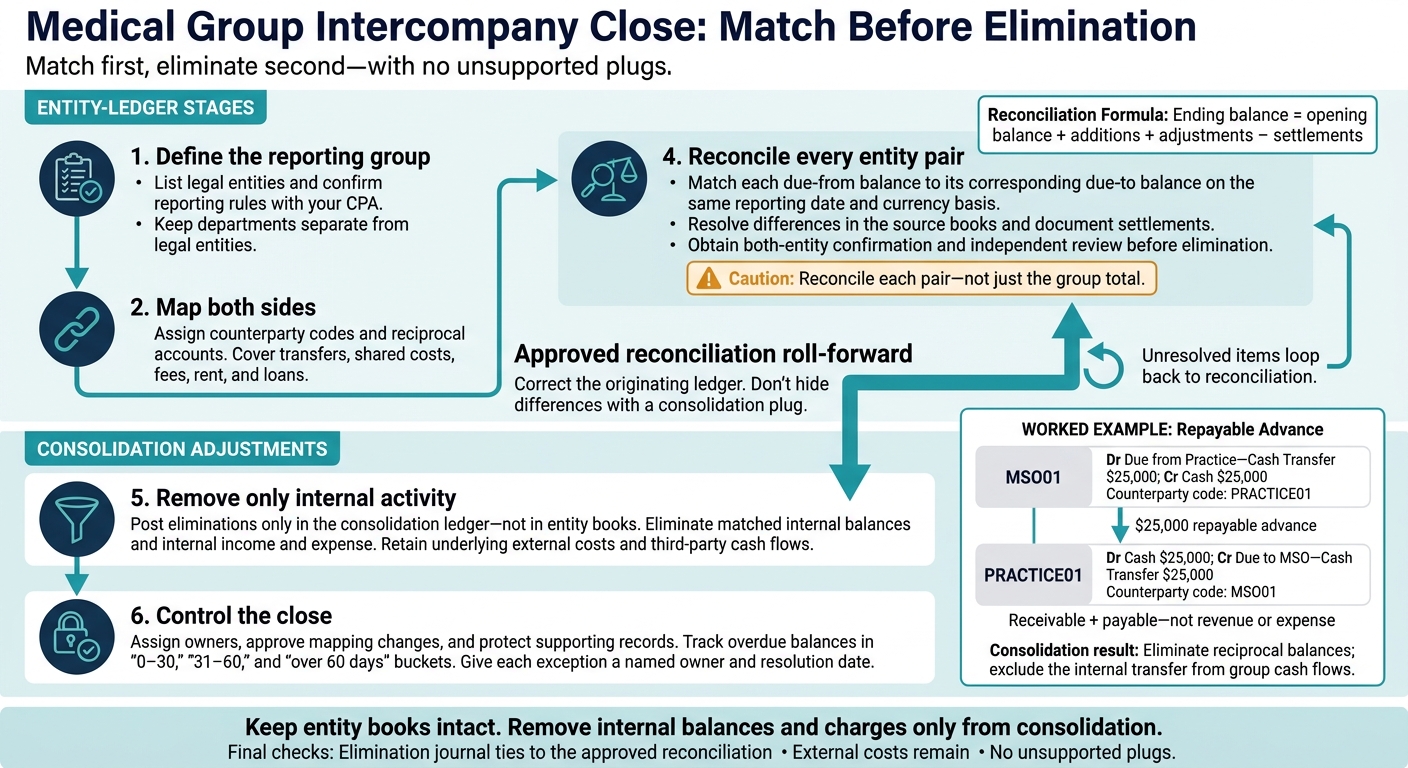
Medical Group Intercompany Close: Match Before Elimination
CPA Expert Shares Top Intercompany Accounting Tips
sbb-itb-17e8ec9
2. Record Transfers, Shared Costs, and Fees
Use one source record for both entries. Include the reference, amount, currency, posting date, service period, entity pair, invoice or agreement number, settlement terms, preparer, and approver. Match both ledgers to that record. If posting timing differs, document the difference rather than quietly moving one side into another period.
Record Cash Transfers and Shared Expenses
Post each entry using the assigned counterparty code from the matrix.
Confirm the purpose before posting cash. A repayable advance creates a receivable and payable - not revenue or expense. Permanent ownership funding requires equity or investment treatment, while an owner distribution reduces equity. Keep approved repayment terms on file for repayable funding, and use the counterparty code to identify the other entity.
Transaction Originating entity: debit / credit Receiving entity: debit / credit Counterparty codes Group elimination treatment $25,000 repayable advance MSO01: Dr Due from Practice - Cash Transfer $25,000; Cr Cash $25,000PRACTICE01: Dr Cash $25,000; Cr Due to MSO - Cash Transfer $25,000MSO tags PRACTICE01; practice tagsMSO01Eliminate reciprocal balances; no revenue or expense Shared cost allocated to a practice SHARED01: Dr Due from Practice; Cr Cash or Accounts Payable, for the allocated amountPRACTICE01: Dr applicable operating expense; Cr Due to Shared Services, for the same amountShared services tags PRACTICE01; practice tagsSHARED01Eliminate reciprocal balances; retain the underlying external expense once $30,000 management fee MSO01: Dr Due from Practice $30,000; Cr Management Fee Revenue $30,000PRACTICE01: Dr Management Fee Expense $30,000; Cr Due to MSO $30,000MSO tags PRACTICE01; practice tagsMSO01Eliminate internal fee revenue, expense, and open balances $100,000 loan principal MSO01: Dr Loan Receivable $100,000; Cr Cash $100,000PRACTICE01: Dr Cash $100,000; Cr Loan Payable $100,000MSO tags PRACTICE01; practice tagsMSO01Eliminate principal receivable and payable Monthly interest on $100,000 at 6%, using annual rate ÷ 12 MSO01: Dr Interest Receivable $500; Cr Interest Income $500PRACTICE01: Dr Interest Expense $500; Cr Accrued Interest Payable $500Same counterparty codes and loan reference Eliminate internal interest and accrued balances
Keep the vendor invoice and allocation schedule showing each entity’s share and the basis used. Recognize the external cost once. If the paying entity first recorded the entire invoice as an expense, reclassify the allocated portion to due-from before the other entities record their shares.
Record Management Fees and Loan Activity
Support management fees with the agreement, services, fee calculation, service period, and approval. Both entities should accrue fees in the service period, even if billing happens later. Have healthcare counsel and tax advisers review applicable fee-splitting, corporate-practice-of-medicine, and fraud-and-abuse requirements.
Keep the note as support for each loan. Record principal, accrued interest, and interest income or expense separately. Calculate interest using the note’s rate, dates, and day-count terms.
Record Settlements and Approved Netting
Settlement clears balances; it does not create another expense. The paying practice debits due-to and credits cash. The recipient debits cash and credits due-from.
Before netting, reconcile the gross balances and get documented approval for the counterparties, amounts, settlement date, and remaining balances. Retain each underlying charge and reimbursement. Payment netting does not automatically permit balance-sheet offset; have the CPA assess presentation separately.
Use these source records to reconcile each due-to and due-from pair in the next step.
3. Reconcile Due-To and Due-From Balances
Use the source records from the posting step to reconcile each entity pair for investor-ready reporting.
Reconcile each pair - not just the group total - before elimination. Offsetting errors can leave the group total at zero even when balances are assigned to the wrong counterparties. Match each due-from balance with its corresponding due-to balance using the same reporting date and currency basis.
Match Balances by Entity Pair
Identify each pair using the account map. Extract these fields: entity, counterparty, account number and name, opening balance, additions, adjustments, settlements, ending balance, transaction currency, functional currency, reporting currency, transaction date, posting date, service period, reference, and preparer.
Check the extract against the account map. Include related intercompany balances held outside the main due-to/due-from accounts.
Calculate ending balance = opening balance + additions + adjustments − settlements, with ledger detail and source records supporting the calculation.
Apply one sign convention to every pair: either show both balances as positive or show receivables as positive and payables as negative. With the signed convention, reciprocal balances across the matrix should net to zero. Match references, amounts, accounts, transaction types, posting dates, and service periods - not just ending totals.
Resolve Differences and Approve Balances
Trace missing or duplicate entries, incorrect counterparties, unmatched settlements, and cutoff differences back to their source. For management fees and shared expenses, check the agreement, fee calculation, or allocation schedule. For currency differences, verify transaction and functional currencies, exchange rates, and remeasurement dates before comparing reporting-currency balances.
Correct the originating ledger. Don’t hide the difference with a consolidation plug.
Complete the checklist below for each pair. Both entities must confirm the balance or acknowledge the variance, and an independent reviewer must review the reconciliation before it’s released for elimination. Assign every unresolved item an owner, due date, and status. Escalate overdue or higher-risk items to the controller or CPA.
| Check | Required record |
|---|---|
| Opening balance | Agreed prior-period ending balance |
| Additions and adjustments | Transaction references, supporting records, and approvals |
| Settlements | Bank confirmations or approved netting statements |
| Ending balance | Completed roll-forward tied to the ledger |
| Counterparty balance and variance explanation | Reciprocal balance on the same date and currency basis; explanation for every difference |
| Correcting entry | Proposed entry, responsible entity, accounts, counterparty code, amount, support, and posting reference |
| Unresolved items | Owner, due date, status, and both entities’ acknowledgment |
| Final approval and sign-off | Preparer, independent reviewer, both-entity confirmation, and approval date |
Use the approved roll-forward as the source for elimination entries.
4. Eliminate Internal Activity from Group Reports
Eliminate activity only among entities in the approved reporting scope. Internal management reports must identify the included entities, ownership basis, elimination policy, and any departures from GAAP consolidation. Once the entity pair ties out, post the elimination entry from the approved reconciliation roll-forward.
Eliminate Internal Balances and Charges
Post eliminations only in the consolidation ledger - not in the entity books. For matched balances, debit the due-to liability and credit the corresponding due-from asset. For management fees, debit internal management-fee revenue and credit the practice’s corresponding management-fee expense. Link every entry to its entity pair, reporting period, and supporting schedule.
Use the same approach for internal rent, shared services, purchases, and interest income: remove internal income and the matching expense or purchase activity. Make separate adjustments for unrealized profit in inventory or capitalized assets. Eliminate loan principal against the corresponding receivable.
Keep external third-party costs, including payroll, supplies, malpractice insurance, landlord charges, inventory, and fixed-asset costs - even when another group entity funded or recharged them.
Check Entity Results and Group Cash Flows
Use this table to separate entity-level bookkeeping from group-report adjustments.
| Transaction type | Standalone entity accounting | Reconciliation status required | Group-report treatment |
|---|---|---|---|
| Cash transfer | Sender records lower cash and a due-from asset; recipient records higher cash and a due-to liability | Bank entry and reciprocal balance matched | Eliminate internal balances and exclude the transfer from group cash flows |
| Management fee | Management company records revenue; practice records expense | Invoice, period, and amount matched | Eliminate internal revenue and expense |
| Internal rent or shared services | Provider records income; recipient records expense | Agreement or allocation and period matched | Eliminate internal charges; retain external landlord, payroll, and vendor costs |
| Loan principal and interest | Lender records receivable and interest income; borrower records payable and interest expense | Principal, rate, and accrual matched | Eliminate principal balances and internal interest |
| Inventory or equipment transfer | Seller records sale or gain; buyer records inventory or fixed asset | Cost, transfer price, and ending holdings verified | Eliminate internal activity and unrealized profit; adjust asset basis and depreciation |
| External payroll, supplies, or vendor payment | Entity records the external expense or asset and payment obligation | Third-party support only | Retain external activity and related cash flows |
Check transferred inventory still held within the group for unrealized internal profit. For transferred equipment, remove the internal gain and adjust depreciation using the group’s external cost basis and applicable useful life.
Before releasing the report, compare standalone totals with the elimination journal and final group totals. Confirm that internal activity is removed while external revenue, expenses, and third-party cash movements remain.
5. Maintain the Map and Close Controls
After reconciliation and elimination, lock the mapping and assign an owner to every account and exception.
Assign Owners and Approve Mapping Changes
Put the controller in charge of the approved account dictionary and entity-counterparty matrix. Bookkeepers post entries, a close lead handles reconciliation, authorized managers approve journals and settlements, and a CPA or CFO reviews group reporting. Set monthly deadlines and record the owner, reviewer, approval date, and open exceptions.
The dictionary should include account types, normal balances, permitted transactions, supporting-document requirements, and elimination treatment. The matrix should list legal entities, reciprocal accounts, counterparty codes, and currencies.
For every mapping change, document the old and new mapping, the reason, effective date, reporting impact, and approver. Keep prior versions and test changes before use. Update posting rules, close checklists, and elimination support tied to the approved roll-forward. Do not remap closed periods retroactively without an approved correction process. A new location, service line, or bank account does not automatically create a new counterparty.
Limit manual entries to approved users and keep preparation separate from approval. Both sides must use the same entity pair, reference, service period, and settlement date. At each close, review unmatched accounts, abnormal balances, and past-due items. Track aging in 0–30, 31–60, and over 60 days buckets, and give each exception a named owner and resolution date.
Coordinate the Close with CPA Review
At close, send the CPA reviewer the approved reconciliation package and change log. Include trial balances by entity, reconciliations, aged exceptions, fee and loan schedules, settlement evidence, elimination support, and mapping changes. Resolve unusual balances and document required corrections before reports are approved.
Store supporting records by entity pair and period in a controlled repository. Use accounting references - not patient names, medical record numbers, or clinical notes. Apply role-based access and the HIPAA minimum-necessary standard wherever protected health information is involved.
6. Conclusion: Match Balances Before Elimination
Once the reconciliation roll-forward is approved, eliminate only matched internal balances in the consolidated group.
Keep entity books intact. Remove internal balances and charges only from consolidation.
At final close, require sign-off confirming that the elimination journal ties to the approved reconciliation, external costs remain, and no unsupported plugs are included.
FAQs
How do I distinguish a cash advance from a management fee?
Check how each transaction is recorded. Cash advances usually create temporary intercompany due-to/due-from balances that reconcile cash movements between entities. They appear on the balance sheet as receivables or payables - not income or expenses.
Management fees are recorded as an expense by the paying entity and income by the receiving entity. Eliminate these internal fees in combined or group reports so they don’t appear as external revenue or expenses.
What if due-to and due-from balances still differ at close?
Reconcile intercompany transfers and management fees before finalizing group reports to avoid misstatements or double-counting. Log each variance with the transaction details, affected entities, and supporting evidence.
If an issue remains unresolved, mark the affected financial section as provisional and disclose the limitation instead of reporting an unsupported figure. Don’t force a match. Document a clear explanation for any material differences.
Should I eliminate transactions with a practice I only partly own?
Yes - but only in consolidated/group reports, using the approved consolidation treatment. Eliminate intercompany due-to/due-from balances, transfers, and internal management fees so they aren’t double-counted as external revenue or expenses.
Keep the underlying entity records and your prorated ownership responsibilities visible. Map and reconcile cash movements and intercompany balances before eliminating them. Don’t ignore these items or net them without supporting documentation.