
AI spots suspicious payments - not proven fraud. I’d start with 2 controls: require a second approval for high-risk transfers and confirm changed bank details through a known vendor contact before paying.
AI compares payment history, account activity, invoices, and links between accounts to flag payments for review. But a risk score is a signal, not a verdict. People still need to check the facts, follow sanctions rules, and decide what happens next.
Here’s what I’d focus on:
- Data and detection: Clean records, fraud rules, and AI checks that work together.
- Payment decisions: Clear steps to approve, verify, hold, or reject a transfer.
- Oversight: Named reviewers, privacy safeguards, and records that explain each decision.
- Response and follow-up: Contact the provider at once, preserve records, and reconcile the books.
<u>Good records help explain a payment. They don’t replace checks before money leaves.</u>
How AI Uses Payment Data to Flag Fraud
Those risk scores work only when the model can see more than a startup’s books.
Banks and payment providers combine transaction amounts, currencies, timestamps, payment messages, sender and recipient details, account history, login and device data, IP addresses, rejected payments, chargebacks, sanctions-screening results, and account relationships.
Startup books usually contain invoices, bills, bank feeds, vendor records, approvals, and ledger entries. They generally lack device identifiers, bank-wide network patterns, and complete sanctions-screening data. Accounting records add context, but they don’t give startups the same monitoring view.
Prepare Data Across Entities and Currencies
Build a standardized payment dataset with stable identifiers for each entity, customer, vendor, owner, account, and payment instruction. Keep legal names, aliases, registration numbers, ownership percentages, addresses, country codes, account numbers or tokenized equivalents, plus each record’s source and date.
Normalize names, addresses, country codes, timestamps, and payment-purpose categories. Keep the original values so auditors can trace changes. Check for missing beneficiary ownership, unexplained account changes, incomplete payment purposes, duplicate invoices, and unverified bank details.
Convert amounts to U.S. dollars using a documented exchange-rate source and conversion timestamp, while keeping the original amount and currency. Standardize timestamps to UTC, but retain the original event time and time zone.
Combine AI Models With Fraud Rules
Use several detection methods together. Fixed rules set boundaries; AI looks for patterns within and across payments.
Rule-based controls can block or flag impossible travel, duplicate payment instructions, newly added beneficiaries, unusually large payments, prohibited corridors, and transfers above approval limits. Anomaly detection compares payments with the startup’s normal activity, peer companies, corridors, vendors, currencies, amounts, timing, and frequency.
Supervised learning draws on confirmed fraud, legitimate payments, chargebacks, rejected transactions, and investigator outcomes to estimate the likelihood of a known fraud type. Behavioral analysis looks for changes in login patterns, device use, payment timing, beneficiary creation, and approval behavior.
Graph analytics finds shared identifiers, circular flows, pass-through accounts, and connections to entities previously flagged as risky. Natural-language processing compares invoice descriptions, purchase orders, emails, and payment messages. It checks for inconsistent goods, altered bank instructions, duplicate wording, urgency, and mismatched parties. AI combines these signals with fixed rules to produce risk scores.
FFIEC guidance recognizes rule-based and intelligent monitoring systems and expects testing, gap checks, and independent validation.
Payment Warning Signs and Responses
The table separates behavioral warning signs from sanctions-screening concerns. Each response depends on the combined evidence, contractual permissions, and applicable requirements. Treat sanctions matches separately - not as routine anomalies.
These signals help AI flag payments for escalation rather than routine review.
| Signal category | What AI examines | Potential risk | Typical response |
|---|---|---|---|
| Identity and ownership discrepancies | Legal names, aliases, beneficial owners, registration data, and inconsistent addresses | Synthetic identity, concealment, account takeover, or undisclosed control | Pause or require added verification; compare authoritative records and request supporting documents |
| Payment history | Frequency, amount, timing, reversals, chargebacks, and prior investigation outcomes | Account takeover, mule activity, or abnormal behavior | Apply limits, require stronger approval, or escalate |
| Unusual amounts or corridors | Deviation from the entity’s baseline, peer activity, currency, destination, and business purpose | Invoice fraud, commercial fraud, or laundering | Hold for confirmation and validate the payment purpose and beneficiary |
| Fast transfers through new or dormant accounts | Account age, reactivation, velocity, deposits, withdrawals, and time to onward transfer | Mule networks, fraud proceeds, or rapid movement of funds | Delay settlement where permitted, contact the customer through a trusted channel, and review linked activity |
| Jurisdiction and sanctions exposure | Origin, destination, transit countries, counterparties, ownership, and applicable sanctions lists | Sanctions violation or elevated AML risk | Screen and resolve potential matches; block or reject only under applicable requirements and documented procedures |
| Device changes | New device, IP address, geolocation, session behavior, and authentication events | Credential theft, deepfake-enabled access, or account takeover | Require step-up authentication, revoke sessions, and verify independently |
| Shared identifiers | Devices, IP addresses, email domains, phone numbers, bank accounts, addresses, and owners | Coordinated fraud or a payment network | Link related accounts and conduct network-level review |
| Invoice inconsistencies | Supplier name, invoice language, purchase order, tax details, bank instructions, duplicate text, and document metadata | Business-email compromise, fake invoice, or altered beneficiary | Match invoice, contract, goods, and approval records before release |
| Fraud-network links | Graph connections to confirmed fraud, mule accounts, suspicious merchants, or rapid pass-through flows | Organized fraud or laundering | Escalate the network, restrict connected payments as permitted, and preserve evidence |
sbb-itb-17e8ec9
How Risk Scores Guide Payment Decisions
How AI Guides Cross-Border Payment Decisions
Once AI scores a payment, that score needs to lead to a specific action.
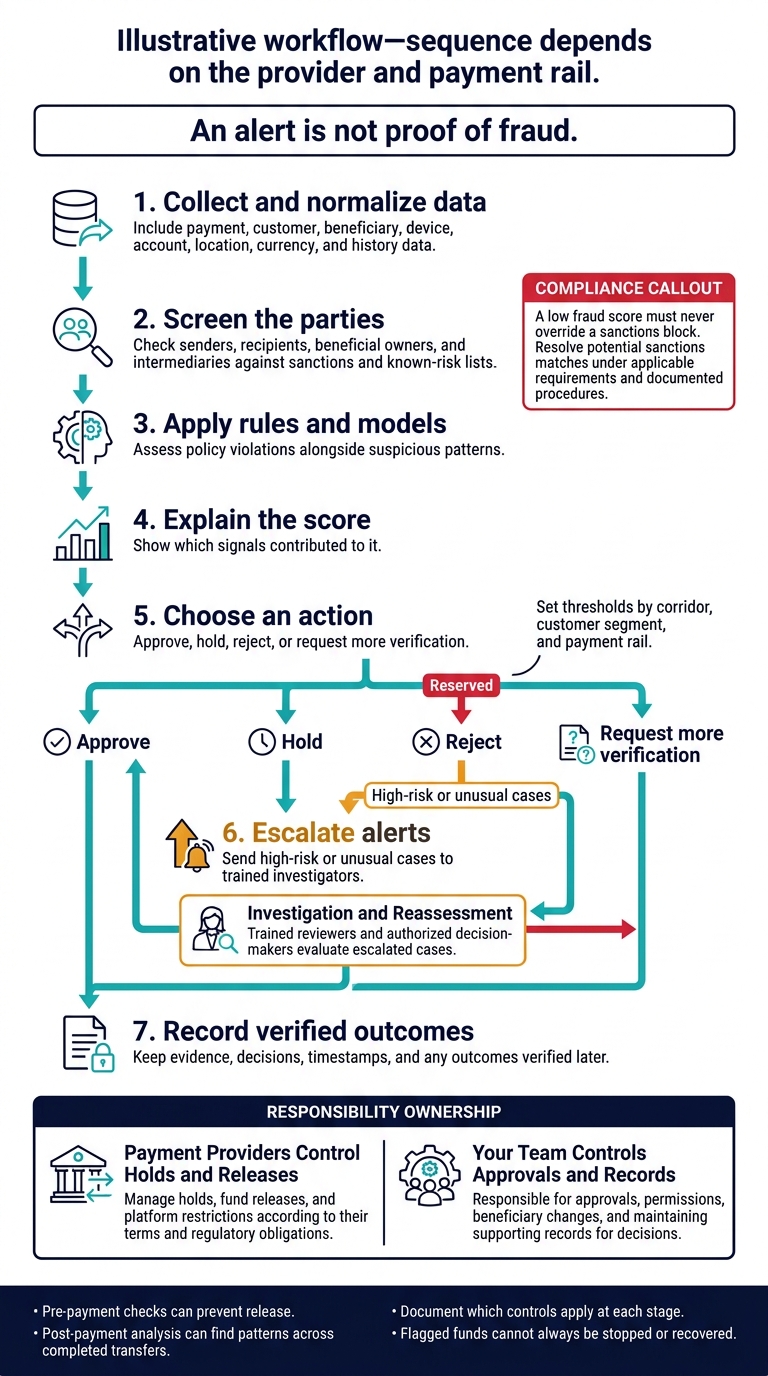
For cross-border payments, risk scores should trigger release, additional verification, a hold, or rejection. Set thresholds by corridor, customer segment, and payment rail. A low fraud score must never override a sanctions block. Payment providers control holds and releases; your team controls approvals, permissions, beneficiary changes, and supporting records.
Steps in Monitoring and Investigation
The workflow turns payment data into a decision:
- Collect and normalize data: Include payment, customer, beneficiary, device, account, location, currency, and history data.
- Screen the parties: Check senders, recipients, beneficial owners, and intermediaries against sanctions and known-risk lists.
- Apply rules and models: Assess policy violations alongside suspicious patterns.
- Explain the score: Show which signals contributed to it.
- Choose an action: Approve, hold, reject, or request more verification.
- Escalate alerts: Send high-risk or unusual cases to trained investigators.
- Record verified outcomes: Keep evidence, decisions, timestamps, and any outcomes verified later.
The sequence depends on the provider and payment rail. Pre-payment checks can prevent release. Post-payment analysis can find patterns across completed transfers. Document which controls apply at each stage. An alert is not proof of fraud, and flagged funds cannot always be stopped or recovered.
Human Review and U.S. Compliance Duties
For your startup, human review is the handoff from AI scoring to the person with authority to release, hold, or reject a payment.
BSA requirements, including applicable AML program and SAR filing duties, apply to covered financial institutions and money services businesses - not automatically to ordinary startups. OFAC sanctions obligations can apply more broadly to U.S. persons, including businesses. Identify the responsible legal entity before assigning compliance tasks.
| Control | Risk addressed | AI contribution | Human or compliance responsibility |
|---|---|---|---|
| Due diligence | Impersonation or hidden ownership | Flags inconsistent identities and relationships | Verify required identity, ownership, and supporting evidence |
| Sanctions screening | Prohibited transactions | Prioritizes potential matches | Determine true matches and applicable blocking, rejection, or authorization requirements |
| Alert thresholds | Missed fraud or overloaded queues | Groups payments by risk | Approve thresholds by product and corridor; test customer impact |
| Explanations | Unsupported decisions | Identifies contributing signals | Challenge weak explanations and document the decision |
| Audit trails | Decisions that cannot be reconstructed | Logs inputs, scores, versions, and actions | Protect records and ensure decisions can be reproduced |
| Data quality | Misleading scores | Flags missing or inconsistent fields | Assign data owners and correct source records |
| Model validation and drift | Declining detection quality | Tracks performance and changing patterns | Independently validate models and approve changes |
| False positives and negatives | Delays or undetected fraud | Ranks alerts and measures outcomes | Sample cleared payments and investigate missed cases |
| Privacy and access | Disclosure without permission | Supports masking and limited analysis | Enforce lawful use, least privilege, encryption, and vendor controls |
| Retention | Excess storage or missing evidence | Applies retention tags | Set periods under applicable law, contracts, and policy |
| Escalation | Unresolved suspicious activity | Routes cases by severity | Assign investigators, escalation authority, and applicable reporting duties |
Privacy Rules for Cross-Border Data Sharing
Before sharing records, establish what information moves, who receives it, where it is processed, and why it is needed. Check applicable privacy laws, contracts, security safeguards, and SAR confidentiality.
FinCEN’s SAR-confidentiality guidance distinguishes the SAR itself - and information revealing its existence - from the underlying facts, transactions, and documents. Organizations must protect SAR information while handling those underlying records appropriately.
Privacy-enhancing technologies reduce exposure of raw data during analysis. Federated learning, for example, trains models locally and shares model updates instead of bringing the underlying records into one place.
These tools do not make data sharing compliant on their own. They can introduce challenges with accuracy, governance, key management, interoperability, and performance. Lawful data-sharing arrangements, security controls, human review, and retention policies are still needed within the broader payment-control program.
Build a Payment Fraud-Control Program
Turn AI scores into payment controls, clear ownership, and response steps. These controls produce the clean payment data and evidence that AI and investigators need.
Map Payments and Set Approval Rules
Start with payment controls, not an in-house AI build. Map each entity, account, rail, corridor, currency, vendor type, expected payment frequency, and normal amount range. Keep recurring payroll, supplier invoices, customer refunds, tax payments, and ad hoc purchases separate. Match invoices and contracts to the correct entity.
Set approval limits based on risk. Require dual approval for high-value transfers, new beneficiaries, and changed bank details. Keep vendor-record editing separate from payment approval, and verify every beneficiary or bank-detail change through an out-of-band channel. Store the invoice, beneficiary record, verification notes, and approvals together.
Check Your Payment Provider’s Fraud Controls
Ask which countries, currencies, and rails support pre-payment screening, beneficiary verification, configurable approvals, and transaction holds. Can reviewers see why a payment was flagged, export case records, and reach an investigator during an incident?
Confirm recall support, record retention, and any jurisdiction-specific gaps. Judge alert quality and payment delays against your own payment mix, not vendor claims. Assign named owners to act on flagged payments.
Assign Owners and Track Results
For first-time beneficiary changes, pause the payment, verify through a known contact, preserve evidence, and escalate before release.
Give each team clear responsibility for its part of the cross-border fraud chain. Finance owns payment policy and reconciliation. Operations owns vendor and invoice records. IT/security owns identity and access controls, while leadership approves high-risk exceptions.
Track alert quality, investigation time, losses, recoveries, and payment delays. Label prevented-loss figures as estimates and explain the assumptions behind them. Reassess restrictions as new evidence emerges, but never bypass a mandatory legal block to meet a deadline.
Plan Your Response to Payment Fraud
Contact the provider immediately through a trusted channel and request a hold or recall where available. Share the transaction reference, amount, currency, beneficiary, and timestamps.
Stop related transfers, revoke active sessions and tokens, and reset credentials. Preserve original invoices, messages, approval records, call notes, and access logs. Notify internal owners, along with legal, insurance, or reporting contacts as needed.
For U.S. business-email-compromise incidents, the FBI advises contacting the financial institution immediately and filing an IC3 complaint as soon as possible. Recovery depends on timing, the rail, the recipient institution, and the jurisdictions involved.
Use Reconciled Books to Investigate Payments
After an alert or dispute, reconcile the books to confirm what moved and where. Check flagged or disputed transfers against vendor histories, contracts, and prior settlements to validate the transactions.
Look for duplicate payments, missing refunds, unexplained foreign-exchange charges, and entries assigned to the wrong entity. Use monthly reporting - or more frequent reviews for higher-risk accounts - to spot exceptions.
Lucid Financials helps keep books reconciled so investigators can trace disputed payments quickly. These services are separate from payment-fraud detection, sanctions screening, and regulatory monitoring. They do not replace pre-payment controls.
Conclusion: Combine AI With Payment Controls
AI helps detect cross-border fraud, but controls and reviewers determine payment outcomes. Measure performance and tune monitoring using verified case results - not alert volume.
Keep pre-release controls, payment maps, and out-of-band verification for beneficiary changes in place. Use reconciliations and confirmed case outcomes to adjust controls and separate actual fraud from routine exceptions. Repeat this process to keep cross-border payment monitoring accurate as corridors, vendors, and fraud patterns change.
FAQs
How can I test whether AI fraud detection works?
Put your AI fraud detection to the test with regular, formal audits and stress tests of your compliance technology. Run internal audits monthly, external audits annually, and mini-audits of high-risk areas, such as transaction monitoring, quarterly.
Review system controls and risk assessments, and check documentation for accuracy. Track false positive rates, test for algorithmic bias, and make sure the AI gives clear explanations for its decisions that auditors can review.
How can I reduce false alerts without missing fraud?
Move beyond rigid rules with AI-driven behavioral analysis. AI learns each customer’s usual behavior and checks transactions in real time to help separate legitimate activity from fraud. These systems can cut false positives by 50–80% without sacrificing detection accuracy.
Standardized data formats such as ISO 20022 and Legal Entity Identifiers (LEIs) also reduce identity mismatches during sanctions screening. That helps teams focus human oversight on genuine anomalies.
How much fraud-monitoring data does my startup need?
Focus on data depth and quality, not a fixed volume. AI uses detailed transaction data to establish a baseline for each customer’s behavior rather than relying on static thresholds. Include transaction purpose, party identification, exchange rates, and geopolitical risk factors.
Lucid Financials brings these data streams together for real-time reporting and clean, investor-ready records. It also helps maintain the complete audit trails required for regulatory compliance.