

I’d start with one AI personalization test - not a full rollout. Compare it with a control group over a renewal cycle, then check whether it keeps more subscribers and earns more profit after costs.
Here are the five uses I’ll cover:
- Recommendations: Suggest content and features based on subscriber interests and use.
- Behavior-based groups: Match onboarding and support to subscriber needs.
- Plans and offers: Recommend upgrades, lower-cost plans, pauses, or discounts when they fit.
- Churn prevention: Spot signs of cancellation risk and address the cause.
- Messages: Send relevant guidance and reminders without flooding subscribers.
McKinsey reports that personalization most often delivers a 10%–15% revenue lift, but that isn’t a promise - or a profit figure. My rule: use only the data you need, give subscribers control, and measure paid renewals and profit, not just clicks. Then <u>check the results against real-time financial insights</u> before expanding.
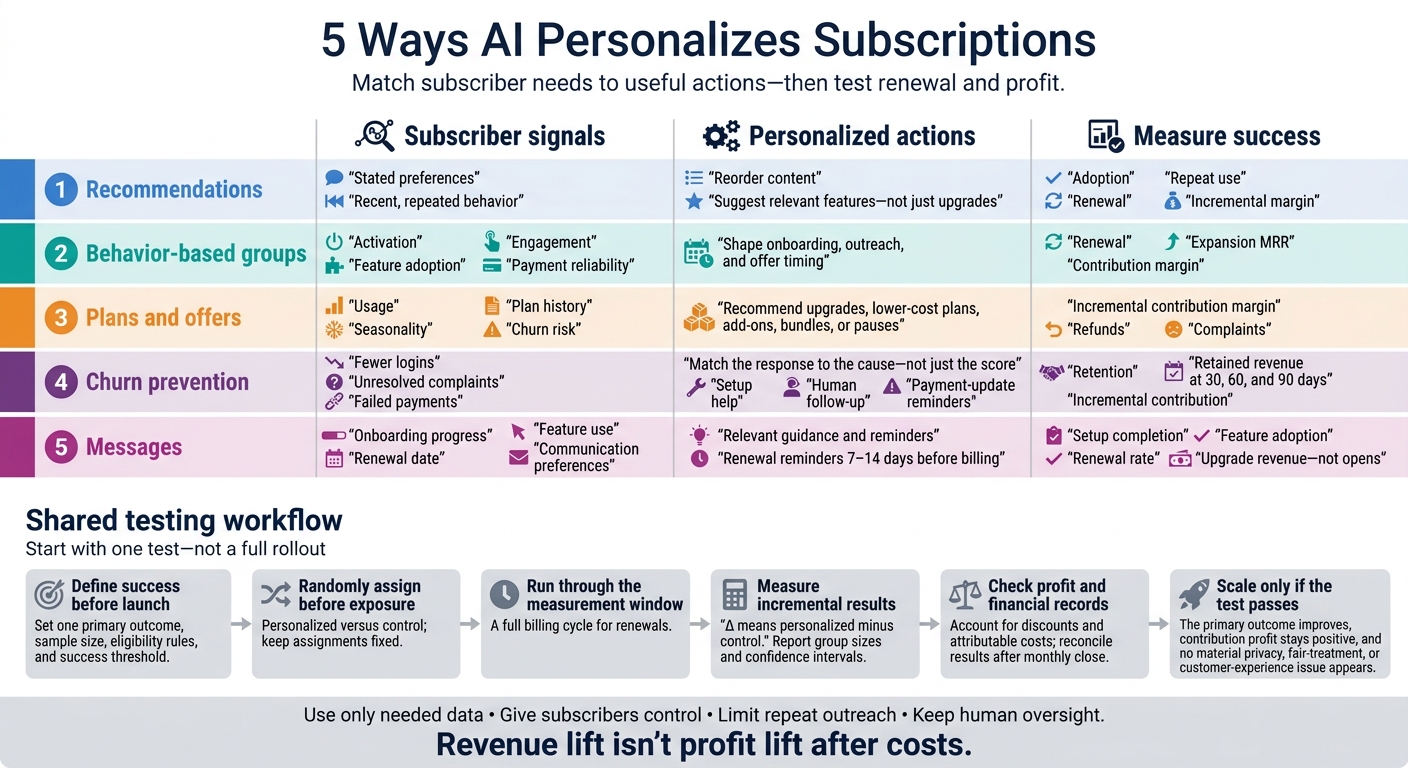
5 Ways AI Personalizes Subscriptions
AI personalization strategies that work
sbb-itb-17e8ec9
Data and Privacy for Subscription Personalization
Clean, governed data helps personalization work as intended: better recommendations and fewer false churn signals. Link first-party data to a consistent subscriber ID, and record the source and timestamp for each record. Browsing and searches can point to interests; purchases can show value; feature usage can reveal onboarding needs; and billing history can clarify renewal status. Stated preferences and support interactions add context. Keep stated facts separate from model inferences, and check account status against billing records. A failed payment during a grace period shouldn’t count as churn.
Next, set clear limits on how AI can use that data. Let AI find patterns, while people define permitted uses, exclusions, discount caps, message frequency, and escalation rules. Log the inputs and rationale behind each decision, and give reviewers the authority to override it. NIST’s guidance identifies privacy, security, transparency, explainability, fairness, and human oversight as important elements of trustworthy AI.
Collect only the fields needed for the stated purpose. Explain how you use them, set retention periods by data type, and delete or de-identify records when that purpose ends. When consent is required, record its scope, date, method, and policy version. Give subscribers accessible controls for optional personalization, marketing preferences, and recommendation resets, along with ways to submit applicable access, correction, and deletion requests.
Protect subscriber data with least-privilege access, multifactor authentication, encryption, audit logs, masked payment IDs, and restrictions on training data. Check vendor contracts for advertising, resale, or training uses, and maintain an incident-response plan. NIST includes data, systems, code, and model components within AI security.
Before launch, check that personalization rules meet legal limits. Have counsel review state privacy, children’s privacy, sector-specific, and marketing rules. Keep an up-to-date state-by-state map of opt-outs, risk reviews, and request deadlines. In California, CCPA gives qualifying residents rights to opt out of personal-data sales or sharing and limit some sensitive-data uses. Duties related to profiling and automated decisions vary by law and use case.
1. Personalized Recommendations and Experiences
Subscriber Signals
Once clean, governed data is in place, rank what each subscriber is most likely to use. AI combines stated preferences - ratings, saved items, selected interests, and survey responses - with behavior: browsing, searches, purchases, content starts and completions, feature usage, session frequency, device type, and recency.
Give recent, repeated behavior more weight than one-off clicks. For new subscribers, start with optional interest questions and curated picks. Refine recommendations as their activity grows.
Personalized Actions
Use recommendation scores to reorder content, highlight tools that help subscribers get set up or adopt the service faster, and suggest relevant features - not just upgrades. Mix new options with familiar ones, and coordinate recommendations across channels so subscribers don’t keep seeing the same suggestions.
Revenue and Retention Outcomes
Better matching matters only if it helps subscribers get value faster. That can make them more likely to stay, upgrade, and renew, but results aren’t guaranteed. Suggest advanced features when usage points to a genuine need.
McKinsey reports that personalization most often produces a 10%–15% revenue lift, though results vary by company and use case.
Measurement and Safeguards
Test the lift before scaling. Compare one recommendation surface against a control group, tracking adoption, repeat use, renewal, incremental margin, and revenue impact.
Limit repeated suggestions and let subscribers dismiss them. Test how useful recommendations are across plans, devices, and subscription age.
2. Subscriber Segments Based on Behavior and Value
Subscriber Signals
AI can do more than recommend content. It can group subscribers by behavior and value - not demographics alone. Signals can include activation, engagement, usage intensity, feature adoption, plan type, payment reliability, estimated customer lifetime value (CLV), upgrade likelihood, and churn probability.
Update segments at meaningful moments, such as setup completion, a failed payment, or renewal. These groups should change as subscribers’ needs change, rather than become permanent labels.
Personalized Actions
Use each segment to shape onboarding, outreach, and offer timing. Match message frequency to the subscriber’s needs. New subscribers may need guided setup and brief onboarding reminders, while engaged subscribers may only need occasional in-app education.
High-CLV accounts with falling usage may call for personal outreach. Stable power users generally need fewer messages, not more promotions.
The thresholds below are starting points. Define entry and exit rules before launch.
Hypothetical signals Personalized action Intended revenue outcome Setup incomplete after 14 days; few sessions Short onboarding sequence and guided assistance Lower early churn Repeated plan-limit hits; growing team usage Relevant plan comparison and usage review Higher expansion revenue Usage down 40% over 30 days; renewal within 60 days Customer-success check-in and targeted training Preserve renewal revenue Failed payments; otherwise stable usage Payment-update reminders and billing support Recover recurring revenue
Revenue and Retention Outcomes
Fix the friction before offering a discount. Failed payments call for billing help. Weak adoption calls for education. Capacity limits may justify an upgrade.
Track expansion, contraction, and churn through net revenue retention (NRR). When assessing profit, account for discounts and service costs, too. Keeping more subscribers doesn’t automatically mean earning more profit.
Measurement and Safeguards
Use a randomized holdout group to measure renewal, expansion MRR, and contribution margin by segment. Check churn scores against actual outcomes and review false positives.
Treat CLV as an estimate, not a reason to reduce service quality. Limit data collection, explain how you use the data, and require human review for decisions with serious effects on subscribers. Never use scores to set prices subscribers can’t understand.
3. Personalized Plans, Pricing, and Offers
Subscriber Signals
Once you’ve grouped subscribers by behavior and value, use those signals to suggest a plan or offer that fits. Look at usage, plan history, seasonality, and churn risk. Estimate willingness to pay from purchases and responses to offers - not sensitive traits or proxies.
Personalized Actions
Separate plan fit from price. A better fit doesn’t always mean a discount. Depending on usage, recommend upgrades, lower-cost plans, add-ons, bundles, or pauses. For usage-based charges, clearly explain the units, rates, and disclosures. Reserve time-limited incentives for high-risk accounts.
| Approach | Advantages | Risks |
|---|---|---|
| Uniform pricing with plan recommendations | Easier to explain and audit; supports equal treatment and plan fit | May miss revenue or retention opportunities |
| Uniform list price with rule-based promotions | Predictable experience; simpler margin control | Discounts may go to subscribers who would pay full price |
| Targeted pricing or discounts | Matches offers to needs; limits unnecessary discounts | May feel unfair, expose sensitive inferences, or create regulatory and discrimination risks |
Revenue and Retention Outcomes
Judge offers by incremental contribution margin, not acceptance. Include fulfillment, payment, support, and discount costs, and account for subscribers who would have paid full price anyway. Before automating offers, set margin floors, discount caps, and expiration dates.
Measurement and Safeguards
Test each offer before expanding it. Compare it with the standard experience over one renewal cycle, tracking retained revenue, margin, refunds, and complaints. Before subscribers accept, show the features, charges, fees, duration, renewal price, and cancellation terms. Keep standard plans available to comparable customers.
Collect as little personal data as possible and explain how you use it. Exclude protected traits, and check proxies such as ZIP code, language, and device type for discriminatory effects. Audit eligibility and prices across groups.
The FTC’s January 2025 market-study findings reported that intermediaries could use precise location, browser history, demographics, shopping behavior, mouse movements, and products left in carts to set individualized prices.
4. Early Churn Detection and Prevention
Subscriber Signals
Once segments are in place, AI can flag churn risk before renewal. Warning signs include fewer logins, less feature use or content consumption, unresolved complaints, visits to billing or cancellation pages, and failed payments.
Compare each subscriber’s activity with their own baseline and similar subscribers, not population averages. A risk score doesn't prove someone plans to cancel. Have people define the thresholds and review them across teams.
Example threshold: a 50% weekly-login drop for three straight weeks.
Personalized Actions
Match the response to the cause - not just the score. That cause might be onboarding friction, product fatigue, or payment failure.
Subscribers who haven't finished onboarding may need setup help. Those using fewer features may need a relevant tutorial or content. Unresolved complaints call for human follow-up, while lower usage may call for a smaller plan or a pause.
Failed payments need clear reminders and a secure payment-update link - not an automatic discount. Address these issues early: failed payments can cause involuntary churn, and one industry analysis found that 90% of recovered transactions happened within 10 days of failure. Use offers only when reminders, education, or support are unlikely to recover the account.
Revenue and Retention Outcomes
Track retention, churn, recovered subscribers, and retained revenue at 30, 60, and 90 days. Keep payment recovery separate from voluntary churn prevention.
Calculate incremental contribution by subtracting discounts, credits, messaging, support, and payment-recovery costs from incremental revenue retained. An accepted offer doesn't always mean a profitable save.
Measurement and Safeguards
Randomly assign eligible subscribers to treatment or holdout groups. Holdouts should receive business as usual. Compare retention, churn, and recovered subscribers across groups, then scale the lift by group size to estimate true recoveries.
Uplift matters more than model accuracy because it shows whether outreach changes the outcome. Monitor complaints, unsubscribes, and false positives. Limit repeat outreach, offer human support, and honor cancellation and pause requests without adding friction. Use these results to judge retained revenue, not just response rates.
5. Personalized Messages for Engagement and Growth
Subscriber Signals
Once AI identifies subscribers who need attention, send messages that act on those signals without adding noise.
Base each message on onboarding progress, feature use, renewal date, payment status, support history, engagement, and communication preferences. Let subscribers choose message types, channels, and frequency. Don’t infer sensitive traits.
Personalized Actions
Use AI to guide each subscriber through the shortest relevant onboarding path. Show feature guidance on the right product screen, send renewal reminders 7–14 days before billing, and base upgrades or cross-sells on actual usage. Each message should help the subscriber activate, renew, or expand their use.
Choose timing based on time zone, past engagement, and renewal date. Reserve SMS for time-sensitive alerts, such as failed payments, and send it only with consent. For win-back messages, address the cancellation reason rather than offering everyone the same discount.
Revenue and Retention Outcomes
Track setup completion, feature adoption, renewal rate, and upgrade revenue - not opens. Subtract offer and delivery costs to measure profit.
Measurement and Safeguards
Test whether the chosen message improves retention without increasing unsubscribes. Test content, timing, or channel separately, then track results through the next renewal. Measure whether each message increases retained revenue and margin after costs.
Keep one contact history across channels to prevent duplicate sends. Set frequency caps and quiet hours, use approved templates, and provide a simple preference center to avoid overwhelming subscribers.
Measure Engagement, Retention, and Profit
Use the same test framework for all five personalization tactics above. For each AI-personalized use case, randomly assign eligible subscribers to personalized and control groups before exposure, then keep those assignments fixed.
Before launch, define one primary outcome, the sample size, eligibility rules, and success threshold. Check that the groups are balanced by plan, tenure, acquisition channel, geography, and prior spending. Put retention and profit ahead of engagement alone.
Match the test window to what you’re measuring: 30 days for engagement or trial conversion, and a full billing cycle for renewals. Report group sizes and confidence intervals. Don’t end a test early just because the results look good.
Put the results in one scorecard, using the same cohort definition, measurement window, and denominator for both groups. Here, Δ means personalized minus control. Express rate differences in percentage points; relative lift equals Δ ÷ control rate. For churn, a negative Δ is a good result.
| Metric category | Measure for each group | Incremental difference |
|---|---|---|
| Engagement | Active days per eligible subscriber | Δ active days |
| Feature adoption | Share completing a qualifying action within 14 days | Δ percentage points |
| Retention | Share of starting cohort still active at cutoff | Δ percentage points |
| Churn | Subscribers lost ÷ starting subscribers | Δ percentage points; lower is better |
| Renewals | Renewals ÷ subscribers due to renew | Δ percentage points |
| Conversion | Paid conversions ÷ eligible trial users | Δ percentage points |
| ARPU | Recurring revenue ÷ paying subscribers | Δ dollars per user |
| Expansion revenue | Upgrade, add-on, and usage expansion revenue per eligible subscriber | Δ dollars per subscriber |
| Estimated CLV | Margin-adjusted forecast using group-specific inputs, with the same model and forecast horizon | Δ estimated dollars |
| Contribution profit | Revenue less discounts and attributable costs, per eligible subscriber, using the same cost basis | Δ dollars per subscriber |
Revenue lift isn’t profit lift after costs. Deduct discounts, refunds, payment fees, AI delivery costs, implementation work, and incremental support costs. If revenue is already net of discounts, don’t deduct them again. Report contribution-margin changes alongside contribution profit, and separate one-time setup costs from recurring costs.
Treat CLV as an estimate - not proof of lifetime results from a short test. Document the churn, expansion, margin, and forecast assumptions. Show low, expected, and high scenarios.
Before launch, set guardrails for complaint rates, opt-outs, refunds, and privacy concerns. Compare results across subscriber segments large enough to support the analysis. Check whether sensitive traits, or their proxies, are linked to worse prices, offers, or access.
Judge commercial results at the planned endpoint. Scale the tested use case only if the primary outcome improves, contribution profit stays positive, and no material issue appears involving privacy, fair treatment, or customer experience.
Check Results Against Financial Reports
Once the test ends, check the numbers against the books.
Reconcile test results after each monthly close. Match billing, payment processor, and bank records to the general ledger using consistent customer and subscription IDs. Check discounts, credits, refunds, chargebacks, and failed payments separately. A recorded renewal doesn’t mean the payment was collected.
Keep MRR, cash collected, and recognized revenue separate. What you bill isn’t always what you’ve earned. Upfront annual payments create deferred revenue, which you recognize as you deliver the service.
Build a monthly forecast-vs.-actual bridge that accounts for subscribers, renewals, upgrades, downgrades, pricing, discounts, refunds, and timing. Save the forecast version used before the test began, and assign someone to investigate material gaps.
Tag personalized offers and related spending with campaign codes so you can tie campaign costs and realized revenue back to the ledger. Use the P&L to verify revenue and expenses, and cash flow to check affordability. These reports confirm the books - not the test’s effect. The experiment estimates causation.
Use finance systems that link campaign codes, invoices, and cash receipts to the ledger, connecting personalization tests to monthly reporting.
Conclusion: Test 1 Use Case First
AI can tailor subscriptions, but each tactic starts as a hypothesis.
For your first test, try personalized recommendations for subscribers whose usage is declining. Measure success by 60-day paid renewal. Randomly assign eligible subscribers to treatment or control, exclude overlapping campaigns, and run the test through the renewal window with a sufficient sample size.
Then check the lift against financial records. Review results by segment before rollout, and expand only if the lift is large enough to matter and remains profitable after discounts, model fees, and service costs - not just because clicks increased. Personalization needs to improve both subscriber value and profit.
FAQs
How much subscriber data do I need to start?
You don’t need massive datasets. Quality and accuracy matter more than volume. For basic AI segmentation, start with one data category: website activity, purchase trends, or engagement stats.
For churn analysis, the recommended starting point is 6–12 months of historical data from at least 500 customers. Remove duplicates and standardize data across your CRM and billing systems to keep your numbers accurate and investor-ready.
How do I test personalization with few subscribers?
Start by checking your data for accuracy, completeness, and bias. Then run controlled pilots with high-value segments to limit risk while testing pricing or engagement tactics. Use A/B testing over 4–8 weeks to compare AI-powered personalization with your current methods.
Lucid Financials brings financial and operational data together to help spot gaps between predicted and actual segment performance, keeping results accurate as you grow.
When should I retrain my personalization models?
Retrain your personalization models regularly with new data to keep pace with market changes and shifts in customer behavior. Monthly retraining is generally recommended to maintain performance without reacting to every daily fluctuation. If accuracy or precision drops below 70–75%, retrain immediately.
Use a closed-loop feedback system to feed the results of your interventions back into the model. This helps prevent model drift and improves predictions over time.