
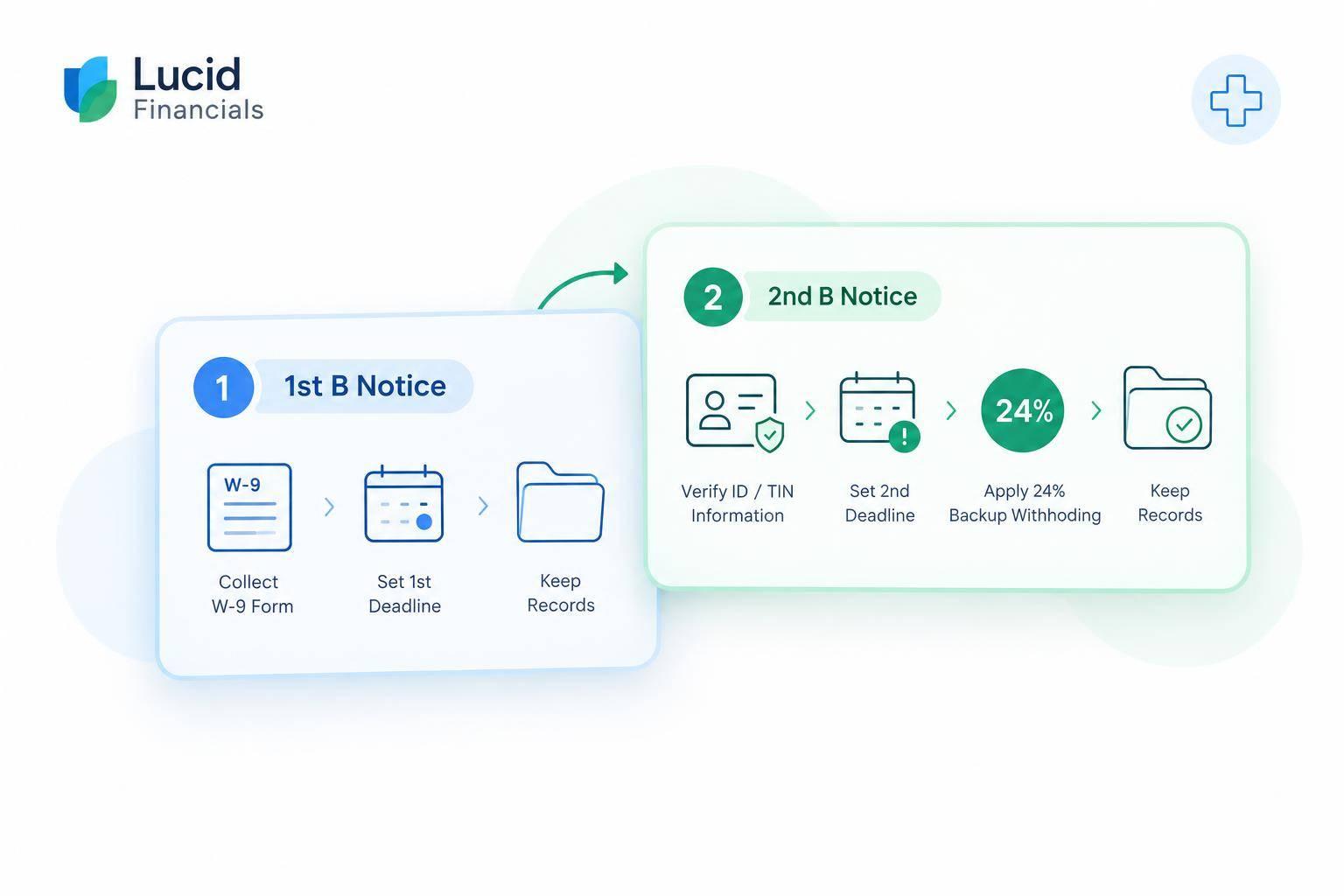
A first B notice requires a signed Form W-9. A second requires SSA or IRS validation - not another W-9. Before mailing either, a medical practice must check the IRS CP2100/CP2100A against its records and confirm that the mismatch requires a B notice.
The next step is to review the same payer entity and payee account’s history over three calendar years - not 36 months. Qualifying notices received in the same calendar year count as one.
Quick Comparison
| Requirement | First B Notice | Second B Notice |
|---|---|---|
| When it applies | First qualifying notice | Second qualifying notice within three calendar years |
| What to mail | First B Notice with Form W-9 | Second B Notice without Form W-9 |
| Required response | Completed, signed Form W-9 | SSA or IRS validation |
Both follow the same deadlines, measured from the IRS notice date or receipt date, whichever is later:
- Mail within 15 business days.
- Start 24% backup withholding on covered payments no later than 30 business days, unless the required response resolves the notice.
- Stop withholding within 30 calendar days after receiving the required documentation.
Keep the notice history, mailing proof, response documents, and withholding records. Accounts payable and the tax team should coordinate the work while keeping each payer EIN’s liability, deposits, and Form 945 records separate.
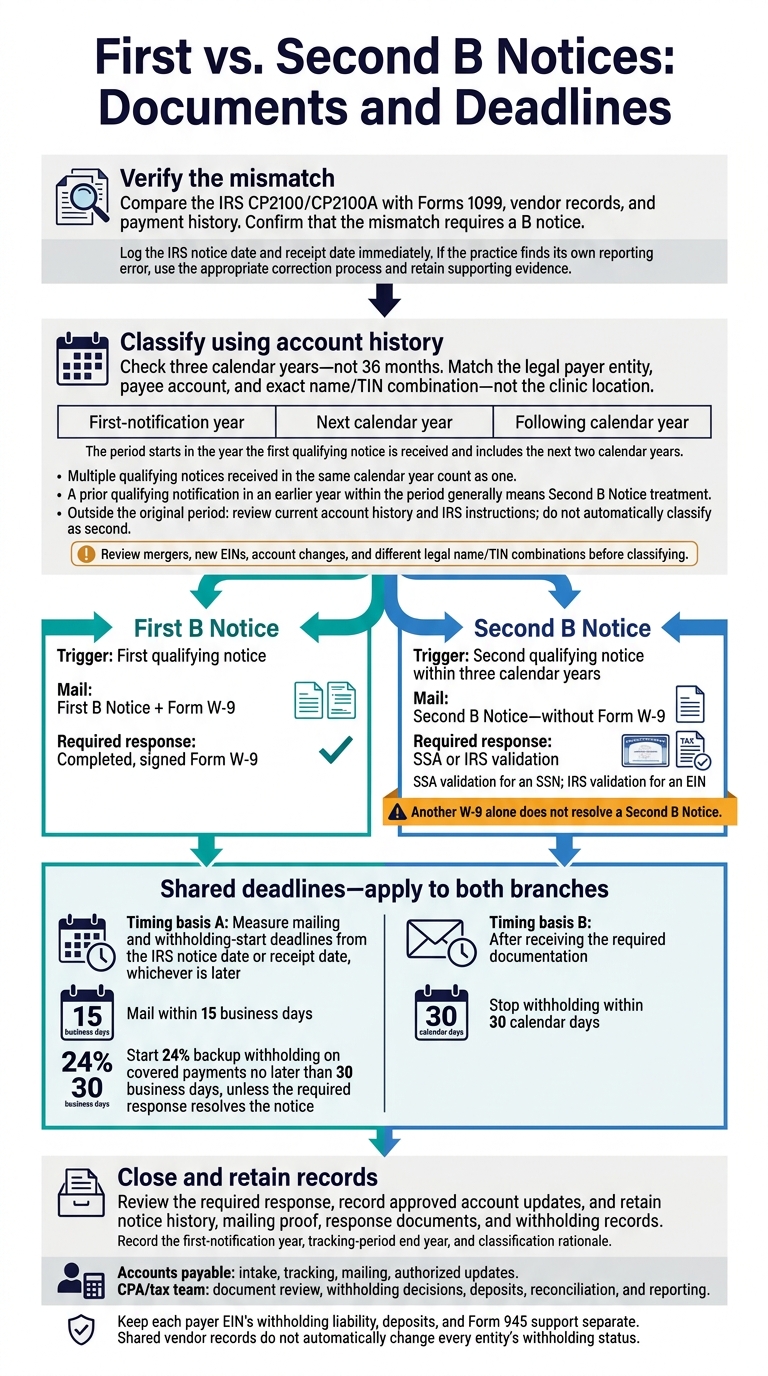
First vs. Second B Notices: Documents and Deadlines
Why Did I Receive an IRS B-Notice?
sbb-itb-17e8ec9
First vs. Second B Notices: Documents and Deadlines
After you confirm the mismatch, check the account’s notice history. A first B notice requires a signed Form W-9. A second qualifying notice requires SSA or IRS validation instead.
| Requirement | First B Notice | Second B Notice |
|---|---|---|
| Trigger | First qualifying incorrect name/TIN notice for the account | Second qualifying notice for the same account within three calendar years |
| Mailing package | First B Notice and Form W-9 | Second B Notice; do not include Form W-9 |
| Required response | Completed, signed Form W-9 | SSA or IRS validation |
| Backup withholding start | No later than 30 business days after the IRS notice date or the date the practice receives it, whichever is later | Same deadline |
| Records to retain | Notice, mailing record, signed W-9, account updates, and withholding records | Notice history, mailing record, validation, account updates, and withholding records |
Mail either notice within 15 business days after the IRS notice date or the date the practice receives it, whichever is later. For multi-location medical groups, use the matching notice package below.
First B Notice: Request a Signed Form W-9
Mail the First B Notice with Form W-9. When the completed, signed W-9 comes back, keep it in the account’s records.
Second B Notice: Require SSA or IRS Validation
Mail the Second B Notice without Form W-9. Request SSA or IRS validation instead.
Backup Withholding: Start and Stop Deadlines
The backup withholding rate is 24% of covered payments. Start withholding no later than 30 business days after the IRS notice date or receipt date, whichever is later. Stop within 30 calendar days after receiving the required documentation.
How the Three-Calendar-Year Rule Works
Once the practice confirms the mismatch, count prior notices to determine whether to send a first or second B notice.
The period covers three calendar years - not a rolling 36 months. It starts in the year the practice receives the first qualifying CP2100 or CP2100A and includes the next two calendar years. Multiple qualifying notices received in the same calendar year count as one.
Check Notice History by Payer Entity and Payee Account
Match the legal payer entity, payee account, and exact name/TIN combination - not the clinic location. Use account-level history rather than a consolidated vendor list.
| Notice history for the same account and name/TIN combination | Classification action |
|---|---|
| Another qualifying notification received in the same calendar year | Count as one; the repeat alone does not trigger Second B Notice treatment. |
| Prior qualifying notification received in an earlier year within the three-calendar-year period | Generally apply Second B Notice treatment. |
| New notification falls outside the original period | Review current account history and IRS instructions; do not automatically classify it as second. |
Before classifying the notice, review mergers, new EINs, account changes, and mismatched payee names. A different legal name/TIN combination may require First B Notice treatment. A vendor name alone does not change the classification.
Document the count so the practice can support its classification later.
Keep B Notice and Withholding Records
Record the first-notification year, the tracking-period end year, and the reason for the classification. These records should show why the account qualified for first- or second-notice treatment.
Store the history securely, restrict access to authorized accounts payable, tax, and finance staff, and keep it for as long as your payroll tax record retention rules require.
Steps for Responding to a B Notice
Once you classify the notice, follow this workflow to document the response and track the required paperwork.
- Log the dates. Date-stamp the notice and record when it arrived.
- Match the IRS listing. Compare each IRS entry with Forms 1099, vendor records, and payment history to confirm whether there’s a mismatch. If the practice finds its own reporting error, correct the information-return records through the appropriate process and keep the supporting evidence.
- Identify and classify the account. Confirm the payer’s legal name and EIN, the payee account, and the tax year. Then check the notice history to determine whether this is a first or second notice.
- Send the correct package. Mail the package for that notice type. Keep a copy, along with the address used, mailing date, and proof of mailing.
- Review the response and update records. For a first notice, check the signed W-9. For a second notice, check the SSA or IRS validation. Record approved updates and use the required document to close the account’s B-notice response.
- Apply withholding deadlines. Follow the withholding deadlines established above.
- Reconcile withheld amounts. Match withholding for each payment to the vendor ledger, federal deposits, and Form 945.
Assign Accounts Payable and CPA Tasks
Divide the work by notice type and who handles each task.
- Accounts payable - payer actions: Handle intake, deadline tracking, mailing, and authorized vendor record updates. Have a second person check the payer entity and payee mailing address.
- Payee - first-notice document: Return a properly completed, signed Form W-9 or an acceptable substitute.
- Payee - second-notice documents: Obtain SSA validation for an SSN or IRS validation for an EIN. Another W-9 alone does not resolve the notice.
- CPA or tax team - payer actions: Review questionable documents, approve withholding start and stop decisions, verify federal deposit procedures, reconcile the liability, and prepare Form 945 and applicable Form 1099 reporting.
- Payroll team - separation control: Keep vendor backup withholding separate from employee withholding and payroll deposits.
Coordinate Records Across Practice Entities
Use consistent payee names, addresses, and account identifiers across locations. But keep each payer EIN’s withholding liability, deposits, and Form 945 support separate.
A shared vendor record should help staff find documents - not automatically change every entity’s withholding status. Require entity-specific approval before applying a correction or stopping withholding.
Conclusion: Match the Documents to the Notice
First B Notice: signed Form W-9. Second B Notice: IRS or SSA validation. Review the payer entity and payee account history within the three-calendar-year window to determine whether this is the first or second notice. Then send the matching notice package.
FAQs
What if a payee ignores our B notice?
Send the notice to your CPA or qualified tax adviser immediately. They can determine whether you need an account correction, an amended filing, or a formal agency inquiry.
Direct correspondence to a named contact at the practice. Record the notice details, assigned adviser, and response deadline. Keep the matter open until you have proof of final resolution or a documented follow-up plan from your adviser.
Which documents satisfy a second B notice?
The search results provided don’t identify which documents satisfy a second B notice. Check with your licensed tax adviser to confirm current IRS guidance and the documentation your practice needs for its circumstances.
Does a new payer EIN reset our B notice history?
No. A new Employer Identification Number (EIN) does not reset your B notice history. Backup withholding requirements follow the entity and its filing history - not just its EIN.
Keep records of notices and their resolutions for each entity over the applicable three-calendar-year period. Ask your tax adviser how entity changes or a new EIN affect your withholding duties and recordkeeping.